
Guide
How to learn a new skill: a plain plan you can start today
Updated 25 October 2026 · 9 min read
To learn a new skill, pick one skill, decide what 'good enough' looks like, and break it into small parts. Practise a little and often, test yourself instead of just rereading or watching, and spread your sessions over days. Write a short learning plan, then check it each week and adjust.
Drawn from deliberate-practice and learning-technique research · Part of work and skills
Maybe you want to learn to code, speak a language, play an instrument, cook properly or use a tool at work. The wish is easy. Knowing where to start, and how to keep going when it feels slow, is harder.
Here is a plain way to learn most skills: a clear first target, a short plan, and practice that research rates above rereading. If you are also thinking about your career, the professional development plan template turns a skill into a plan for the year. A free habit tracker helps you keep it going.
How long does it take to learn a new skill?
It depends. It depends on the skill, on what you already know, on what 'good enough' means for you, and on how often you practise. A skill you want for a hobby needs less than one you want for a job. Anyone who gives you one number for every skill is guessing.
You may have heard that it takes 10,000 hours to master something. That is a popular claim, not a rule. One paper often named here is a 1993 paper by Anders Ericsson, Ralf Krampe and Clemens Tesch-Römer. It looked at how top performers reach expert level. It argued the route is many years of deliberate practice, meaning hard, focused effort aimed at getting better. It was not a study of how long it takes an ordinary learner to become good enough to enjoy a skill or use it at work.
A better question is 'good enough for what?' Being able to hold a simple conversation in a new language, build a basic spreadsheet or play three chords takes far less time than expert level. Decide on your own target first, then judge your progress against that.
How to learn a new skill: step by step
You do not need a course or special equipment to begin. You need a target, a plan and a regular slot.
- 1Pick one skill. If you want to learn several, choose the one that matters most this season and park the rest.
- 2Say why. Write one sentence on why you want it. This helps you decide what to learn first and what to skip.
- 3Describe 'good enough'. Write what you want to be able to do in three months, in a form you could show someone: 'order a meal in Spanish', 'build a simple web page', 'play one song all the way through'.
- 4Break it into parts. List the smaller things the skill is made of, and pick the one or two that come first.
- 5Choose your learning sources. Pick one or two, such as a book, a course or a person to learn from, rather than ten. Too many sources means you never practise.
- 6Book your practice. Choose a short slot you can keep on a normal week, for example 20 minutes after dinner, and write it in your diary or on a weekly planner.
- 7Practise by doing and testing. Spend most of each session using the skill, not reading about it, and test yourself on what you have learned (more below).
- 8Review once a week. Ask what went well, what felt stuck and what you will change next week.
The weekly planner is a simple place to put your practice slots. If you are learning for work, the professional development plan below pulls the whole thing onto one page.
Open the Professional Development Plan TemplateWays to practise that work
How you practise matters too. A 2013 review by John Dunlosky and colleagues looked at ten common study techniques. They rated two as high utility: practice testing, and distributed practice. The authors wrote that these two helped learners of different ages and abilities and boosted performance across many kinds of task. They rated rereading and highlighting as low utility, and suggested practice testing in place of rereading.
That review was about students' learning, so it does not prove the same result for every adult skill. But the two ideas are simple, they cost nothing and they fit most skills.
- Practice testing means pulling the answer out of your own head. Close the book and write down what you remember. Use flashcards. Explain the idea out loud. Do the exercise before you look at the solution. For a physical or creative skill, this means doing it, not watching someone else do it.
- Distributed practice means spreading your sessions out over days and weeks, instead of one long block. Four sessions of 20 minutes across a week, for example, rather than one session of 80 minutes the night before.
- Come back to older material. Each week, spend a few minutes on something you learned earlier, before it fades completely.
Short, regular sessions are also easier to keep up. If you want them to run on autopilot, the guide to building good habits shows how to tie your practice to something you already do.
Open the Habit Tracker PrintableLearning a skill as an adult
Learning as an adult has its own shape. You may have less spare time, more on your mind and a clearer sense of what you want the skill for. You can plan around all three.
- Plan for small slots. Twenty minutes you actually do is worth more than a free Saturday that never comes.
- Tie the skill to something real. A language is easier to keep up when you have a trip, a friend or a film to aim at. A work skill sticks when you use it in an actual task.
- Expect to feel clumsy. Being a beginner feels odd when you are good at other things. That feeling is part of the start, not a sign you should stop.
- Learn from someone a step or two ahead. A friendly colleague, a class or an online group can show you what 'good enough' looks like.
- Use what you know already. Skills overlap. Think about what you can already do that gives you a head start.
If you are learning because you are changing direction at work, the guide to changing career at 40 covers that bigger step. You can start a skill at any stage, but only you can decide which one is worth your time.
When you get stuck
Everyone hits a flat patch. Progress feels slow, or you stop improving for a while, or you lose interest. Some questions help.
- Is the target too big? Shrink it. Pick one small part and practise only that.
- Are you only reading or watching? Switch to doing. Test yourself, make something, or ask someone to check your work.
- Is the session too long or too rare? Try shorter sessions, more often.
- Do you know what 'good enough' is? If not, go back to the step where you wrote what 'good enough' means and write it down.
- Is the fear of looking bad stopping you? Practise somewhere safe first, on your own or with a friend. If you notice you are holding yourself to a perfect standard, the growth mindset worksheet can help you think about mistakes as part of learning.
- Do you keep putting off the first move? Try the procrastination worksheet.
If your goal is still fuzzy, the SMART goals worksheet turns it into something you can measure. The guide to setting goals goes deeper.
When to get more support
Sometimes the block is not the skill. If you cannot get going with anything because you feel low, flat or exhausted most days, or stress is taking everything you have, that is worth taking seriously. A GP is a good first step and can talk you through your options. If the skill is for a job and you feel stuck, a trusted colleague or a careers adviser can also help.
This is a self-help tool, not therapy. If you ever feel unsafe or have thoughts of harming yourself, call Samaritans on 116 123 (UK and Ireland), 988 (US), or find a line at findahelpline.com. You deserve real support, not just a plan.
Sources and further reading
This is an educational self-reflection resource, not therapy or medical advice.
If you want to go deeper
- Ericsson, K. A., Krampe, R. T. & Tesch-Römer, C. (1993). The role of deliberate practice in the acquisition of expert performance. Psychological Review, 100(3), 363-406.
- Dunlosky, J., Rawson, K. A., Marsh, E. J., Nathan, M. J. & Willingham, D. T. (2013). Improving students' learning with effective learning techniques: Promising directions from cognitive and educational psychology. Psychological Science in the Public Interest, 14(1), 4-58.
Your questions, answered
- How do I learn a new skill quickly?
- Pick one skill, say what 'good enough' means, and practise in short, regular sessions. Test yourself instead of rereading, and spread sessions over days. A 2013 review of study techniques rated practice testing and distributed practice as high utility. There is no single speed that fits every skill.
- How long does it take to learn a new skill?
- It depends on the skill, what you already know, how often you practise and what level you are aiming for. The popular '10,000 hours' idea is about reaching expert level, which is a different goal from being good enough to use or enjoy a skill. Set your own target and measure against that.
- What is the best way to learn a new skill?
- Do the skill, rather than only reading or watching about it. Test yourself on what you have learned, spread your practice across the week, and review once a week. Research on study techniques found that practice testing and distributed practice helped learners of different ages and abilities.
- Is there a learning plan template?
- Yes. The professional development plan template has sections for the skills you want to grow, the learning you will do, evidence of progress and quarterly check-ins. Use the Download PDF button or Print. It is free, with no payment and no email needed. You can fill it in on screen, and your answers save in your browser.
- Can I learn a new skill as an adult?
- Yes. You will probably have less spare time but a clearer reason for learning. Plan short slots you can keep, tie the skill to something real, and expect to feel clumsy at first. Only you can decide which skill is worth your time.
- How do I stay motivated while learning a skill?
- Make the first step small, put your practice in a fixed slot, and note what you can do now that you could not do last week. A paper tracker shows your effort over time. If you cannot get going on anything, the guide on getting motivated looks at why.
- Is this a substitute for therapy?
- No. This is a self-help tool, not therapy. If low mood or stress is what is really getting in the way, a GP is a good first step. If you ever feel unsafe or have thoughts of harming yourself, call Samaritans on 116 123 (UK and Ireland), 988 (US), or find a line at findahelpline.com.
Worksheets to do the work
Free to fill in online or print. No email needed.
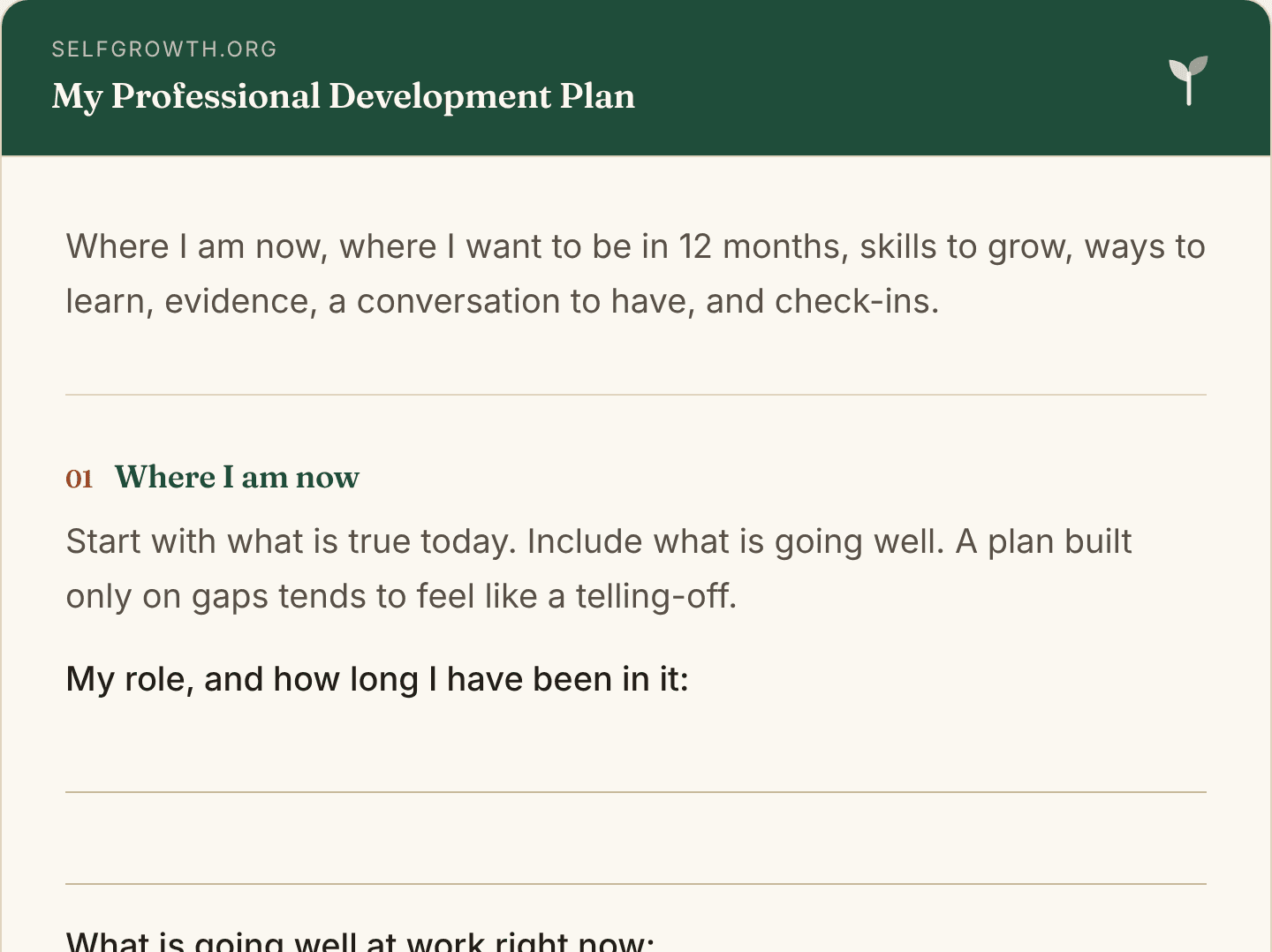
Professional Development Plan Template
A free printable professional development plan template: where you are now, 12-month aims, skills to grow, support, evidence and quarterly check-ins.
Open worksheet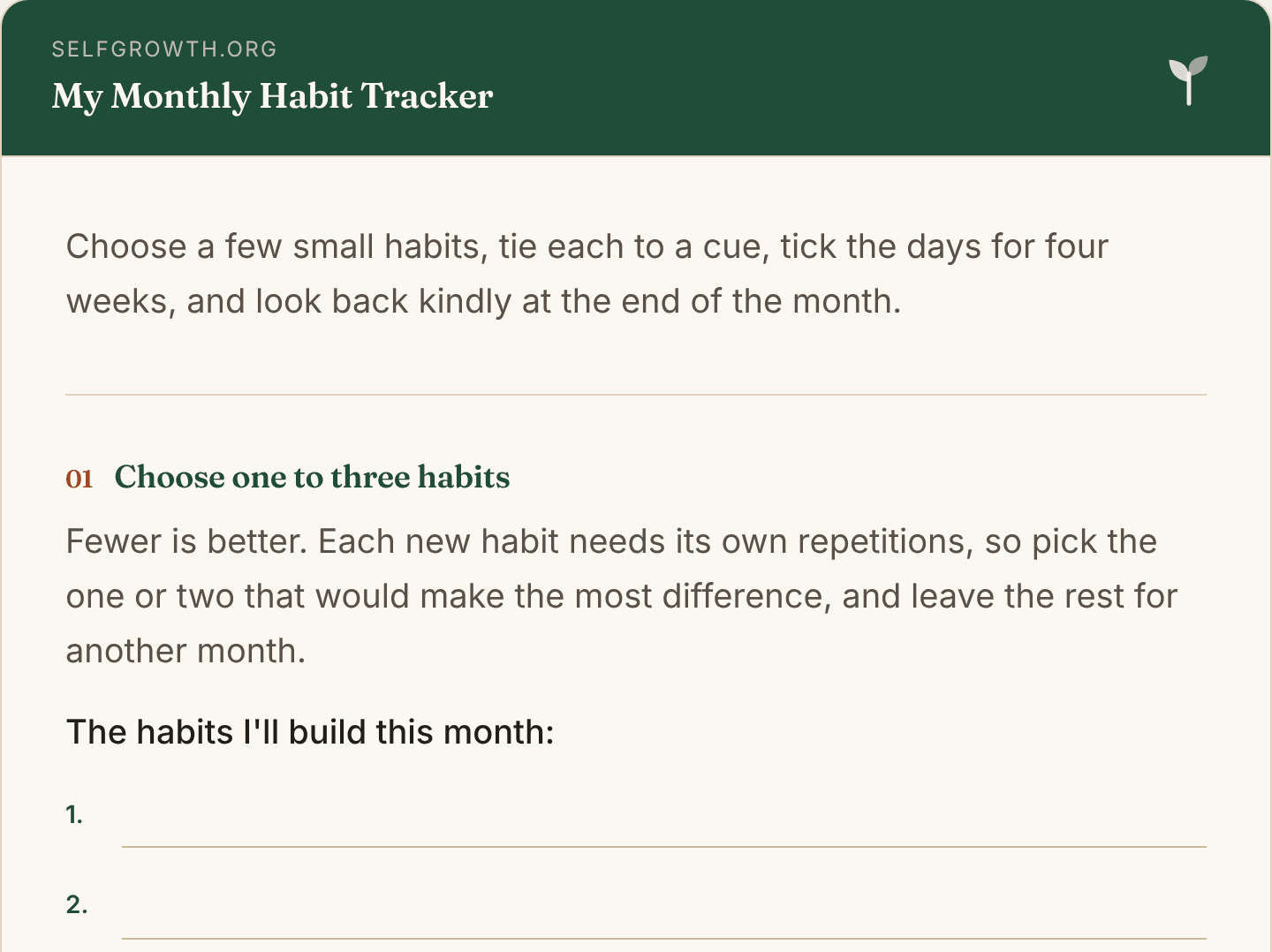
Habit Tracker Printable
A free printable habit tracker for one month: choose one to three small habits, tie each to a cue, tick the days, and review what helped. Print or fill it in.
Open worksheet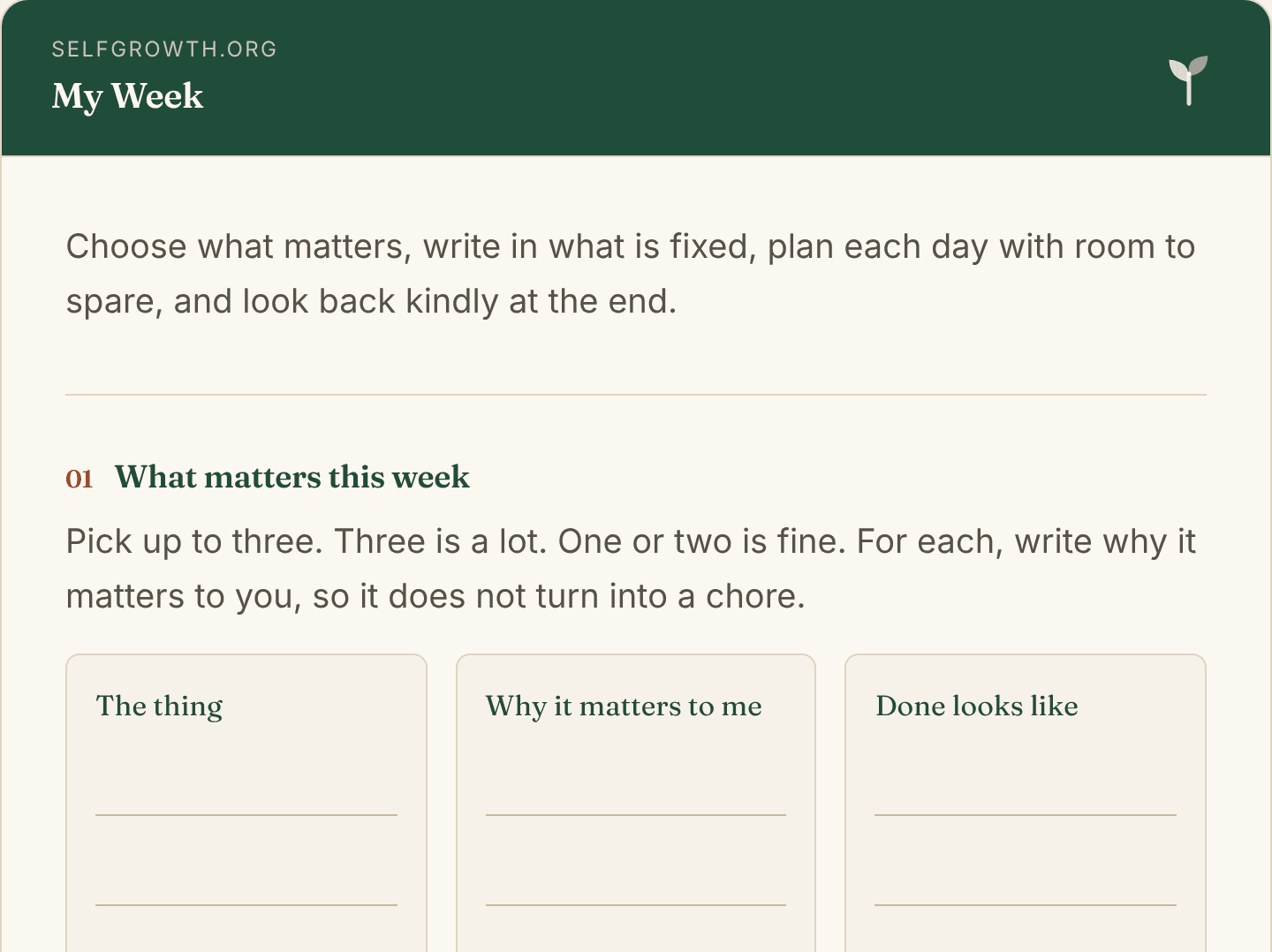
Weekly Planner Printable
A free weekly planner printable: pick up to three priorities, note fixed times, plan each day with a buffer and rest, then look back kindly. Print or fill in.
Open worksheet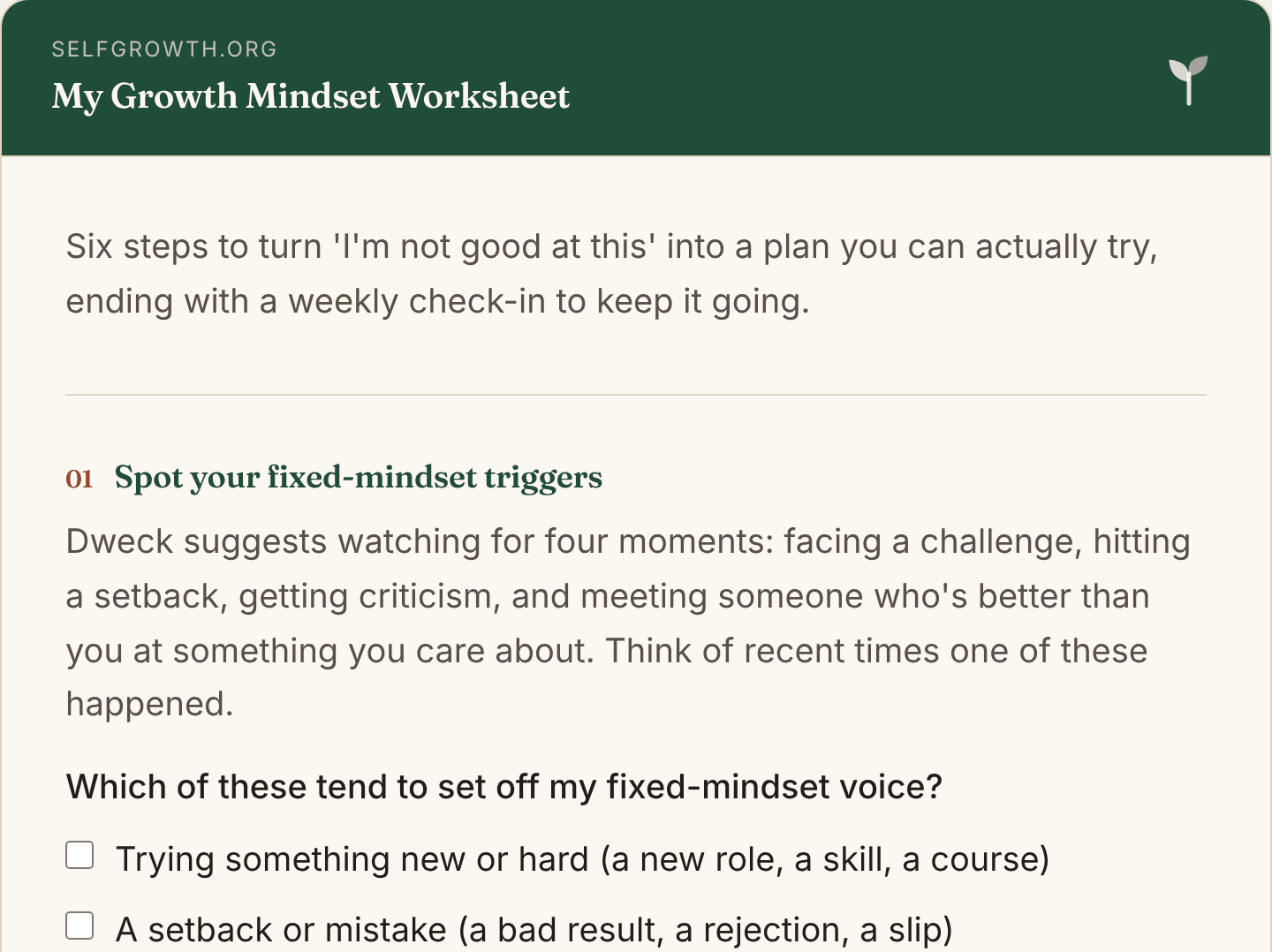
Growth Mindset Worksheet
A free, printable growth mindset worksheet for adults: spot your fixed-mindset triggers, rewrite them, plan practice, review a setback and use the power of yet.
Open worksheet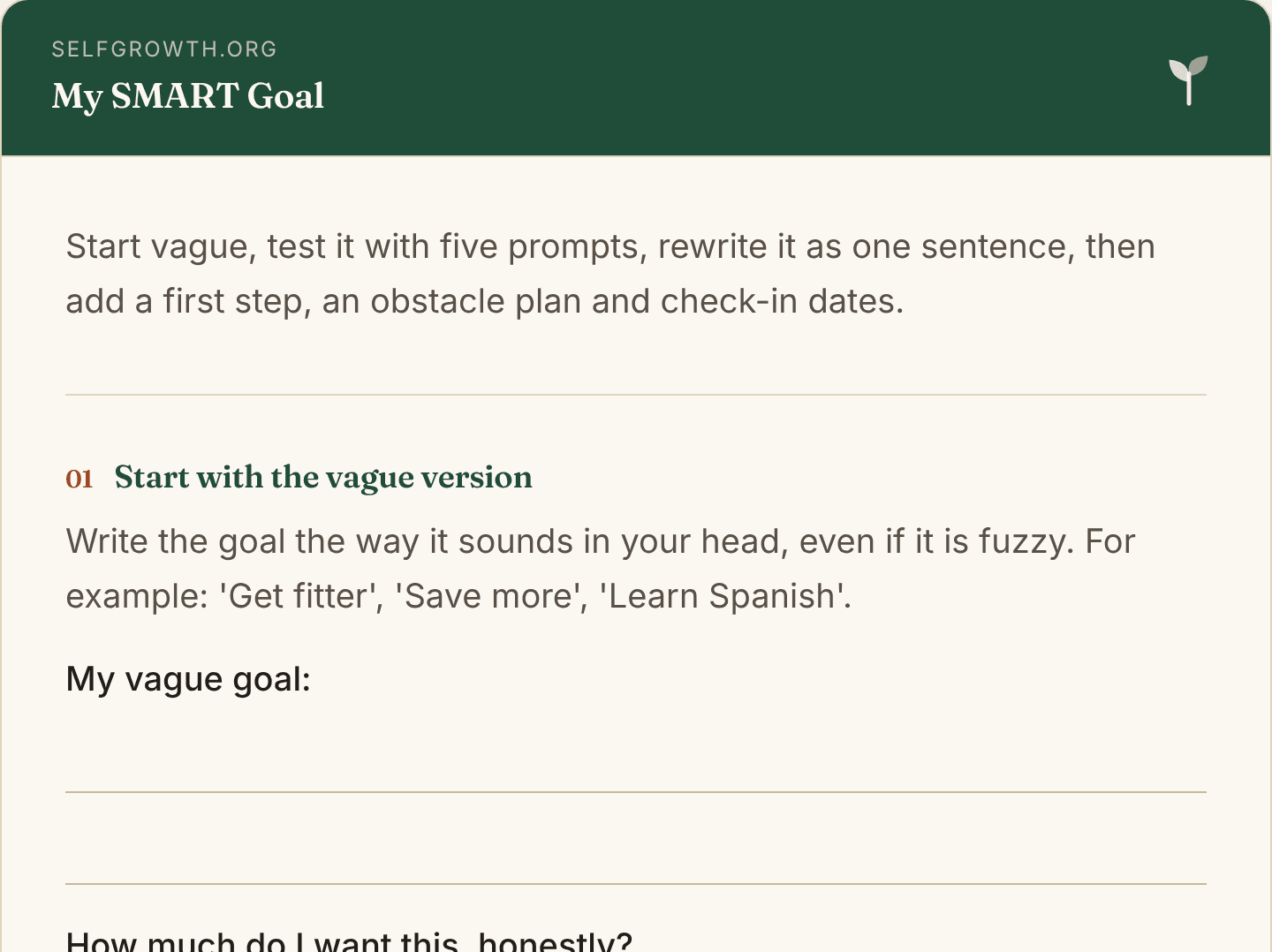
SMART Goals Worksheet
A free, printable SMART goals worksheet: start with one vague goal, answer five prompts with examples, rewrite it as one sentence, then add a first step and check-in dates.
Open worksheetRelated guides
New worksheets, straight to your inbox
An occasional new worksheet or tool, sent only when there's something genuinely worth your time. No spam, no pressure, unsubscribe any time.