
Guide
Career change at 40: how to do it, step by step
Updated 25 October 2026 · 11 min read
A career change at 40 is not too late. You bring years of skills and a clearer idea of what suits you. The usual route is to work out what matters, list your transferable skills, test one or two options cheaply, then plan money and training around what you learn. Move in steps rather than one big leap.
Drawn from careers research · Part of work and skills
If you are around 40 and wondering whether to start again in something new, you are asking a fair question. You may be tired of what you do, curious about something else, or facing a change you did not choose.
This guide takes it in small steps: how to tell if it is time, how to try out ideas before you risk anything, and how to plan money, family and training. It pairs with the career planning worksheet, where you write your own answers. This is self-help, not therapy or personal career advice, and it is not a decision for tonight.
Is 40 too old to change careers?
No. Forty is not a cut-off. People do change direction in their forties and later. By then you have a long list of skills, you know how you work, and you usually know what you do not want. Those are real advantages.
It can also be harder than it was at 25. You may have a mortgage, children or people you care for. Some employers are slow to take on someone new to a field. The law gives some protection: in the US the Age Discrimination in Employment Act forbids age discrimination against people aged 40 or older, and in the UK age is a protected characteristic under discrimination law. The law does not remove every barrier, so plan for a bit of extra effort in explaining why your experience fits.
A change does not always mean starting from zero. Many moves keep part of what you already have: the same skills in a new sector, the same sector in a new role, or the same job on better terms. Think of it as a range, not a switch.
Open the Career Planning WorksheetSigns it might be time for a career change
One bad week is not a sign. A pattern that lasts months might be. Ask yourself whether any of these sound like you:
- You dread Sunday evenings, and it has been going on for months, not days.
- You feel bored or stuck, and have stopped learning anything new.
- The work no longer fits what matters to you now.
- You feel drained after most days, not just the busiest ones.
- You keep daydreaming about a different kind of work.
- You feel you could do more, but nothing in your role lets you.
- Your body is telling you something: poor sleep, tension or constant tiredness linked to work.
Before you decide, check what is actually wrong. It could be the work itself, your manager, the hours, the pay, the pace, or burnout. Burnout can look like a career problem, and rest and a change of workload can help more than a new job. The guide to the signs of burnout can help you tell the difference. If the question is bigger than work, the guide to finding your purpose may help.
What makes a career change at 40 hard (and what makes it easier)?
It helps to be honest about both sides.
What can make it harder:
- Money. You may have bills and fixed costs that leave little room for a pay dip while you retrain or start at a lower level.
- Time and family. Work, caring and a social life already fill your week.
- Confidence. Being a beginner again can feel uncomfortable after years of being good at your job.
- Hiring habits. Some employers favour people with a direct track record in the field.
- Fear of getting it wrong. The more you have built, the more it can feel you have to lose.
What can make it easier:
- Transferable skills such as managing people, solving problems, communicating, organising and learning fast.
- Knowing yourself. You have a better idea of what drains you and what suits you than you had at 22.
- A network. Years of colleagues, friends and contacts can open doors and answer questions.
- Working while you test. You can often try things on the side before you leave anything.
- Clearer reasons. You can say why you want the change, which helps with interviews.
Look at your own list of skills. The strengths list worksheet is a quick way to start, and it feeds straight into the skills inventory in the career planning worksheet.
Open the Strengths List WorksheetHow to change careers at 40: step by step
The advice people often hear is to first work out what you want to do, then act. Herminia Ibarra, a professor at London Business School, argues in her book Working Identity (2003) that it often works the other way round. From her research on professionals and managers in transition, she describes people finding out what suits them by trying things: new activities, new people, and making sense of what they learn. That comes from her research with real career changers, not a controlled test, so treat it as a useful way to think. It is why most of the steps below are small tests.
- 1Write down why you want to change. Is it the work itself, the people, the pay, the hours, the sector, or something else? Sometimes a different role or employer in the same field fixes the real problem.
- 2Name what you want from work. Money, flexibility, meaning, variety, calm, a team, learning. Rank your top five. The core values worksheet can help with this.
- 3List your skills, including those from home, volunteering and hobbies. For each one, note whether you enjoy it and where else it could be used.
- 4Choose two to four options to look into. Include one that feels a bit unlikely. Read real job adverts to see what each role asks for.
- 5Test each option cheaply. Talk to two or three people who do the work, shadow someone for a day, take a short course, volunteer, or run a small project on the side. Note what gives you energy and what does not.
- 6Check the practical side. Work out the pay you would need, what training is required, and whether you could move gradually, such as part time, a secondment or a side business at first.
- 7Pick your next step and set a date. Make it small enough to do this week, such as booking one conversation. Review after a few weeks and adjust.
You are allowed to find out an option is not for you. That is a good result. It saved you from a costly mistake.
Open the Professional Development Plan TemplateMoney, family and time: planning the practical side
A change plan that ignores money tends to fall apart. A few plain steps help, and none of them needs a spreadsheet.
- Know your numbers. Write down what you must pay each month, and what you could cut if you had to. This tells you how much of a pay drop you can live with.
- Build a cushion first if you can. Even a small amount of savings makes decisions less frightening.
- Test while you are still employed. A side project, evening course or volunteering lets you try the work without giving up your income.
- Think about the people who rely on you. Talk to your partner or family early, share the plan and listen to their worries.
- Check what a change does to your pension, benefits, notice period and any employer training support before you hand in notice.
- Plan a way to move gradually. Part-time work, a secondment, or moving internally to a new team can be a bridge.
If you are making a big financial decision, speak to a qualified, independent money adviser. The SMART goals worksheet and the guide to setting goals can help you break the plan into dated steps.
Retraining at 40: do you need a new qualification?
Not always. Some jobs require a specific qualification or licence, such as nursing, teaching, electrical work or law. Many others value experience, a portfolio or a short course more than a full degree. Check before you pay for anything.
- Read several job adverts for the role. See what they ask for, not what a course website says.
- Ask people in the job how they got in, and what they would do if they started now.
- Try a short or taster course before a long one. If you still like it after a few weeks, go further.
- Look for other routes: apprenticeships open to adults, volunteering, work experience, or moving into the field through a related role.
- Look for funded training. In the UK, the National Careers Service has advice on finding courses that do not cost you money. In the US, CareerOneStop (careeronestop.org) has a training finder, and American Job Centers help people find training.
A course is a tool, not a plan. A certificate does not help much unless you know where it leads.
When to get more support
A careers adviser can look at your situation, local jobs and training, which a guide cannot. In England, adults aged 18 and over can use the National Careers Service (nationalcareers.service.gov.uk), which points to the DWP Jobs and Careers Service. You can also call 0800 072 0288, open 8am to 6pm, Monday to Friday, closed on weekends and bank holidays. Calls are free from landlines and most mobile numbers. In Scotland, My World of Work (myworldofwork.co.uk) from Skills Development Scotland offers a free careers advice service. In Wales, Careers Wales (careerswales.gov.wales) is on 0800 028 4844. In Northern Ireland, see nidirect.gov.uk/campaigns/careers. In the US, CareerOneStop (careeronestop.org) is sponsored by the US Department of Labor, and its American Job Center Finder lists local centres.
If work is hurting your sleep, mood or health, see your GP, whatever you decide about your career. A job change will not always fix stress that has built up over a long time. A counsellor or therapist can also help if you feel stuck, low or anxious about the future. This guide is self-help and is not a substitute.
If you ever feel unsafe or have thoughts of harming yourself, call Samaritans on 116 123 (UK and Ireland), 988 (US), or find a line at findahelpline.com.
Sources and further reading
This is an educational self-reflection resource, not therapy or medical advice.
If you want to go deeper
- Ibarra, H. (2003). Working Identity: Unconventional Strategies for Reinventing Your Career. Harvard Business School Press. Updated edition 2023, Harvard Business Review Press.
- Age discrimination. US Equal Employment Opportunity Commission (eeoc.gov).
- Discrimination: your rights, types of discrimination (protected characteristics). GOV.UK.
- Contact and skills assessment. National Careers Service, UK government (nationalcareers.service.gov.uk).
- CareerOneStop and American Job Center Finder. Sponsored by the US Department of Labor (careeronestop.org).
Your questions, answered
- Is 40 too old to change careers?
- No. Many people change direction in their forties and later, and you bring real skills and experience. It can take more planning if you have bills or family to think about, so test an option and plan the money before you leave a job.
- How do I find a career I love?
- Start with what you want from work, what you are good at and what gives you energy. Pick a few options and try them in small ways, such as a conversation or short course. You find out what you like by trying things. You may also find a role that fits you well enough, which is a fair goal.
- How do I change careers with no experience?
- Start with your transferable skills, then look for a bridge: a related role, volunteering, a short course or a side project that gives you something to show. Talk to people in the field about how they began. Read job adverts to see what is really asked for.
- What is the best career to change to at 40?
- There is no single best career. A good fit matches what you value, what you are good at and what the local job market needs. Use official tools such as the National Careers Service skills assessment (UK) or the O*NET Interest Profiler at mynextmove.org (US) for ideas, then check real job adverts.
- How long does a career change take?
- It depends on how big the change is and whether you need new training. A move that uses your current skills can be quicker. A move that needs a new qualification takes longer. Plan in steps and review as you go, rather than setting one deadline.
- Is there a career change worksheet PDF?
- Yes. The career planning worksheet works for a first plan or a change. It has a Download PDF button and a Print option. It is free, with no payment and no email needed. You can fill it in on screen, and your answers save in your browser.
- Is this guide career advice or therapy?
- No. It is a self-help guide, not therapy or personal career advice. A careers adviser can look at your situation. If work stress is affecting your sleep or mood, see a GP. If you ever feel unsafe or have thoughts of harming yourself, call Samaritans on 116 123 (UK and Ireland), 988 (US), or find a line at findahelpline.com.
Worksheets to do the work
Free to fill in online or print. No email needed.
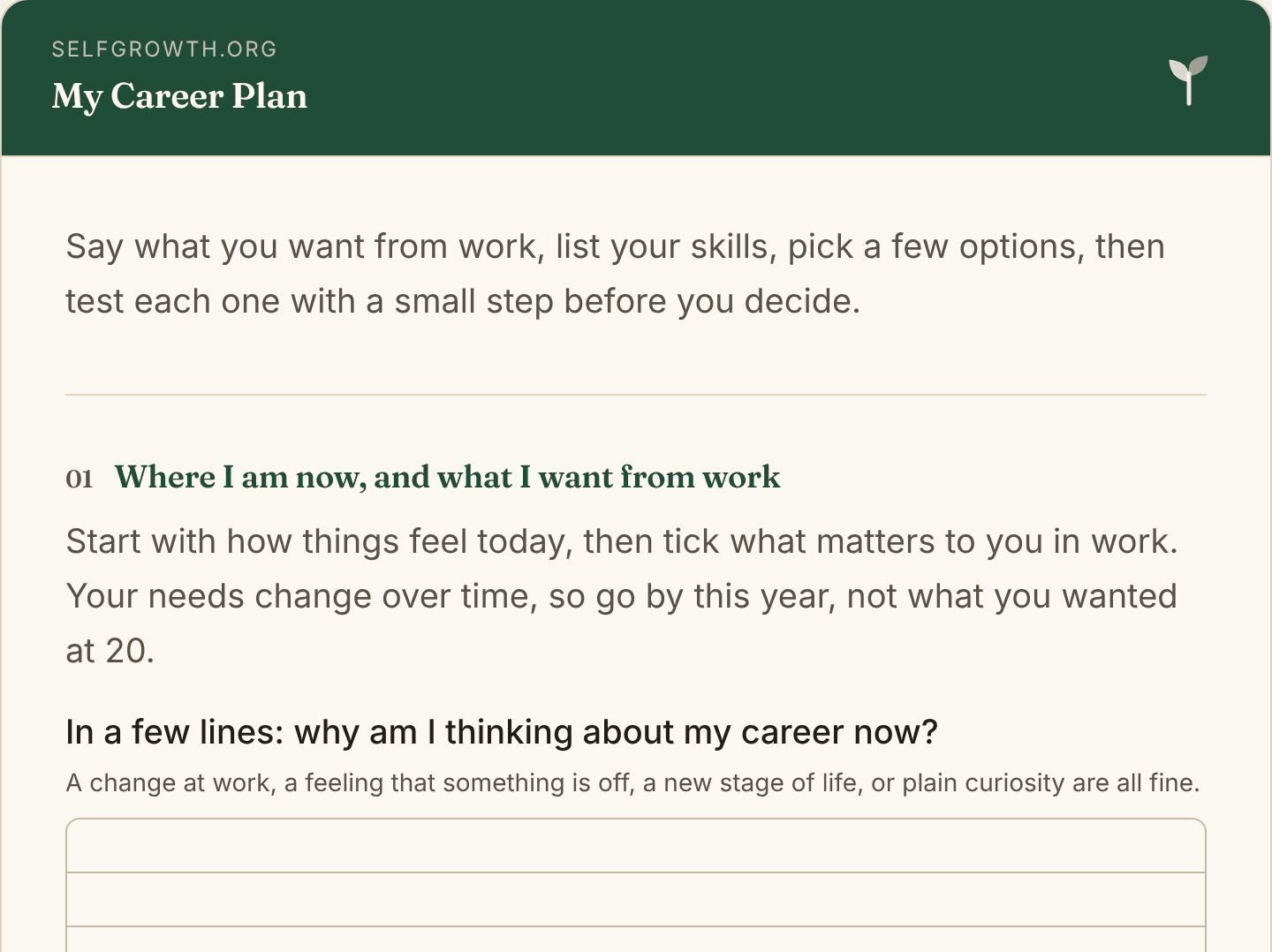
Career Planning Worksheet
A free career planning worksheet with a skills inventory, values checklist and small experiments. Use it for a first plan or a career change. No email needed.
Open worksheet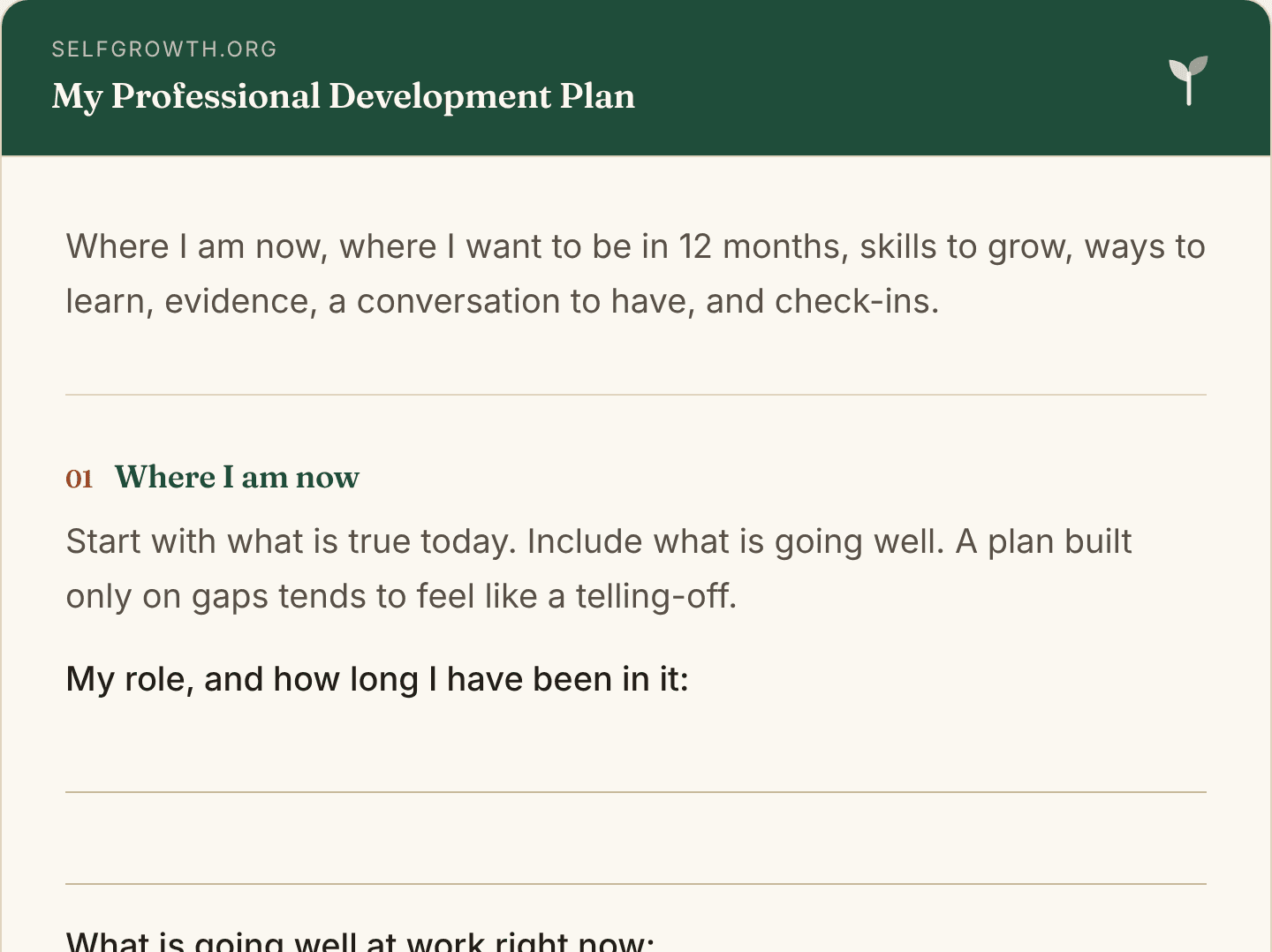
Professional Development Plan Template
A free printable professional development plan template: where you are now, 12-month aims, skills to grow, support, evidence and quarterly check-ins.
Open worksheet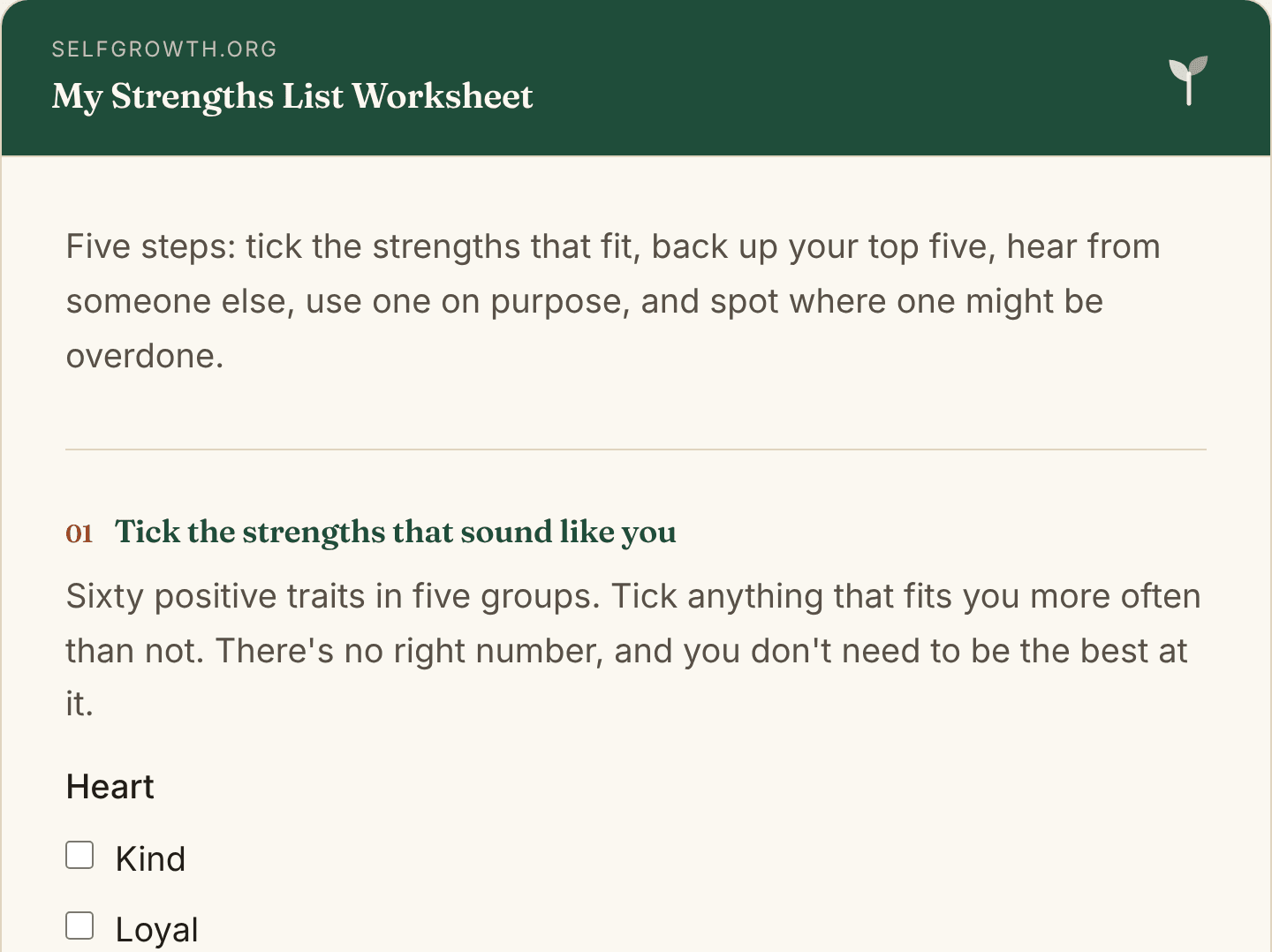
Strengths List Worksheet
A free list of 60 positive character traits and strengths to tick, with space for evidence, what others see in you and one strength to use on purpose this week.
Open worksheet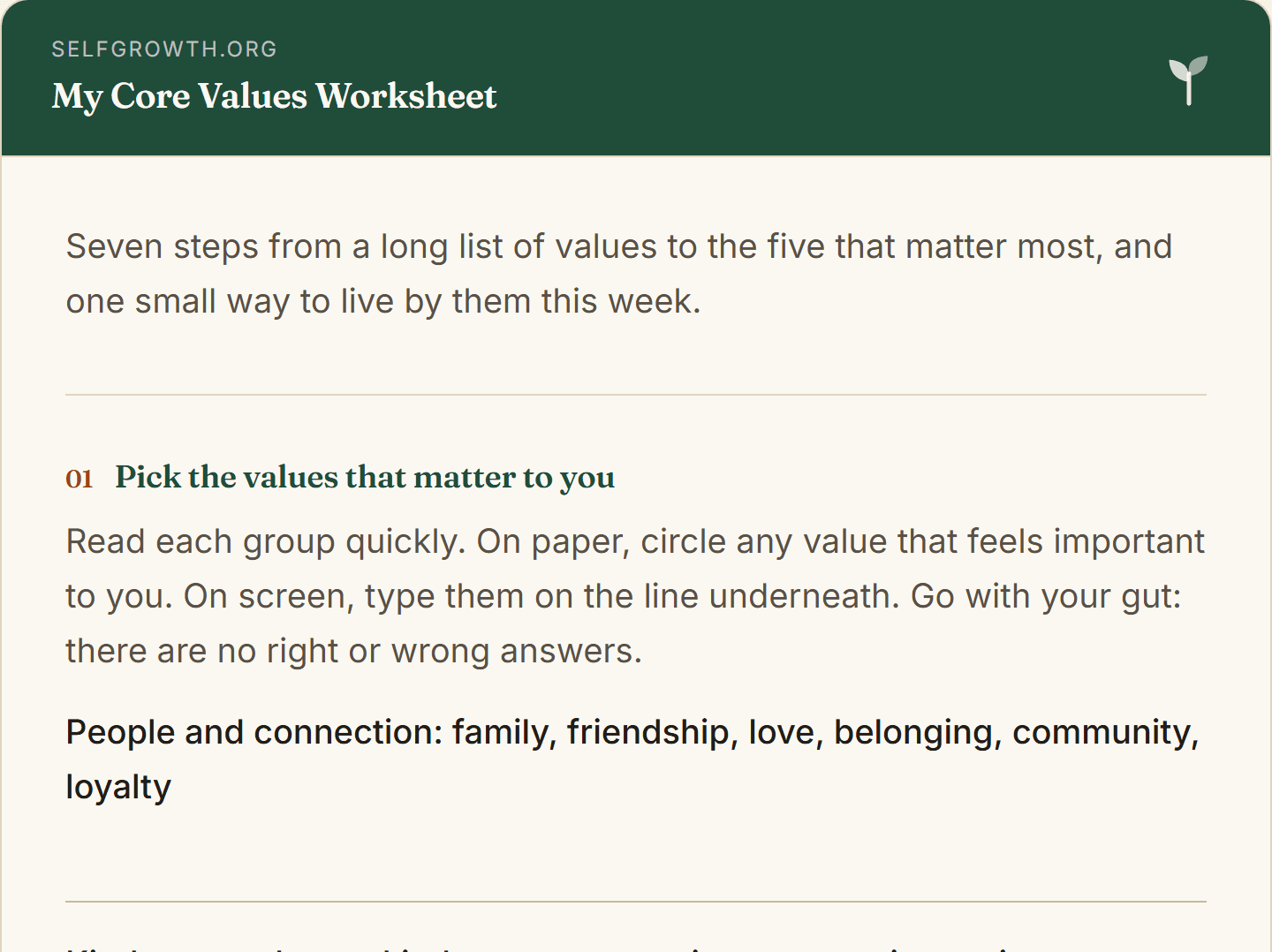
Core Values Worksheet
A free, printable core values worksheet: pick values from a list, narrow them to your top five, put them in your own words and plan one step to live by them.
Open worksheet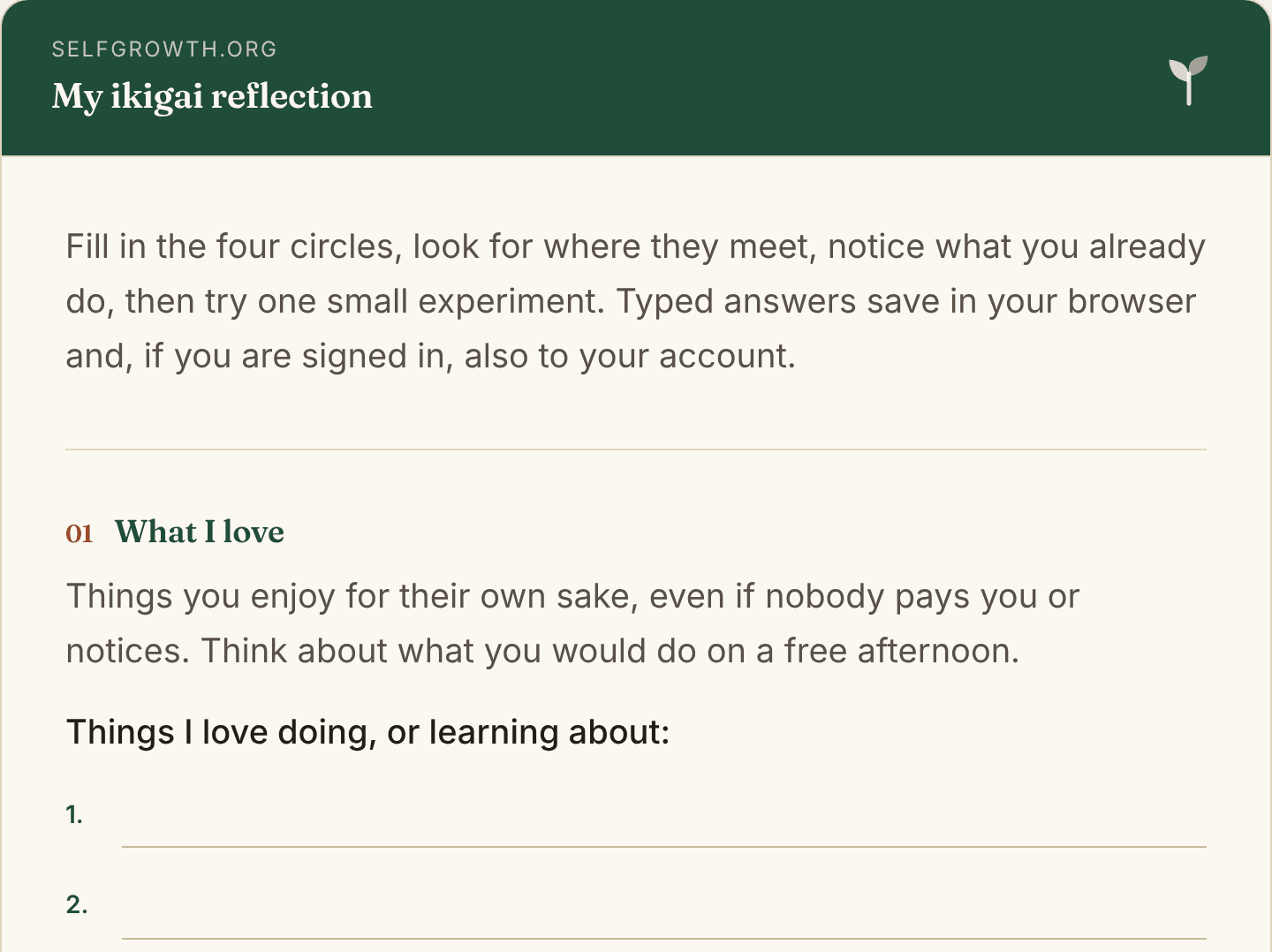
Ikigai Worksheet
A free printable ikigai worksheet: list what you love, do well, the world needs and you can be paid for, then try one small experiment this week.
Open worksheet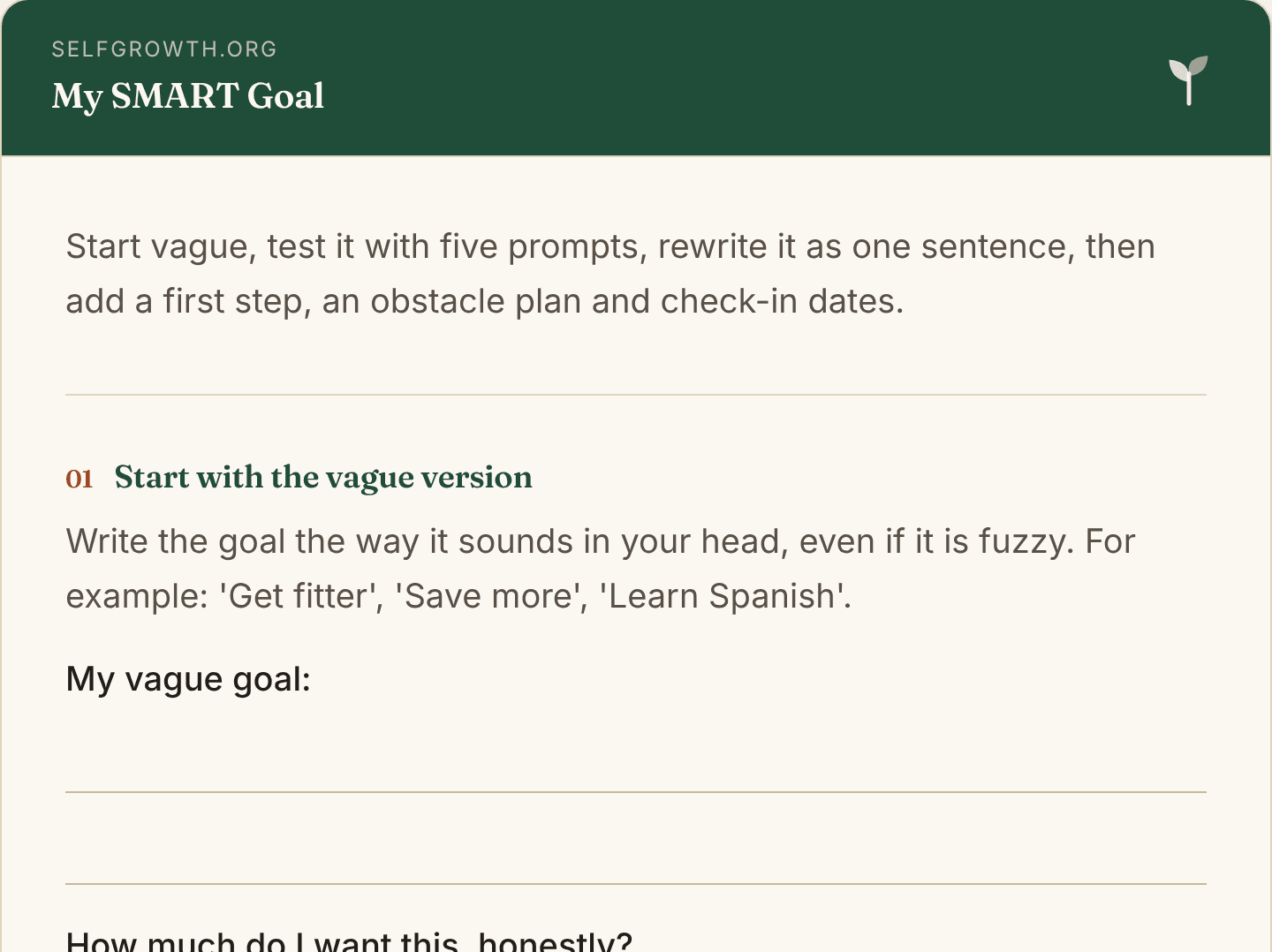
SMART Goals Worksheet
A free, printable SMART goals worksheet: start with one vague goal, answer five prompts with examples, rewrite it as one sentence, then add a first step and check-in dates.
Open worksheetRelated guides
New worksheets, straight to your inbox
An occasional new worksheet or tool, sent only when there's something genuinely worth your time. No spam, no pressure, unsubscribe any time.