
Work
Career planning worksheet: a free sheet to work out what you want and what to try next
Updated 25 October 2026 · 14 min read · Free to print
A career planning worksheet helps you work out what you want from work, what you can already do and what to try next. This free one covers values, a skills inventory, what energises and drains you, options to explore and small experiments. It works for a first plan or a change. It gives ideas to test, not a verdict.
Drawn from careers research · Part of work and skills
Fill it in here (it saves in this browser, but not in a private window), print it, or download the PDF. Free, no sign-up.
Planning a career can feel like guessing at your whole future. This sheet breaks it into small pieces you can fill in over a few sittings: what you want from work, what you can already do, what gives you energy, and what you could try next.
It works whether you are planning a first career, a move up, or a change of direction. It does not tell you your ideal job. It helps you spot patterns in your own answers, then test a few options cheaply before you commit. If it brings up a bigger question, the guide to career change at 40 goes into the practical side, and the core values worksheet goes deeper on what matters to you.
This is a self-help planning tool, not therapy or a substitute for a careers adviser. If work stress is hitting your sleep or mood, a GP is the right first call. Careers advisers can help with local jobs, training and money.
How to use this worksheet
- 1Work through the sections in order, or start with the one that feels easiest. Short phrases are enough.
- 2Be generous with the skills inventory. Include things from home, volunteering, hobbies and past jobs, not only your job title.
- 3Pick options that are worth a look, not options you are sure about. You are collecting information, not choosing yet.
- 4Plan tests that are small and cheap, such as a chat or a short course, before you plan any big move.
- 5Come back in a few weeks, note what you learned and update the sheet.
The worksheet
selfgrowth.org
My Career Plan
Say what you want from work, list your skills, pick a few options, then test each one with a small step before you decide.
01Where I am now, and what I want from work
Start with how things feel today, then tick what matters to you in work. Your needs change over time, so go by this year, not what you wanted at 20.
In a few lines: why am I thinking about my career now?
A change at work, a feeling that something is off, a new stage of life, or plain curiosity are all fine.
How well does my work fit me right now?
What I want from work (tick all that matter to me):
My top five, and how they match my work today:
Rate how much each matters (1 to 10) and how much you have it now (1 to 10). Big gaps show where to look.
Entry 1
Entry 2
Entry 3
Entry 4
Entry 5
02My skills inventory
List what you can do, not just what is on your CV. Include things you did unpaid, at home or years ago. Then ask where each could be used in a different job. Examples: explaining things clearly, handling upset customers, keeping a budget, organising an event, fixing things, writing, spotting errors.
Entry 1
Entry 2
Entry 3
Entry 4
Entry 5
Entry 6
Entry 7
Entry 8
Skills I have and enjoy, which I want to use more:
Skills I have but would be glad to stop using:
Being good at something does not mean you must do it forever.
Skills I would like to build:
03What gives me energy, and what drains me
Think about the last few months. Look at tasks, people, places, pace and the kind of day, not just job titles. Patterns here are often more useful than any list of job ideas.
Moments at work (or outside it) when I felt energised or absorbed:
- 1.
- 2.
- 3.
- 4.
- 5.
Moments that left me drained, bored or dreading the next day:
- 1.
- 2.
- 3.
- 4.
- 5.
What do the two lists have in common? What would I want more of, and less of?
04My interests
Interests can point at work you have not considered. List what you read, watch, fix, talk about or lose time to. Then, if you want an outside prompt, two official tools can help. In England, the National Careers Service skills assessment (nationalcareers.service.gov.uk) asks 40 multiple-choice questions and suggests careers to compare. In the US, the O*NET Interest Profiler at mynextmove.org, from the US Department of Labor, is a free 30-question tool that sorts interests into six broad areas: realistic, investigative, artistic, social, enterprising and conventional. Treat any results as ideas to look into, not a verdict on who you are.
Things I am curious about or enjoy for their own sake:
- 1.
- 2.
- 3.
- 4.
- 5.
- 6.
If I used one of these tools: which suggestions interested me, and which surprised me?
Skip this if you have not tried one. It is optional.
05Options to explore
Pick two to four options. They can be a different role, the same job in a new place, a move up, going self-employed, or a small change to your current job. Include one that feels a bit unlikely. For each, note what draws you and what worries you.
Entry 1
Entry 2
Entry 3
Entry 4
06Small experiments to test each option
Test before you leap. Cheap tests tell you more than hours of thinking: talk to someone who does the work, shadow them for a day, try a short course, do a small project on the side, or volunteer. Pick tests that cost little and can be stopped. Set your own date for each.
Entry 1
Entry 2
Entry 3
Entry 4
After a test: what did I learn? Did it give me more energy or less? What next?
07My goal for the next year, and my first step
Choose one direction for the next twelve months. It can be small, like finding out, or big, like a new role. Make the first step something you can do this week. If you want help turning it into a proper goal, the SMART goals worksheet can help.
My career goal for the next year, in plain words:
My first step, and when I will take it:
What could get in the way, and what will I do about it?
Money, time, confidence, family and health all count.
How ready do I feel to take the first step?
08Who can help
You do not have to plan this alone. Think of people who know the work, people who know you, and advice services. In the UK, the National Careers Service (England) and the careers services for Scotland, Wales and Northern Ireland offer careers advice. In the US, CareerOneStop (careeronestop.org) and American Job Centers can help with training and job search. If work worry is affecting your sleep or mood, see your GP too.
Entry 1
Entry 2
Entry 3
Entry 4
One thing I want to say to myself about this plan:
When you're done, a moment to reflect
- Which section was easiest to fill in, and which was hardest? What does that tell you?
- What shows up on more than one page, such as a skill, a value or a kind of task?
- What do you want more of in your working week, and what would you happily drop?
- Which option would you regret not looking into?
- What is the smallest test you could run in the next two weeks?
- Who could you talk to this week, and what would you ask?
Done for now?
Save today's answers as a dated entry. You can come back, fill it in again and compare the two side by side.
Where does this approach come from?
This is a planning format, not a tested treatment or a test of any kind. It puts together common career-planning steps: clarify what matters, take stock of your skills, notice what energises you, list options, then try small experiments before you decide.
The idea of trying things before you decide is taken from Herminia Ibarra, a professor at London Business School. In her book Working Identity (Harvard Business School Press, 2003) she argues, from her research on professionals and managers in transition, that people usually find out what they want by doing and experimenting, not by thinking alone. This comes from her research with real career changers, not a controlled test. It is a useful way to think, not proof that it works for everyone.
The two tools named on this page are published by governments. The O*NET Interest Profiler groups interests into six areas that its publisher describes as compatible with John Holland's RIASEC model of interests. Such tools are conversation starters. They can show where to look. They cannot say what you should do, and your circumstances matter as much as your interests.
These are educational self-reflection tools, not therapy.
If you want to go deeper
- Ibarra, H. (2003). Working Identity: Unconventional Strategies for Reinventing Your Career. Harvard Business School Press. Updated edition 2023, Harvard Business Review Press.
- O*NET Interest Profiler (Mini-IP). US Department of Labor, Employment and Training Administration, via My Next Move (mynextmove.org) and O*NET Resource Center (onetcenter.org).
- Skills assessment. National Careers Service, UK government (nationalcareers.service.gov.uk).
Your questions, answered
- What is a career planning worksheet?
- It is a set of prompts that helps you think through your career on paper. You write down what you want from work, what you can do, what energises you and what you might try, then turn the answers into a small next step. It organises your thinking. It does not choose a job for you.
- How do I make a career plan?
- Start with what matters to you, list your skills, notice what gives you energy, choose two to four options, and test each with a small experiment such as a chat or short course. Then set one goal for the next year and a first step. This worksheet follows that order.
- How do I do a transferable skills inventory?
- List what you can do from paid work, home, volunteering and hobbies. Next to each, note where you have used it and whether you enjoy it. Then ask where it could be used in a different role. The skills inventory section above has columns for exactly this.
- Can I use this to change careers?
- Yes. The sections on what you want, your skills, and small tests are made for a change as well as a first plan. You test options before you leave anything. The guide to career change at 40 covers money, time and retraining.
- Are there official career tools I can use?
- Yes. In England, the National Careers Service has a skills assessment at nationalcareers.service.gov.uk. In the US, the O*NET Interest Profiler at mynextmove.org is a free tool from the US Department of Labor. Both give ideas to look into, not answers.
- Is there a career planning worksheet PDF?
- Yes. Use the Download PDF button for a clean, print-ready copy, or Print to print straight from the page. It is free, with no payment and no email needed. You can also fill it in on screen, and your answers save in your browser.
- Is this career advice or therapy?
- No. It is a self-help planning tool, not therapy or personal career advice. A careers adviser can look at your situation and local jobs. If work stress is affecting your sleep, mood or health, a GP can help. If you ever feel unsafe or have thoughts of harming yourself, call Samaritans on 116 123 (UK and Ireland), 988 (US), or find a line at findahelpline.com.
Keep going, related worksheets
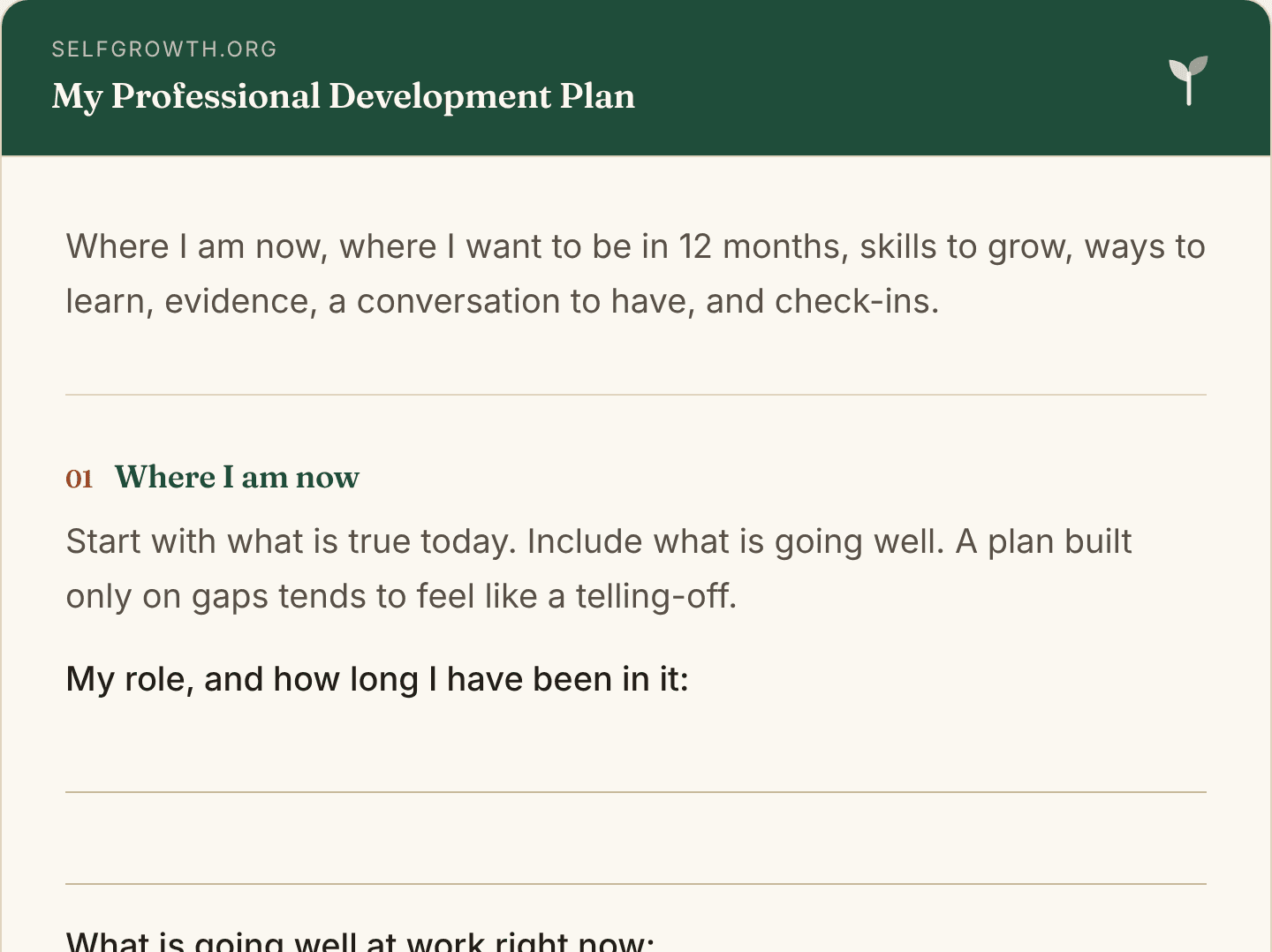
Professional Development Plan Template
A free printable professional development plan template: where you are now, 12-month aims, skills to grow, support, evidence and quarterly check-ins.
Open worksheet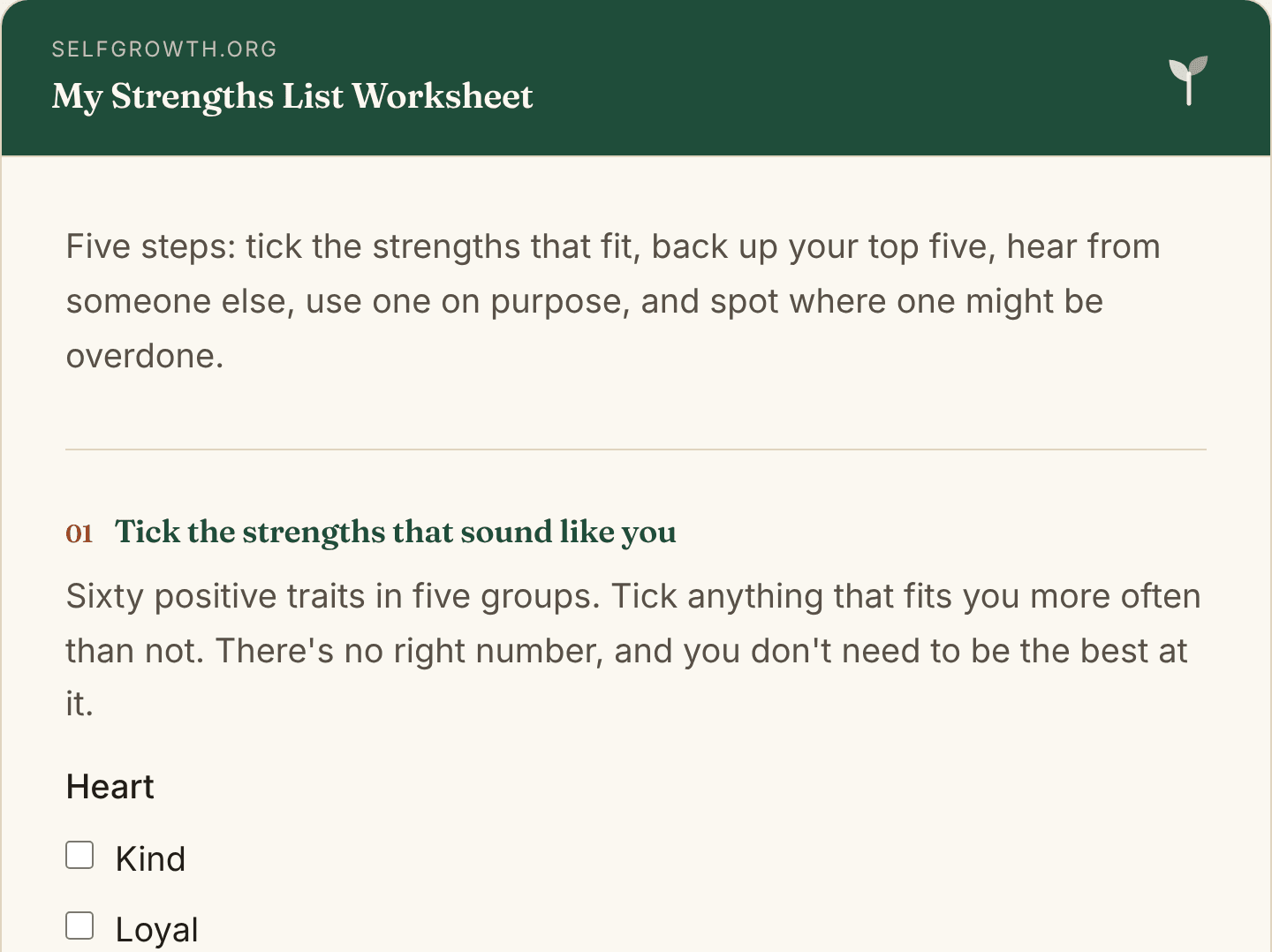
Strengths List Worksheet
A free list of 60 positive character traits and strengths to tick, with space for evidence, what others see in you and one strength to use on purpose this week.
Open worksheet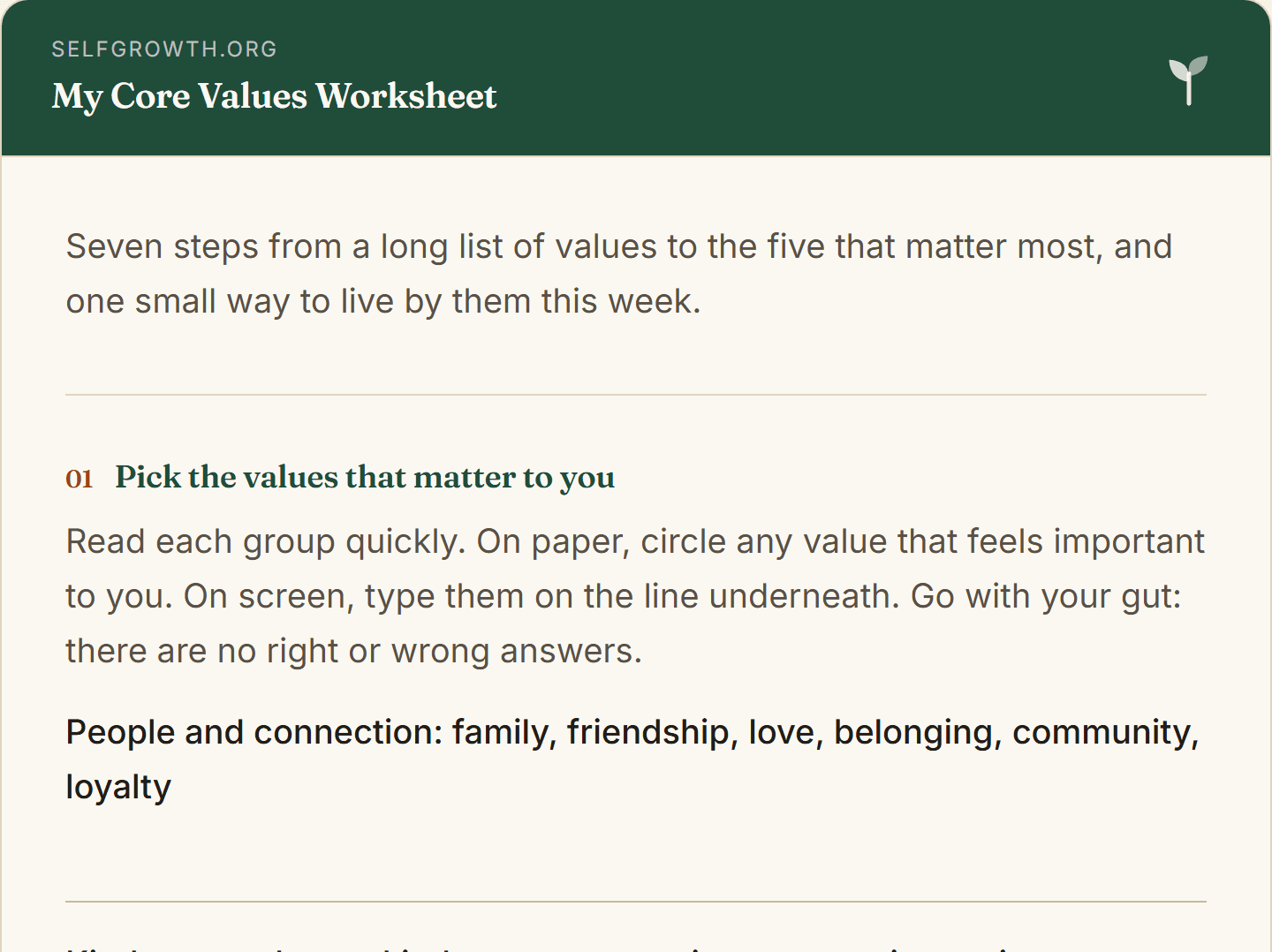
Core Values Worksheet
A free, printable core values worksheet: pick values from a list, narrow them to your top five, put them in your own words and plan one step to live by them.
Open worksheetNew worksheets, straight to your inbox
An occasional new worksheet or tool, sent only when there's something genuinely worth your time. No spam, no pressure, unsubscribe any time.