
Self-esteem
Self-esteem worksheets for kids: free printable activities
Updated 11 October 2026 · 6 min read · Free to print
Self-esteem worksheets for kids are simple draw-or-write activities that help a child notice what they're good at, remember a time they kept trying, and practise kind things to say to themselves. This free, printable worksheet is for children of about 7 to 12 to do with a parent, carer or teacher, with tips for the adult.
By the Self Growth team · drawn from research on praise, parental warmth and children's self-esteem · how we make these
Fill it in here (it saves in this browser, but not in a private window), print it, or download the PDF. Free, no sign-up.
If your child has started saying things like 'I'm rubbish at everything' or 'nobody likes me', it's hard to hear. Most children have spells like this, often after a hard week at school, a falling-out with a friend or a new challenge that didn't go well. A few calm, specific conversations can help them see themselves more fairly again.
This worksheet gives you a way into those conversations. Your child draws or writes about the things they're good at, what other people like about them, a time they kept going when something was hard, kind things they can say to themselves, and the people who help them. It's built for children of about 7 to 12, with short questions and big spaces, so drawing counts as much as writing.
What you say while they do it matters as much as the sheet. Research on praise suggests that children with low self-esteem can shy away from challenges after over-the-top praise like 'that's perfect!', while plain, specific comments about what they did and how hard they tried tend to land better. Warmth seems to help more than seeing a child as more special than others. This is a home or classroom activity, not therapy, and it can't tell you whether something more is going on.
How to use this worksheet
- 1Sit with your child and give it 15 to 20 minutes, or do one or two sections at a time. Print it, or fill it in together on screen.
- 2Let them draw or write, whichever they like. You can be the scribe for younger children, writing down exactly what they say.
- 3Praise the effort and the details, not the person: 'you thought hard about that one' or 'I love how you remembered the time you helped Sam' works better than 'you're amazing'.
- 4Don't push. If a question makes them clam up or upset, skip it. If they say something harsh about themselves, listen first and don't rush to argue them out of it.
- 5Notice how they seem, not just what they write. If the low mood or harsh self-talk lasts for weeks, or you're worried, talk to their school or GP (see the FAQ below).
- 6Teachers and school staff: this is free to print for one-to-one time, small groups or the whole class. Let children keep their answers private if they want to. If a child tells you something that worries you, follow your school's safeguarding procedure and speak to your designated safeguarding lead.
The worksheet
selfgrowth.org
All About Me: A Self-Esteem Worksheet for Kids
Seven activities about you. You can draw or write. There are no wrong answers, and nobody is marking it.
01How do I feel about me today?
Colour in a number. How do I feel about myself today?
One word for how I feel today:
02This is me
Draw a picture of you doing something you love. Or write about it.
Draw or write: me doing something I love
03Things I'm good at
Big things and small things all count. Being kind, being funny, drawing, football, making friends laugh, looking after a pet, building things.
I'm good at…
- 1.
- 2.
- 3.
- 4.
- 5.
04What other people like about me
What do your friends, family or teacher like about you? If you get stuck, ask one of them.
People like it when I…
- 1.
- 2.
- 3.
- 4.
05A time I kept trying
Think of something that was hard at first. Maybe riding a bike, a times table, a new game or making a new friend.
Draw or write: the time I kept trying
How I felt when I kept going:
06Kind things I can say to myself
Sometimes our heads say unkind things to us. We can answer back kindly, like we would to a friend. Tick the ones you like.
Entry 1
Entry 2
07People who help me
Who can you talk to when you feel worried or sad? Family, a teacher, a friend, a club leader, anyone you trust. If you live in the UK, you can also call Childline free on 0800 1111, any time, day or night.
People who help me:
- 1.
- 2.
- 3.
- 4.
If I feel worried, I can tell…
When you're done, a moment to reflect
- What was your favourite part of this worksheet?
- What would you say to a friend who thought they weren't good at anything?
- What's one thing you'd like to get better at, and what's the first small step?
How should you praise a child to build self-esteem?
The activities stick to things a child can actually see and remember: what they're good at, what other people like about them, a real time they kept trying, and the people they can turn to. That's deliberate. Telling a child they're wonderful is easy to brush off; a memory of the time they learned to swim is harder to argue with.
The tips for the adult lean on research about praise. Claudia Mueller and Carol Dweck's classic experiments (1998) found that children praised for being clever coped worse after a setback than children praised for their effort. Eddie Brummelman and colleagues (2014) found that adults tend to give children with low self-esteem more inflated praise, and that this kind of praise made those children more likely to avoid a challenge. In a later study of children aged 7 to 12 in the Netherlands (2015), the same team found that parental warmth was linked with higher self-esteem over time, while parents seeing their child as more special than others was linked with narcissism instead. These are findings from particular studies, not rules, but they point the same way: warm, specific and honest beats big and general.
The 'kind things to say to myself' section is a child-sized version of answering the inner critic, the same move the adult and teen worksheets use. None of this is therapy, and it can't tell you if a child needs more help than a worksheet can give.
These are educational self-reflection tools, not therapy. See our editorial standards.
If you want to go deeper
- Mueller, C. M. & Dweck, C. S. (1998). Praise for intelligence can undermine children's motivation and performance. Journal of Personality and Social Psychology, 75(1), 33-52.
- Brummelman, E., Thomaes, S., Orobio de Castro, B., Overbeek, G. & Bushman, B. J. (2014). "That's not just beautiful, that's incredibly beautiful!": The adverse impact of inflated praise on children with low self-esteem. Psychological Science, 25(3), 728-735.
- Brummelman, E., Thomaes, S., Nelemans, S. A., Orobio de Castro, B., Overbeek, G. & Bushman, B. J. (2015). Origins of narcissism in children. Proceedings of the National Academy of Sciences, 112(12), 3659-3662.
Your questions, answered
- What are the signs of low self-esteem in a child?
- Common signs include talking about themselves harshly ('I'm stupid', 'I'm rubbish at everything'), giving up quickly or refusing to try new things in case they fail, getting very upset over small mistakes, needing a lot of reassurance, and brushing off compliments. Some children go quiet and withdrawn; others get angry or silly to cover it. A few of these now and then is normal. A worksheet can't diagnose anything, but it can help you start a conversation about how your child sees themselves.
- How can I help my child build self-esteem?
- Small, everyday things tend to matter most: warmth and time together, noticing what they actually did ('you kept going even when it was tricky') rather than labels like 'genius', letting them try hard things and sometimes fail, and listening when they're down instead of rushing to fix it. In one study of Dutch children aged 7 to 12, parental warmth was linked with higher self-esteem over time, while parents seeing their child as more special than others was linked with narcissism, not self-esteem. This worksheet gives you a structured way to have those conversations.
- Should I praise my child a lot to boost their self-esteem?
- Praise helps, but the kind matters. In experiments by Eddie Brummelman and colleagues, adults gave children with low self-esteem more over-the-top praise ('that's incredibly beautiful!'), and that kind of praise made those children less likely to pick a harder challenge afterwards. Plain, honest, specific praise about effort and what they did is a safer bet. You don't need to stop praising, just keep it real.
- What are some self-esteem activities for kids?
- Good ones are simple and concrete: drawing a picture of themselves doing something they love, listing things they're good at (small things count), asking a family member what they like about them, remembering a time they kept trying, and choosing kind things to say to themselves when things go wrong. This worksheet puts those together on one printable page set, with space to draw or write.
- Are these self-esteem worksheets for kids free?
- Yes. It's free to print or fill in on screen, with no payment, no sign-up and no email. Use the Download PDF button for a clean copy, or Print to print straight from the page. Teachers are welcome to print it for the whole class.
- What age is this worksheet for?
- It's written for children of about 7 to 12, with short questions and room to draw. Younger children can do it with an adult writing down their answers. For teenagers, the self-esteem worksheet for teens covers comparison, social media and the mean inner voice in a more grown-up way.
- When should I get help for my child's self-esteem?
- This worksheet is a home or classroom activity, not therapy. Talk to your child's school (their teacher, the pastoral lead or school nurse) or your GP if low mood or harsh self-talk lasts for weeks, if they stop wanting to go to school or see friends, if their sleep or eating changes, if you think they're being bullied, or if they talk about hurting themselves. In the UK, children and young people under 19 can call Childline free on 0800 1111, any time; adults worried about a child's safety can call the NSPCC Helpline on 0808 800 5000. If you think a child is in immediate danger, call 999 (UK) or your local emergency number. In the US, call or text 988. Elsewhere, find a helpline at findahelpline.com. In an emergency, call your local emergency number.
Not quite the right worksheet?
These seven overlap, and more than one may fit you. Here is what each one is for.
Self-esteemYour overall opinion of yourself feels low or harsh, and you want to answer the inner critic.
Self-worthYou feel you only matter when you achieve, please people or get things right.
Self-confidenceYou doubt you can handle one particular thing, like speaking up, a new job or a hard conversation.
Self-loveYou keep putting your own needs last and want to treat yourself with more care, day to day.
Self-esteem for adultsWork, money, parenting or comparison with other adults is wearing your self-esteem down.
Self-esteem for teensYou're a teenager, or you're helping one, and want plain activities about comparison and the mean inner voice.
Self-esteem for kids You're hereYou're a parent, carer or teacher helping a child of about 7 to 12 see what they're good at and talk to themselves more kindly.
Not sure which is wobbling? Read self-worth vs self-esteem.
Keep going, related worksheets
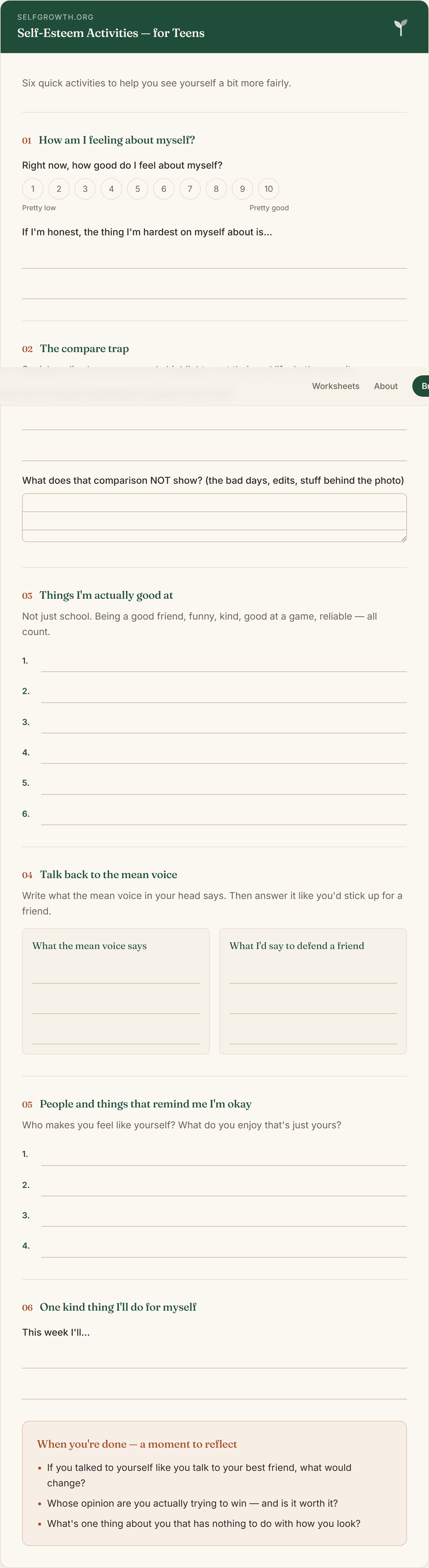
Self-Esteem (Teens)
Free, printable self-esteem worksheets and activities for teens: beat the compare trap, spot real strengths, and quiet the mean inner voice. No jargon.
Open worksheet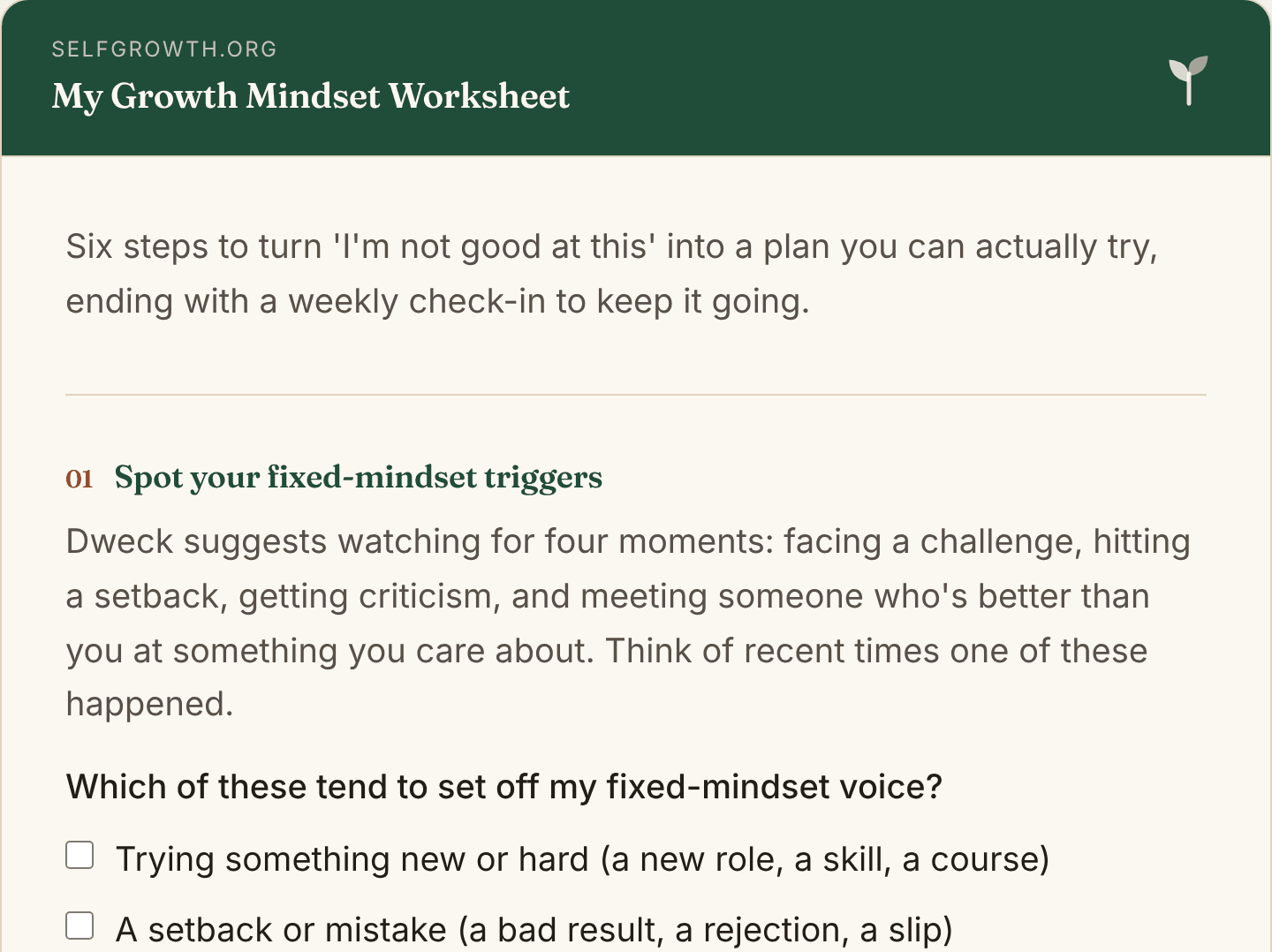
Growth Mindset Worksheet
A free, printable growth mindset worksheet for adults: spot your fixed-mindset triggers, rewrite them, plan practice, review a setback and use the power of yet.
Open worksheet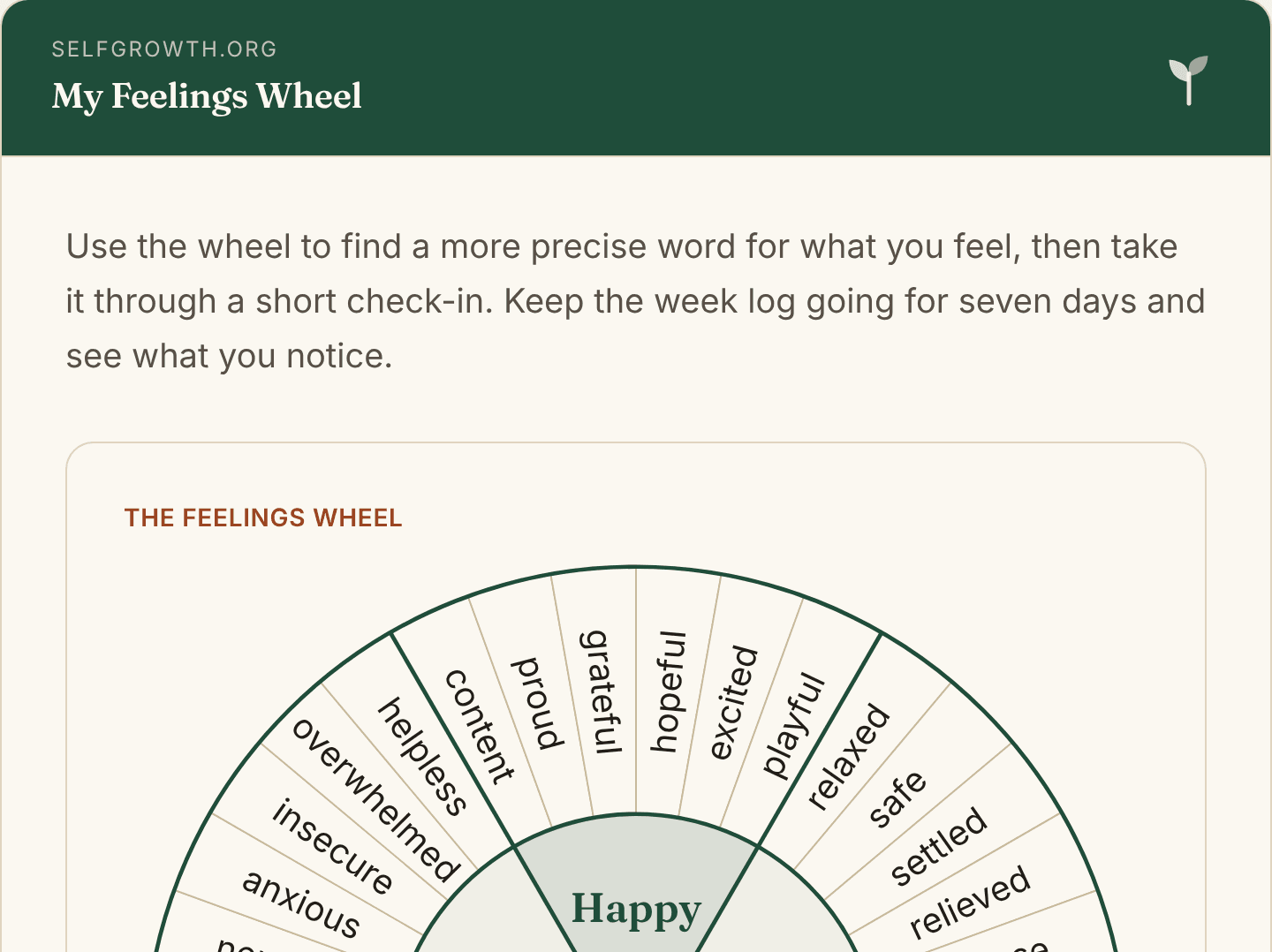
Feelings Wheel
A free feelings wheel printable and PDF: six core feelings and 36 more precise words, with a daily check-in and a week log to help you name what you feel.
Open worksheetNew worksheets, straight to your inbox
An occasional new worksheet or tool, sent only when there's something genuinely worth your time. No spam, no pressure, unsubscribe any time.