
Guide
Morning routine ideas: simple ways to start your day well
Updated 25 October 2026 · 7 min read
Good morning routine ideas are small, specific and easy to repeat: drink a glass of water, open the curtains, write down one task, or lay out clothes the night before. Pick three that fit your life, put them in order, and keep them short enough to do on a bad day.
Plain planning ideas, with habit-formation research on how long habits take · Part of habits and getting things done
Morning routine advice can sound like a list of things to cram in before breakfast. Real mornings have alarms, children, trains, and a phone that wants your attention. You need ideas that fit the time you actually have.
Below are lists of ideas for different kinds of mornings. Take what suits you and leave the rest. If you want somewhere to write your choices down, use the checklist at the end.
What makes a good morning routine?
A good morning routine is one you actually do. It points at something you want from your mornings, such as less rushing, fewer forgotten things, or a few minutes for yourself. It does not have to look like anyone else's.
Keep it small. Three to five steps is plenty. A short routine you repeat on a tired day beats a long one you drop after a week. There is no single best morning routine, so judge yours by one thing: does your morning feel a bit smoother?
Morning routine ideas that take 5 minutes
When time is short, one or two of these is enough.
- Drink a glass of water before you check your phone.
- Open the curtains or a window.
- Make your bed, or just straighten the covers.
- Write down the one thing that matters today.
- Stretch for a minute where you stand.
- Take three slow breaths before you get up.
- Put on one song you like.
- Check the weather and pick your clothes in one go.
Calm morning routine ideas
If you want to start the day slower, try one of these. They work best when you leave a little more time, even ten minutes.
- Have your first drink sitting down, without a screen.
- Leave your phone in another room until you are dressed.
- Write three lines in a notebook about how you feel or what is on your mind.
- Read a few pages of a book you enjoy.
- Sit by a window and look outside for a few minutes.
- Do a short body scan or breathing exercise.
- Play quiet music while you get ready.
A body scan script is a ready-made way to spend those few minutes.
Morning routine ideas for busy parents
With children, the morning is shared, so the best ideas make the whole house run smoother. Your own time may be a few minutes or none, and that is fine.
- Do bags, shoes and lunches the night before.
- Pick the outfits the evening before, for you and for them.
- Give each child one small job, such as putting their plate by the sink.
- Keep a fixed spot by the door for keys, bags and forms.
- Have the same simple breakfast on weekdays so there is nothing to decide.
- Take one minute alone before the household wakes, or in the bathroom, to breathe.
- Say one kind thing to your child or partner before you leave.
Morning routine ideas for work days
Work mornings go better when you know the first thing you will do. These ideas cut down the decisions between waking and starting.
- Write your top three tasks the evening before.
- Leave your first task open and ready on the screen.
- Hold off on email for the first twenty minutes of work.
- Plan your commute: a podcast, music or quiet, picked in advance.
- Pack your bag and your lunch the night before.
- Look at the day's calendar once, and note any gap for a break.
- Start with one small task you can finish, to get moving.
If your whole day needs a plan, see how to be more productive without burning out.
Slow weekend morning ideas
Weekends can have a different pace. A loose routine keeps some shape without the clock.
- Wake without an alarm if you can, then have your first drink slowly.
- Go for a walk before the day fills up.
- Cook a breakfast you do not have time for on weekdays.
- Spend twenty minutes on something you enjoy, just because.
- Look at the week ahead and pick one thing to look forward to.
- Do one small chore, then stop and enjoy the rest.
Morning routine ideas if you are not a morning person
You do not have to wake earlier to have a routine. The aim is a smoother start at the time you already get up.
- Do the work the night before, so the morning has little to do.
- Put your alarm across the room so you have to stand to turn it off.
- Keep the first step tiny: feet on the floor, then a glass of water.
- Shift your wake time by ten minutes at a time, only if you want to.
- Do one thing you enjoy before you look at your phone.
- Plan the hardest thing for later, when you feel more awake.
How to build a morning routine: step by step
Ideas only help if they become a routine. These steps turn a few of them into one.
- 1Look at your mornings as they are. Write down what happens in the first hour and what gets in the way.
- 2Decide what you want from your mornings, such as calm, being ready, or one thing for you.
- 3Pick three to five small steps from the lists above. Choose fewer than you think you need.
- 4Put them in order and tie each to the one before it, so each step prompts the next.
- 5Set up the night before: clothes, bag, breakfast, and your first task.
- 6Write a bad-morning minimum, such as water and one task, for days when everything goes wrong.
- 7Try it for two weeks, then change one thing that is not working.
The morning routine checklist has space for every step above. The evening routine checklist helps with the night-before part.
Open the Morning Routine ChecklistOpen the Evening Routine ChecklistWhy morning routines fall apart
A routine can fall apart for ordinary reasons. The list was too long. It needed a perfect start. One bad day felt like failing, so you stopped.
- Too many steps. Cut the list until it fits a tired day.
- No link between steps. Tie each one to the one before.
- Copying someone else's routine. Yours should fit your home, work and energy.
- Giving up after a missed day. A missed day is just a missed day.
- Expecting it to feel automatic quickly. It can take time.
On that last point, a 2010 study by Lally and colleagues asked 96 volunteers to repeat one chosen eating, drinking or activity behaviour each day in the same situation for 12 weeks. The time it took for the behaviour to feel automatic ranged from 18 to 254 days, and missing one opportunity did not materially affect the process. These were single behaviours, not whole morning routines, so read it as a reason to be patient with yourself.
If your routine keeps slipping, the habit tracker printable shows what is getting in the way, and habit stacking explains how to tie one habit to another.
When to get more support
Sometimes mornings are hard for a reason a routine cannot fix. If getting up feels very heavy, if you have felt low for weeks, or if poor sleep keeps going, see your GP. You do not have to be sure what is wrong before you go.
This is a self-help tool, not therapy or medical advice. If you ever feel unsafe or have thoughts of harming yourself, call Samaritans on 116 123 (UK and Ireland), 988 (US), or find a line at findahelpline.com.
Sources and further reading
This is an educational self-reflection resource, not therapy or medical advice.
If you want to go deeper
- Lally, P., van Jaarsveld, C. H. M., Potts, H. W. W. & Wardle, J. (2010). How are habits formed: Modelling habit formation in the real world. European Journal of Social Psychology, 40(6), 998-1009.
Your questions, answered
- What are some good morning routine ideas?
- Small, specific steps work best: a glass of water, opening the curtains, writing down one task, a minute of stretching, or laying out clothes the night before. Pick three that fit your life and put them in order. Short and repeatable beats long and perfect.
- How do I build a morning routine?
- Look at your mornings as they are, decide what you want from them, and choose three to five small steps. Tie each step to the one before it, set up the night before, and write a bad-morning minimum. Try it for two weeks, then change one thing.
- What is a good 5-minute morning routine?
- Drink a glass of water, open the curtains, take three slow breaths, and write down the one thing that matters today. That fits in five minutes and needs no equipment. Add a step only once those feel easy.
- What should I do the night before?
- Keep it to a few minutes. Pack your bag, set out your clothes, decide on breakfast, and write down the first task for tomorrow so you know where to start.
- How can I make mornings easier if I'm not a morning person?
- You do not need to be. Keep your current wake time and make the morning smoother: do the work the night before, keep the first step tiny, and plan the hardest thing for later in the day. A short routine at your own pace is enough.
- Is there a morning routine ideas PDF?
- Yes. The free morning routine checklist has a Download PDF button and a Print option. It is free, with no payment and no email needed. You can also fill it in on screen, and your answers save in your browser.
- Is this a substitute for therapy?
- No. It is a self-help tool, not therapy or medical advice. If low mood or poor sleep is what is really in the way of your mornings, see your GP. If you ever feel unsafe or have thoughts of harming yourself, call Samaritans on 116 123 (UK and Ireland), 988 (US), or find a line at findahelpline.com.
Worksheets to do the work
Free to fill in online or print. No email needed.
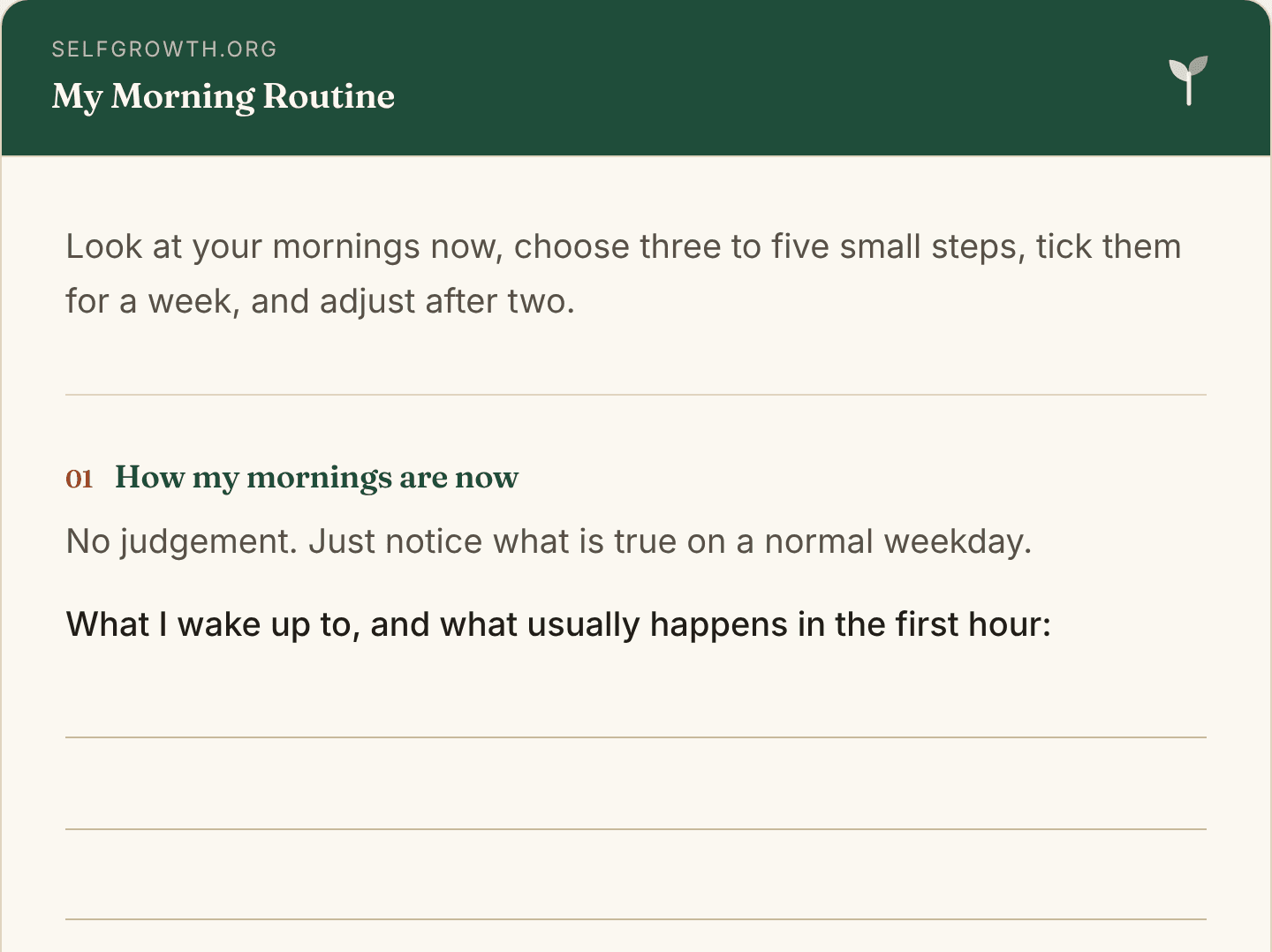
Morning Routine Checklist
A free morning routine checklist and daily routine template: pick 3 to 5 small steps, tick them for a week, plan the night before, set a bad-morning minimum.
Open worksheet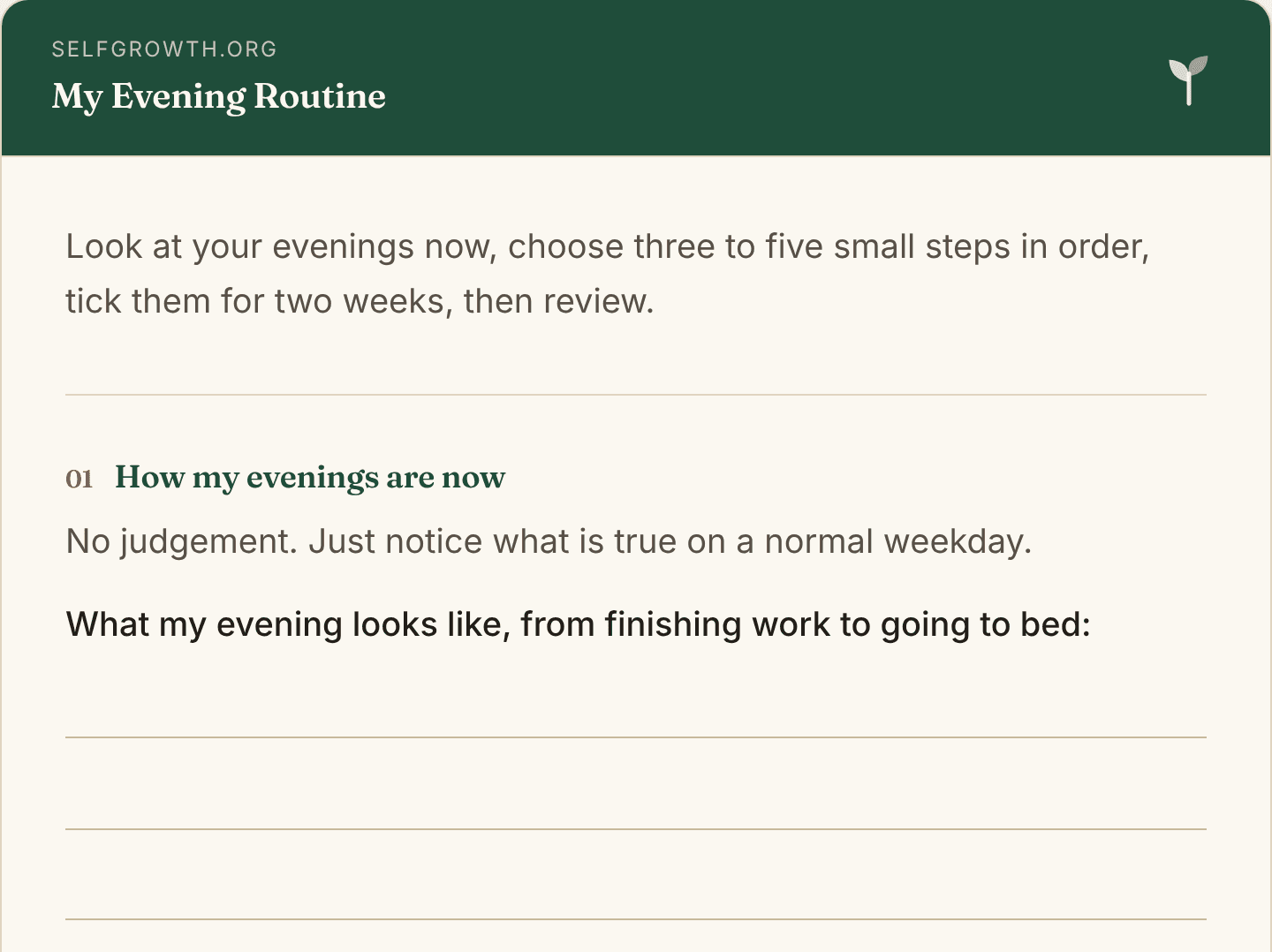
Evening Routine Checklist
A free evening routine checklist and wind down routine: pick 3 to 5 small steps, tick them for two weeks, set a tired-evening minimum, then review what to keep.
Open worksheet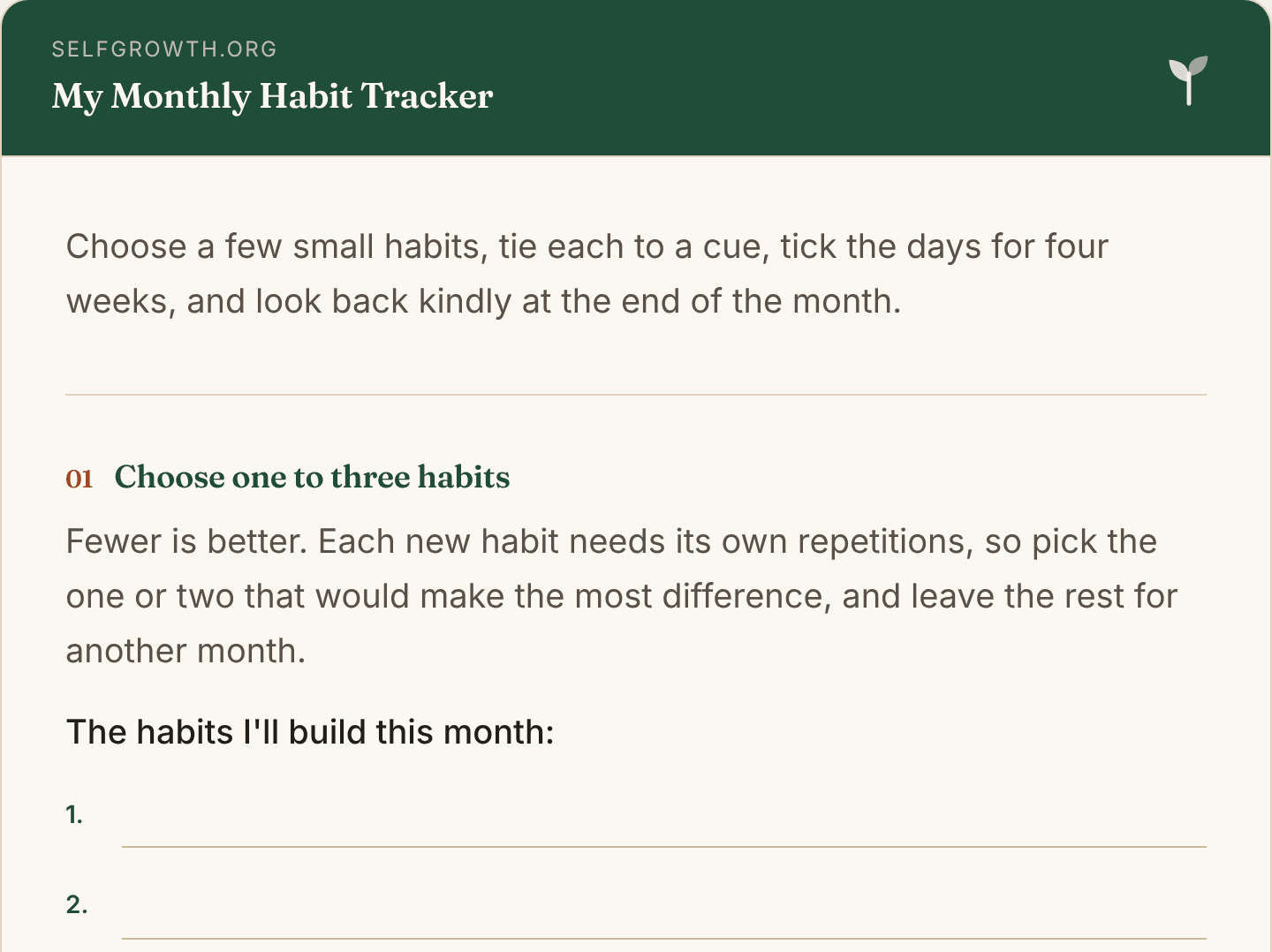
Habit Tracker Printable
A free printable habit tracker for one month: choose one to three small habits, tie each to a cue, tick the days, and review what helped. Print or fill it in.
Open worksheet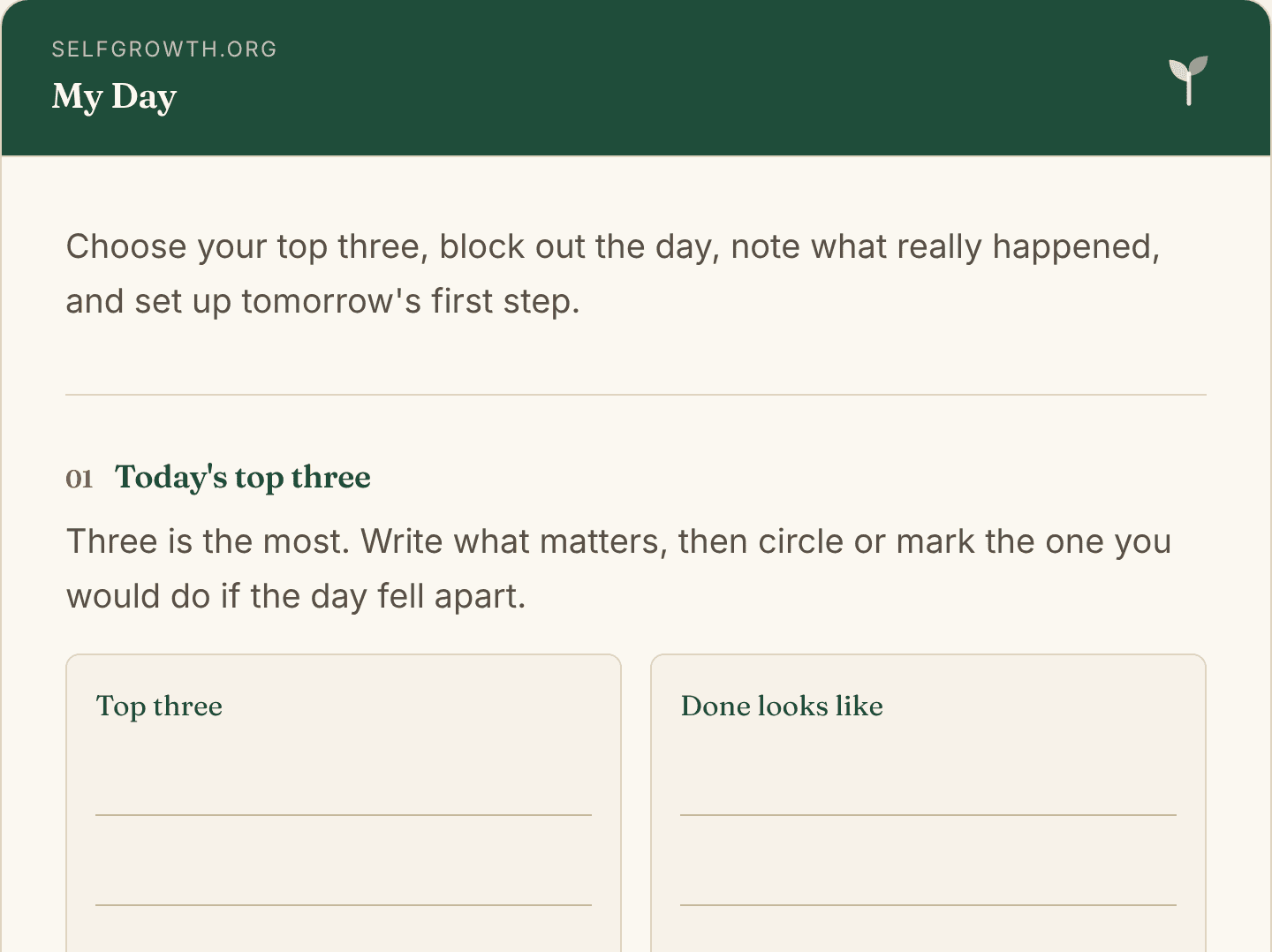
Daily Planner Template
A free daily planner template on one page: top three, time blocks, appointments, breaks, a short to-do list and a two-minute look back. Print or fill in.
Open worksheetRelated guides
New worksheets, straight to your inbox
An occasional new worksheet or tool, sent only when there's something genuinely worth your time. No spam, no pressure, unsubscribe any time.