
Guide
Mindfulness for anxiety: what it is and exercises to try
Updated 23 October 2026 · 11 min read
Mindfulness for anxiety means noticing worried thoughts and body sensations as they happen, without arguing with them or pushing them away. Try a few minutes of feeling your breath, naming what you notice, or a slow walk. It can sit alongside anxious feelings. It is not a treatment on its own, and it can sometimes make things harder.
Drawn from mindfulness-based stress reduction · Part of feelings and calm
When you are anxious, the usual advice is to calm down, stop worrying or think positive. If you could, you would have done it already. Mindfulness takes a different route. Instead of fighting the anxious feeling, you practise noticing it, with a bit of room around it.
This guide is self-help, not therapy, and it is not a treatment for an anxiety disorder.
What is mindfulness?
The NHS describes mindfulness as paying attention to what is going on inside and outside ourselves, moment by moment. That includes your thoughts, feelings and body sensations, and the world around you. You are not trying to empty your mind or feel a particular way. You are noticing what is already there.
The best-known course is mindfulness-based stress reduction (MBSR), developed by Jon Kabat-Zinn. His 1982 paper describes a weeks-long programme that used mindfulness meditation with people living with chronic pain. Courses built on the same ideas are now taught for many kinds of stress.
Mindfulness is not about getting rid of anxious feelings. It is about noticing them without being swept away.
How can mindfulness help with anxious feelings?
Anxiety can pull your attention into the future, into what might go wrong, and into your body's alarm signals. Mindfulness gives you a different job: notice where your attention has gone, and gently bring it back to something steady, like your breath, your feet or what you can hear.
The idea is not to make anxiety vanish. It is to change your relationship with it. A thought like 'something bad is going to happen' becomes 'I am having the thought that something bad is going to happen'. A racing heart becomes a sensation you can observe, rather than proof of danger. You may find that gap makes anxious moments easier to sit with. You may not. If a racing heart or chest tightness is new, or you're not sure it's anxiety, get it checked first (999 or 911, or NHS 111 if unsure).
Mindfulness is not the same as grounding, although they overlap. Grounding is a quick set of tricks to come back to the present when you feel overwhelmed; the guide to grounding techniques covers it. Mindfulness is a gentler, slower practice of noticing, built up over time.
What mindfulness exercises can you try for anxiety?
If a racing heart or chest tightness is new, or you're not sure it's anxiety, get it checked first (999 or 911, or NHS 111 if unsure). Start with the shortest, and try these when you are only mildly anxious, not in the middle of a spike. Your mind will wander. Noticing that it has wandered and gently coming back is the practice, not a sign you are doing it wrong. Stop any practice that makes you feel worse.
- 1Feel your breath for a few minutes. Sit or stand comfortably. Rest your attention on wherever you feel your breath most, such as your nostrils, chest or belly. Do not change your breathing. When you notice you have drifted into a thought, label it quietly ('thinking') and return to the breath. If focusing on breathing makes you feel more anxious, drop it and use your feet or your hands instead.
- 2Name it. When an anxious thought or feeling shows up, describe it in a short phrase: 'This is worry', 'My chest feels tight', 'I am having the thought that I will fail'. Say it in your head or on paper. You are stepping back to observe, not trying to argue the feeling away.
- 3Let thoughts pass. Imagine each thought as a leaf on a stream, a cloud, or a message on a screen. Watch it appear, then drift off. When you catch yourself following a thought, notice that, and put the next one on the stream. Keep this short at first, a couple of minutes.
- 4Do one everyday thing with full attention. Pick an ordinary task: washing up, drinking tea, brushing your teeth, walking to the bus. Notice what you see, hear, feel and smell as you do it. When your mind moves to what is worrying you, return to the task.
- 5Take a slow mindful walk. Walk slower than usual. Feel your feet meeting the ground, the swing of your legs, the air on your skin. Count a few steps to help your attention settle if you like. Do this indoors or out, for a few minutes.
If you want something longer and guided, the body scan script and the progressive muscle relaxation script are gentle options. The mindfulness worksheet helps you pick one everyday practice and keep a short log, and the anxiety journal prompts are a good way to write down what you notice afterwards.
Open the Mindfulness WorksheetCan mindfulness make anxiety worse?
Sometimes, yes. The NHS says many people find mindfulness helpful, but it is not right for everyone. A review of adverse events in meditation, by Marcelo Farias and colleagues, found that unwanted effects are not uncommon. The most common reported were anxiety, depression and unusual changes in thinking, and they could happen to people with no history of mental health problems.
Watch for these signs while you practise:
- Your anxiety or panic gets stronger rather than settling.
- You feel detached, unreal or far away from your body.
- Painful memories or images come up and feel too vivid or hard to manage.
- Sitting still with your breath or body feels unsafe rather than neutral.
If any of that happens, stop. Open your eyes, put your feet on the floor, look around and name what you can see, or do a grounding exercise such as the 5-4-3-2-1 grounding worksheet. Choose something outward-facing, like a walk or a conversation, rather than staying with your inner experience.
If you have lived through trauma, have panic attacks, or dissociate (feel cut off from yourself or your surroundings), go gently. Eyes-open practices focused outward, such as the walk or the everyday task, may be easier than closed-eyes practices focused on the body or breath. It is worth speaking to a GP before you start any regular practice, and a trained teacher or therapist can guide you.
Does mindfulness actually work for anxiety?
Honestly, it is a mixed picture, and the studies are of courses, not of single short exercises. No study tests the individual practices above on their own.
Stefan Hofmann and colleagues published a meta-analysis in 2010 (a study that pools many studies). It looked at mindfulness-based therapy for conditions including generalised anxiety disorder, depression and cancer. Anxiety and mood symptoms improved moderately from before to after treatment, and more in people who had anxiety or mood disorders. The authors called it a promising intervention. That measured change over time, so it cannot rule out that people would have improved anyway or from other things.
A stricter review by Madhav Goyal and colleagues, published in 2014, looked only at randomised trials, which are studies that assigned people to groups by chance. It found moderate evidence that anxiety eased. 'Moderate evidence' describes the strength of the evidence, not the size of the effect. The trials compared mindfulness with active treatments only, not with a control that did nothing, and the benefit was smaller at 3 to 6 months. It also found no evidence that meditation programmes were better than other active treatments, such as drugs, exercise or other behavioural therapies.
So the fair summary is: mindfulness courses look like a reasonable option that may help some people with anxiety, and they do not appear to beat other things you could do. They do not replace treatment from a GP or therapist if anxiety is taking over your life.
When to get more support
Mindfulness is a tool for everyday anxiety, not a substitute for care. Please talk to a GP if anxiety is affecting your sleep, work or relationships, if you have panic attacks that keep coming back, or if mindfulness practice makes you feel worse. A GP can talk through options, which may include talking therapies, and can rule out physical causes.
If you have chest pain or trouble breathing and are not sure whether it is panic, call 999 (UK) or 911 (US), or NHS 111 if you are unsure, rather than waiting it out.
Thoughts like these are serious: thoughts of harming yourself or ending your life, even if they feel quiet or distant. Please get help now. Call Samaritans free on 116 123 (UK and Ireland), or call or text 988 (US). Elsewhere, findahelpline.com lists free, confidential lines by country, and selfgrowth.org/help has more. If you are in immediate danger, call 999 (UK) or 911 (US).
Sources and further reading
This is an educational self-reflection resource, not therapy or medical advice.
If you want to go deeper
- Hofmann, S. G., Sawyer, A. T., Witt, A. A. & Oh, D. (2010). The effect of mindfulness-based therapy on anxiety and depression: A meta-analytic review. Journal of Consulting and Clinical Psychology, 78(2), 169-183.
- Goyal, M. et al. (2014). Meditation programs for psychological stress and well-being: A systematic review and meta-analysis. JAMA Internal Medicine, 174(3), 357-368.
- Farias, M., Maraldi, E., Wallenkampf, K. C. & Lucchetti, G. (2020). Adverse events in meditation practices and meditation-based therapies: A systematic review. Acta Psychiatrica Scandinavica, 142(5), 374-393.
- Kabat-Zinn, J. (1982). An outpatient program in behavioral medicine for chronic pain patients based on the practice of mindfulness meditation: Theoretical considerations and preliminary results. General Hospital Psychiatry, 4(1), 33-47.
- NHS (n.d.). Mindfulness. nhs.uk, Mental health: self-help.
Your questions, answered
- What is mindfulness for anxiety?
- It is the practice of noticing anxious thoughts, feelings and body sensations as they happen, without arguing with them or pushing them away. The NHS describes mindfulness as paying attention to what is going on inside and outside ourselves, moment by moment. It is a self-help skill, not a treatment for an anxiety disorder.
- What are some mindfulness exercises for anxiety?
- Feeling your breath for a few minutes, naming what you notice ('This is worry'), letting thoughts pass like clouds, doing one everyday task with full attention, and a slow mindful walk. Try them when you are only mildly anxious first. If one makes you feel worse, stop and try something outward-facing, like a walk or a grounding exercise.
- Does mindfulness work for anxiety?
- It may help some people. A 2010 meta-analysis found mindfulness-based therapy was associated with moderate improvement in anxiety from before to after treatment. A 2014 review of randomised trials found moderate evidence (that is the strength of the evidence) of improved anxiety. The trials compared mindfulness with active treatments only, not with a control that did nothing, the benefit was smaller at 3 to 6 months, and there was no evidence that it was better than other active treatments. These studies are of courses, not single short exercises.
- Can mindfulness make anxiety worse?
- For some people, yes. The NHS says it is not right for everyone, and a systematic review found unwanted effects such as increased anxiety are not uncommon. If you have trauma, panic attacks or feel detached or unreal, go gently, favour eyes-open outward practices, stop if you feel worse, and speak to a GP.
- What is the difference between mindfulness and grounding?
- Grounding is a quick way to come back to the present when you feel overwhelmed, such as 5-4-3-2-1 or cold water on your hands. Mindfulness is a gentler, slower practice of noticing your thoughts, feelings and sensations without judging them. They overlap, and in a panic, a quick grounding exercise is a simpler place to start.
- Is mindfulness a substitute for therapy?
- No. This guide is self-help, not therapy or medical advice. If anxiety is getting in the way of your life, please see a GP. If you ever feel unsafe or have thoughts of harming yourself, call Samaritans on 116 123 (UK and Ireland), call or text 988 (US), or find a line at findahelpline.com.
- Are the mindfulness worksheets free, and is there a PDF?
- Yes. They are free, with no payment and no email needed. Use the Download PDF button on each worksheet for a print-ready copy, or fill it in on screen.
Worksheets to do the work
Free to fill in online or print. No email needed.
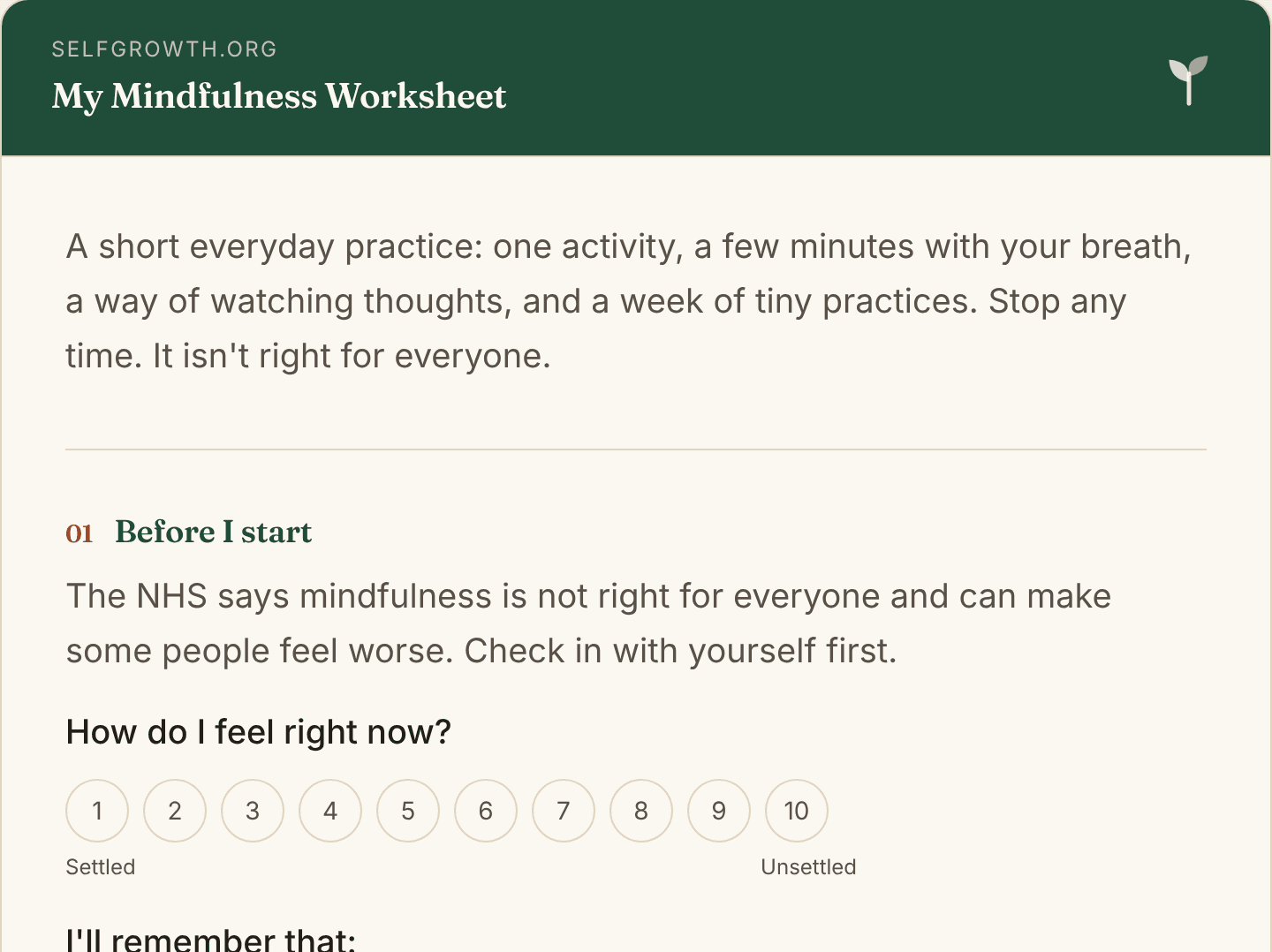
Mindfulness Worksheet
A free mindfulness worksheet: one everyday activity, a few minutes with your breath, a way to watch thoughts and a week of tiny practices. Not for everyone.
Open worksheet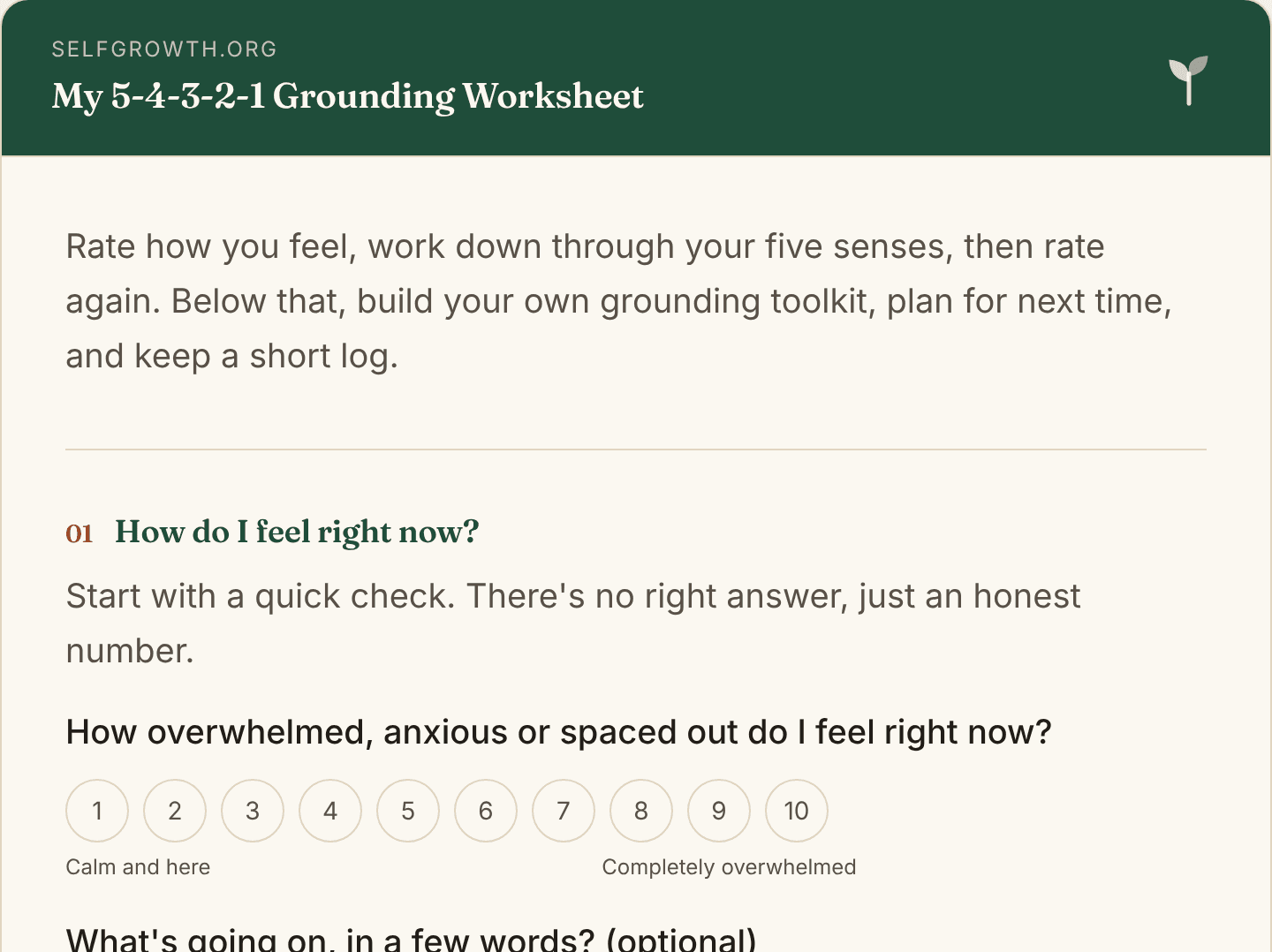
5-4-3-2-1 Grounding Worksheet
A free, printable 5-4-3-2-1 grounding worksheet: rate how you feel, work through your five senses, re-rate, then build your own toolkit and plan for next time.
Open worksheet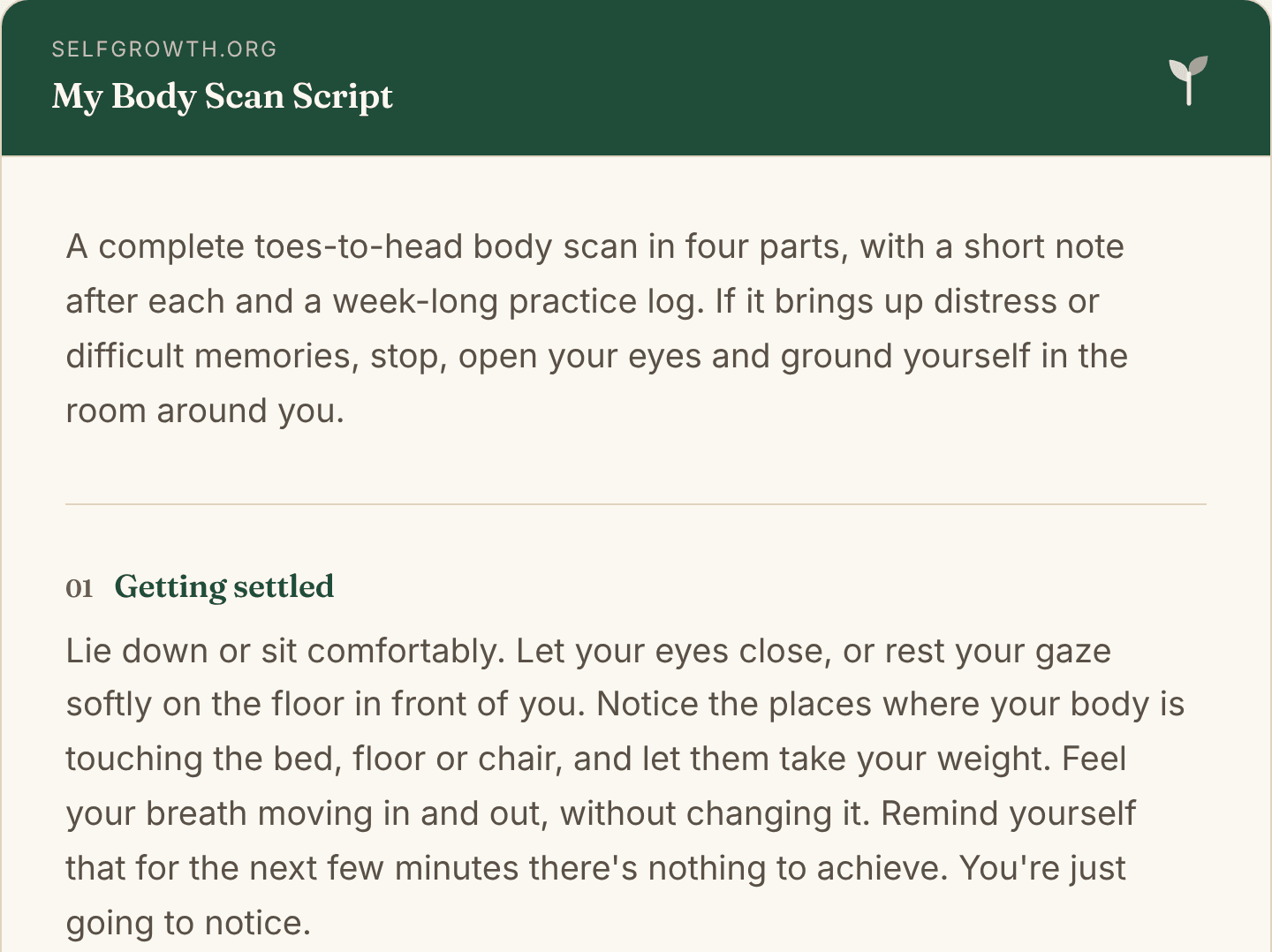
Body Scan Script
A free body scan meditation script in plain English: move your attention slowly from toes to head, noticing without changing, with reflection prompts and a log.
Open worksheet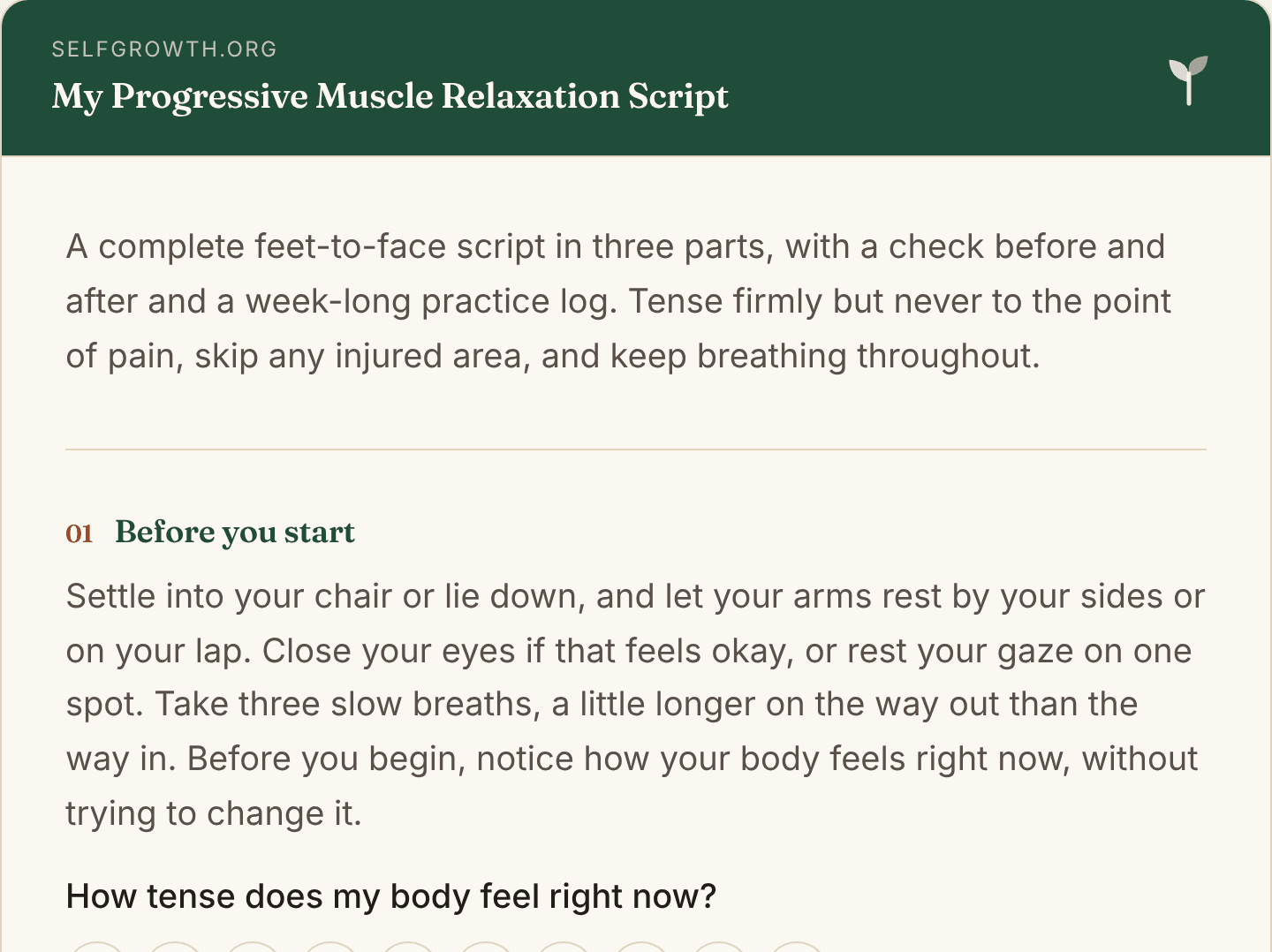
Progressive Muscle Relaxation Script
A free progressive muscle relaxation script in plain English: tense and release 13 muscle groups from feet to face, with a before-and-after check and 7-day log.
Open worksheet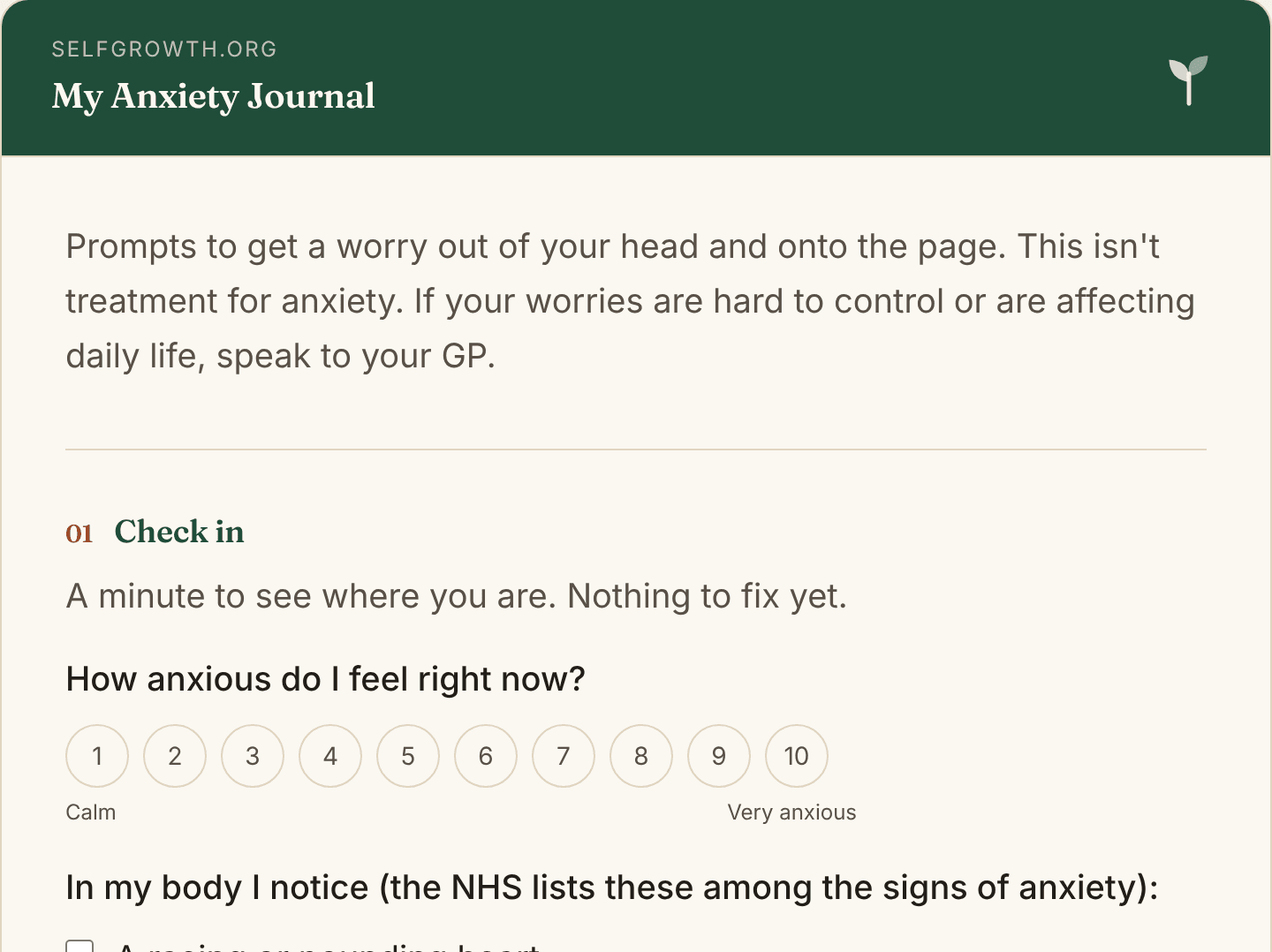
Anxiety Journal Prompts
Free anxiety journal prompts: name the worry, sort what you can influence, note what helped before and pick one small step. Not treatment. Free printable PDF.
Open worksheetRelated guides
New worksheets, straight to your inbox
An occasional new worksheet or tool, sent only when there's something genuinely worth your time. No spam, no pressure, unsubscribe any time.