
Journaling
Year in review template 2026: a free printable to look back and plan ahead
Updated 17 October 2026 · 9 min read · Free to print
A year in review template helps you look back at the year honestly before you plan the next one. This free printable asks what went well, what was hard, what gave you energy, what you learned and what you want to keep, change or let go of. It ends with three small intentions and a first step.
By the Self Growth team · drawn from reflective writing and gratitude research · how we make these
Fill it in here (it saves in this browser, but not in a private window), print it, or download the PDF. Free, no sign-up.
The end of a year can feel like a pile-up. You're tired, the days blur together, and 'what did I even do?' is a fair question. A year in review is a way to answer it kindly. Instead of judging the year on one number, you look at the whole of it: the good days, the hard ones, and what they showed you.
This template goes in six short parts. You look back at what happened, then at what gave you energy and what drained it. Next you pull out what you learned and what you're grateful for. Then you decide what to keep, change or let go of. Last, you choose three small intentions for the year ahead, with a first step for each. It's meant to be reused, so it works at the end of any year.
Be fair to yourself as you go. Some years are mostly good and some are mostly about getting through. Both count. If this year held a loss, a diagnosis or a change you didn't choose, you don't have to find a silver lining. You can write 'it was hard' and leave it there.
This is a self-reflection tool, not therapy. If looking back brings up a lot of pain, stop and be gentle with yourself. If low mood, grief or worry has been with you for weeks, please talk to your GP or a mental health professional. If you're in crisis, call Samaritans on 116 123 (UK and Ireland), call or text 988 (US), or find a helpline at findahelpline.com.
How to use this worksheet
- 1Set aside an hour, or do a section a day. Pick a time you won't be rushed, with a drink and something to write with.
- 2Look at your calendar, photos or messages from the year if that helps. That way the whole year is in front of you, not just the last few weeks.
- 3Write in your own words and keep it short. A few words are enough.
- 4Choose a few intentions, not a long list. Keep the finished sheet somewhere you'll see it, and look at it again in a few months.
The worksheet
selfgrowth.org
My Year in Review
Look back at the year honestly, learn what you can from it, then choose what comes with you into the next one. Be as kind to yourself as you would be to a friend.
01Looking back
Start with what happened. Scroll through your photos or calendar if you need a prompt.
The moments I'm glad I had this year:
What was hard this year:
Something I did that I didn't think I could:
Something I'm proud of, big or small:
Someone who made a difference to my year, and how:
Overall, how did this year feel?
02What gave me energy, and what drained it
Think about where your time and attention went. Be specific: people, places, jobs, habits, even apps.
Entry 1
Entry 2
Entry 3
Entry 4
Entry 5
Something I want to give more of my time to:
Something I want to give less of my time to:
03What I learned
Something I learned about myself:
Something I learned about other people, or about life:
A mistake or setback I can learn from, written kindly:
Something that surprised me:
What I'd tell myself at the start of the year:
04Things I'm grateful for
Gratitude isn't about pretending everything was fine. It's about noticing what was good alongside what wasn't.
Five things, people or moments I'm grateful for from this year:
- 1.
- 2.
- 3.
- 4.
- 5.
05Keep, change, let go
Decide what comes with you into the next year.
Entry 1
Entry 2
Entry 3
Entry 4
06Looking ahead: three small intentions
An intention is a direction, not a promise to be perfect. Choose a few and make each one specific. For each, write a first step you could take in the next week.
Entry 1
Entry 2
Entry 3
What might get in the way, and what I'll do if it does:
Who I could tell, so I'm not doing it alone:
The date I'll look at this sheet again:
When you're done, a moment to reflect
- If I read this as a friend's year, what would I say to them?
- What do I notice when I put the energy list next to how I spent my time?
- Is there anything I'm carrying into the next year that I could put down now?
- Which one intention would make the biggest difference if it was the only one I kept?
- What would make this year a good one, in my own terms, regardless of what I achieve?
Does a year in review help?
Honestly, we don't know of any trial of a year-in-review template, so we can't promise it will change anything. What we can point to is research on two of its parts.
The first is writing about things that matter to you. In 2006, Joanne Frattaroli pooled 146 randomised studies in which people wrote or talked about personal, meaningful topics. On average the effect was positive, but small. Those studies weren't about year-end reviews, so they say little about this template, other than that putting your experience into words is not a waste of time.
The second is the gratitude section. In three studies, Robert Emmons and Michael McCullough (2003) found that people who listed things they were grateful for had higher well-being than comparison groups on several measures, though not all. The most consistent result was more positive feelings. They were mostly self-reported measures, and one of the three studies was in people with neuromuscular disease. We include a short gratitude list because it's easy, not because it will fix a hard year.
The rest, the energy columns, keep-change-let-go and the first step, are plain-English prompts, not a tested method. If you'd like help choosing what to aim for, the goal-setting worksheet goes further, and if your list of strengths is thin, the strengths list worksheet is a good place to start. If the year was one of self-criticism, the guide to self-compassion may help you read it more kindly.
These are educational self-reflection tools, not therapy. See our editorial standards.
If you want to go deeper
- Frattaroli, J. (2006). Experimental disclosure and its moderators: A meta-analysis. Psychological Bulletin, 132(6), 823-865.
- Emmons, R. A. & McCullough, M. E. (2003). Counting blessings versus burdens: An experimental investigation of gratitude and subjective well-being in daily life. Journal of Personality and Social Psychology, 84(2), 377-389.
Your questions, answered
- What is a year in review?
- It's a look back at the year before you plan the next. You write down what happened, what you learned, what gave you energy and what drained it, and what you want to keep, change or let go of. It can turn a blur of days into something you can learn from.
- How do I do a personal year in review?
- Set aside an hour, or a section a day. Look at your calendar, photos or messages to remind yourself what happened, then work through the template: looking back, energy, what you learned, gratitude, keep-change-let-go, and three small intentions for the year ahead. Write short answers and be as kind as you would be to a friend.
- What questions should I ask in a year in review?
- Good ones include: What moments am I glad I had? What was hard? What gave me energy, and what drained it? What did I learn about myself? What do I want to keep, change or let go of? What one small step could I take next week? This template has all of these in order.
- When is the best time to do a year in review?
- The last weeks of the year suit it, but there's no rule. A birthday, the end of a school or work year, or any quiet week works just as well. The template is written so you can use it at the end of any year.
- Does reflecting on your year actually help?
- It may help, though we know of no trial of this exact template. Research on writing about personal, meaningful topics (a 2006 review of 146 randomised studies by Joanne Frattaroli) found a positive but small average effect, and a series of studies by Robert Emmons and Michael McCullough found gratitude exercises improved some measures of well-being, though not all. Treat both as a gentle suggestion, not a guarantee.
- Is this year in review template free, and is there a PDF?
- Yes. It's free, with no payment and no email needed. Use the Download PDF button for a print-ready copy, or fill it in on screen and your answers save in your browser.
- Is a year in review a substitute for therapy?
- No. It's an educational self-reflection tool, not therapy or medical advice. If looking back stirs up pain that doesn't ease, or you've felt low or anxious for weeks, please speak to your GP or a mental health professional. In a crisis, call Samaritans on 116 123 (UK and Ireland), call or text 988 (US), or find a helpline at findahelpline.com.
Keep going, related worksheets

Goal-Setting Worksheet
A free, printable goal-setting worksheet that turns a vague wish into a specific goal, a when-and-where plan, and a first step you'll actually take this week.
Open worksheet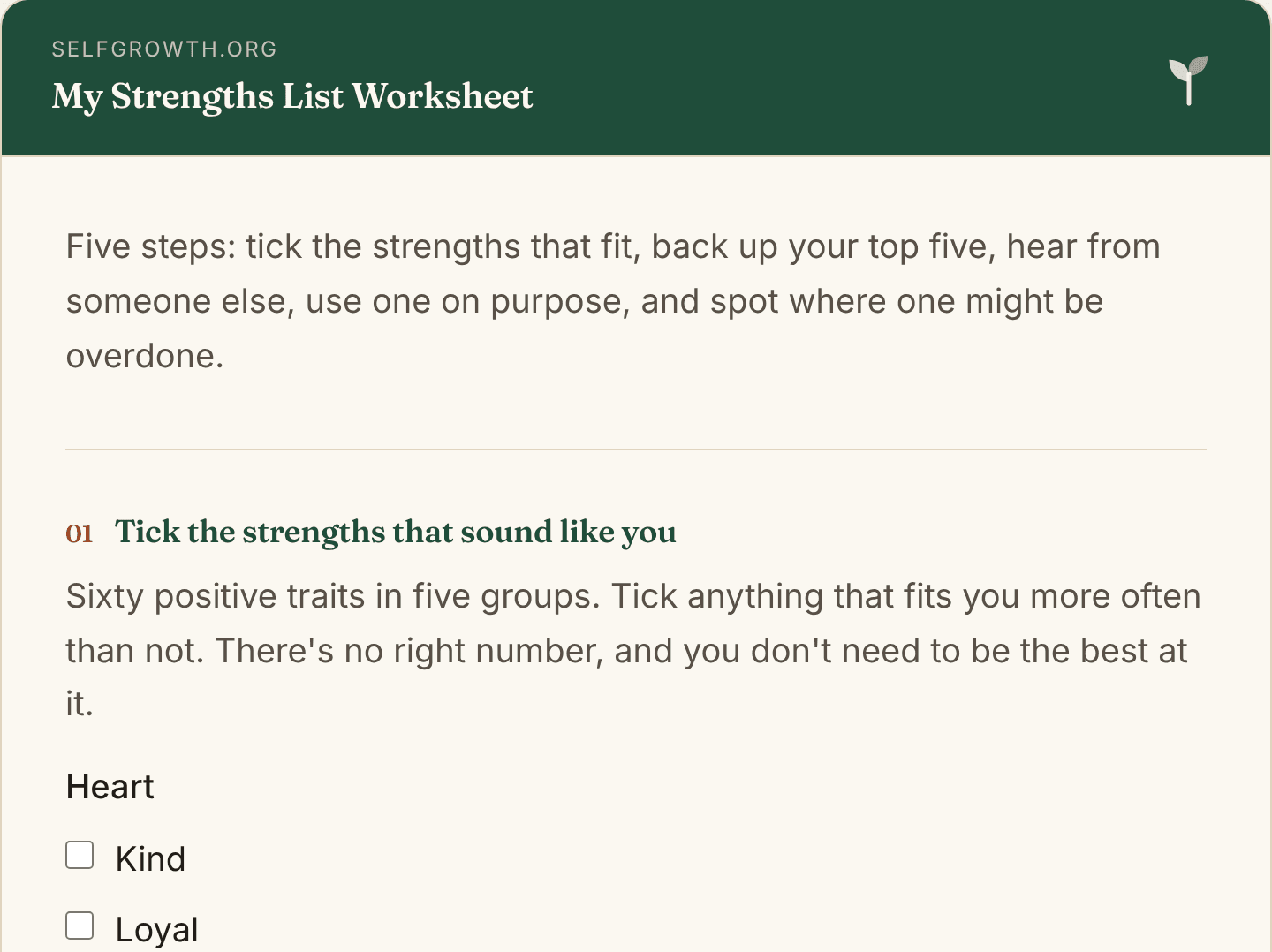
Strengths List Worksheet
A free list of 60 positive character traits and strengths to tick, with space for evidence, what others see in you and one strength to use on purpose this week.
Open worksheet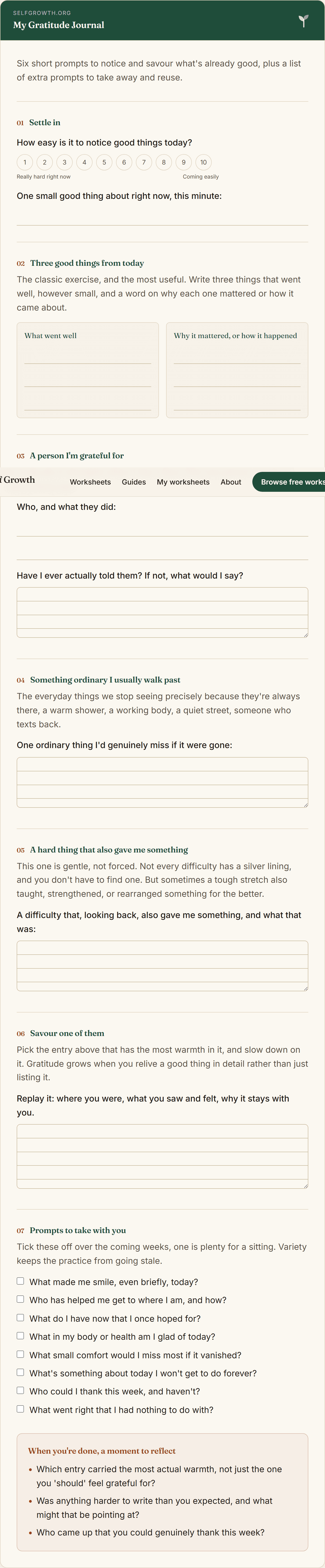
Gratitude Journal Prompts
Free, printable gratitude journal prompts: guided questions with space to write, plus a take-away list, to help you notice and savour what's already good.
Open worksheetNew worksheets, straight to your inbox
An occasional new worksheet or tool, sent only when there's something genuinely worth your time. No spam, no pressure, unsubscribe any time.