
Emotions
Wise mind worksheet: place a decision between emotion and reason
Updated 23 October 2026 · 6 min read · Free to print
Wise mind is the balance between emotion mind, where feelings steer, and reasonable mind, where facts and logic steer. The idea comes from dialectical behaviour therapy (DBT). This free worksheet helps you place one decision across all three states and notice how wise mind feels in your body.
An idea from dialectical behaviour therapy (DBT) · Part of feelings and calm
Fill it in here (it saves in this browser, but not in a private window), print it, or download the PDF. Free, no sign-up.
Some decisions get made by the feeling alone: you send the message, quit the job, say yes to keep the peace. Others get made by the spreadsheet alone, and leave you with a nagging sense that something was missed. Wise mind is a name for the place between the two, where what you feel and what you know are both taken seriously.
The idea is taught in dialectical behaviour therapy (DBT), a therapy developed by Marsha Linehan, as part of its mindfulness skills. DBT calls the three states emotion mind, reasonable mind and wise mind. This page gives you a worksheet to try the idea on something real in your life.
This is a few ideas borrowed from DBT, not DBT, and not therapy. DBT is a full treatment delivered by trained clinicians. The worksheet will not fix a deep problem, but it can slow a decision down enough for you to see it from more than one side.
How to use this worksheet
- 1Pick one real decision or situation, ideally something small to medium for a first go. Avoid starting with the biggest thing in your life.
- 2Write the emotion mind and reasonable mind sides honestly, even the parts that feel unreasonable or cold. Neither side is the wrong one.
- 3Do not force an answer. If wise mind is quiet today, write 'not clear yet' and come back after sleep or a walk.
- 4Keep the body cues section. Over a few goes you learn what wise mind feels like for you, which is more useful than the label.
The worksheet
selfgrowth.org
My wise mind worksheet
Name the situation, place it across emotion mind and reasonable mind, look for wise mind, notice your body, and try a short practice.
01The situation
Thoughts of harming yourself are serious. If this decision is about your safety, or you are having thoughts of harming yourself, put safety first and talk to someone now before using a worksheet: Samaritans 116 123 (UK and Ireland), 988 (US), or findahelpline.com. Also, if the other person in the situation frightens or controls you, this is not the tool to use. See the helplines page (selfgrowth.org/help).
What is the decision or situation? Just the facts, in a few lines.
How strong is the emotion right now?
02Emotion mind
Emotion mind is when feelings and urges are in charge. It is not bad: it holds what matters to you. Write what it is saying, without tidying it up.
What am I feeling? (name as many as you can)
What does the feeling want me to do, right now?
What does this feeling tell me matters to me?
03Reasonable mind
Reasonable mind is when facts, plans and logic are in charge. It is useful too, but on its own it can leave out what you care about. Write what it would say if feelings were not in the room.
The facts I am sure of
- 1.
- 2.
- 3.
What would a sensible, practical person say to do?
What might this side be leaving out?
04Looking for wise mind
Wise mind is the overlap: you have heard both sides and you are not being pushed by either. It can feel like a quiet sense of knowing. Do not hunt for it. Read what you wrote above, take three slow breaths, then ask.
What do the two sides have in common?
If I took both seriously, what would I do? (or: not clear yet)
How settled does this feel?
Is there a small step I can take today, and a bigger one that can wait?
05How wise mind feels in my body
Bodies give hints. Emotion mind might feel hot, tight or fast. Reasonable mind might feel flat or detached. Wise mind may feel steadier, but everyone is different. Tick what you notice, and add your own.
What emotion mind feels like in my body:
What wise mind feels like in my body:
06A short practice, and a log
Try this for a minute or two when you are not in a crisis. Sit comfortably and breathe slowly. On each out-breath, quietly ask yourself, 'What do I feel, and what do I know?' You do not need an answer. Just notice what comes. If your mind wanders, return to the breath without scolding yourself. If you have a medical reason to avoid breathing exercises, skip it. Then log it.
Entry 1
Entry 2
Entry 3
Entry 4
When you're done, a moment to reflect
- When you make a poor decision, is it from the feeling alone, the logic alone, or something else?
- What would you want a friend to remember about this situation?
- Which side did you find harder to write: emotion mind or reasonable mind? What might that tell you?
- What is one thing that helps you slow down before you act?
- Is there part of this that needs another person's view, a GP or a counsellor rather than more thinking?
Done for now?
Save today's answers as a dated entry. You can come back, fill it in again and compare the two side by side.
Does the wise mind exercise work?
Dialectical behaviour therapy was developed by the psychologist Marsha Linehan at the University of Washington. Wise mind, emotion mind and reasonable mind are taught as part of its mindfulness skills.
DBT as a whole therapy has trial evidence. A 1991 randomised trial by Linehan and colleagues compared a year of DBT with ordinary community treatment in women with borderline personality disorder. The DBT group had fewer episodes of self-harm or suicide attempts and fewer psychiatric inpatient days. There was no difference between the groups on depression, hopelessness or suicidal thinking. It was for women with borderline personality disorder and tested the whole therapy, not one skill.
It says little about a single concept used alone on a printed page. The wise mind exercise by itself has not been well tested, so please treat this as a thinking aid. The log is there so you can judge for yourself whether it helps.
These are educational self-reflection tools, not therapy.
If you want to go deeper
- Linehan, M. M., Armstrong, H. E., Suarez, A., Allmon, D. & Heard, H. L. (1991). Cognitive-behavioral treatment of chronically parasuicidal borderline patients. Archives of General Psychiatry, 48(12), 1060-1064.
- Linehan, M. M. DBT Skills Training Manual. Guilford Press. The manual teaches mindfulness, interpersonal effectiveness, emotion regulation and distress tolerance skills.
Your questions, answered
- What is wise mind?
- Wise mind is the balance between emotion mind, where feelings drive your choices, and reasonable mind, where facts and logic drive them. It is a concept taught in dialectical behaviour therapy (DBT) as part of its mindfulness skills. The idea is that both feelings and facts count, and a decision made with both in view is steadier.
- What are emotion mind, reasonable mind and wise mind?
- Emotion mind is when your feelings and urges are in charge. Reasonable mind is when facts, planning and logic are in charge. Wise mind is where the two overlap and you can weigh both. None of the three is a personality. Everyone moves between them, and the point is to notice which one is driving.
- How do you find your wise mind?
- Write what each side is saying, take a few slow breaths, then ask what you would do if you took both seriously. Look for body cues too, such as slower breathing or a steadier chest. If nothing is clear, that is an answer: wait, sleep on it or talk it through with someone you trust.
- Does the wise mind exercise work?
- DBT as a whole therapy has been tested in trials. In a 1991 randomised trial by Linehan and colleagues, women with borderline personality disorder had fewer episodes of self-harm or suicide attempts and fewer psychiatric inpatient days than with ordinary community treatment, but no difference on depression, hopelessness or suicidal thinking. That tested the whole therapy, not one skill. Wise mind used on its own, as a worksheet, has not been well tested, so we cannot promise it works. Treat it as a way to slow down and check your own experience.
- Is wise mind the same as intuition or a gut feeling?
- Not quite. A gut feeling can be emotion mind in disguise, such as fear or wishful thinking. Wise mind is described as coming after you have listened to both feelings and facts. A useful test is whether the sense of knowing is steady and calm, or urgent and pushy.
- Is there a wise mind worksheet PDF?
- Yes. Use the Download PDF button for a clean, print-ready copy, or Print to print straight from the page. It is completely free, with no payment and no email needed. You can also fill it in on screen, and your answers save in your browser.
- Is this worksheet a substitute for therapy?
- No. It is a self-help tool borrowing an idea from DBT, which is a full therapy given by trained professionals. It is not therapy or medical advice. If you feel stuck, overwhelmed or unsafe, talk to a GP or a therapist. If you ever have thoughts of harming yourself, call Samaritans on 116 123 (UK and Ireland), 988 (US), or find a line at findahelpline.com.
Keep going, related worksheets
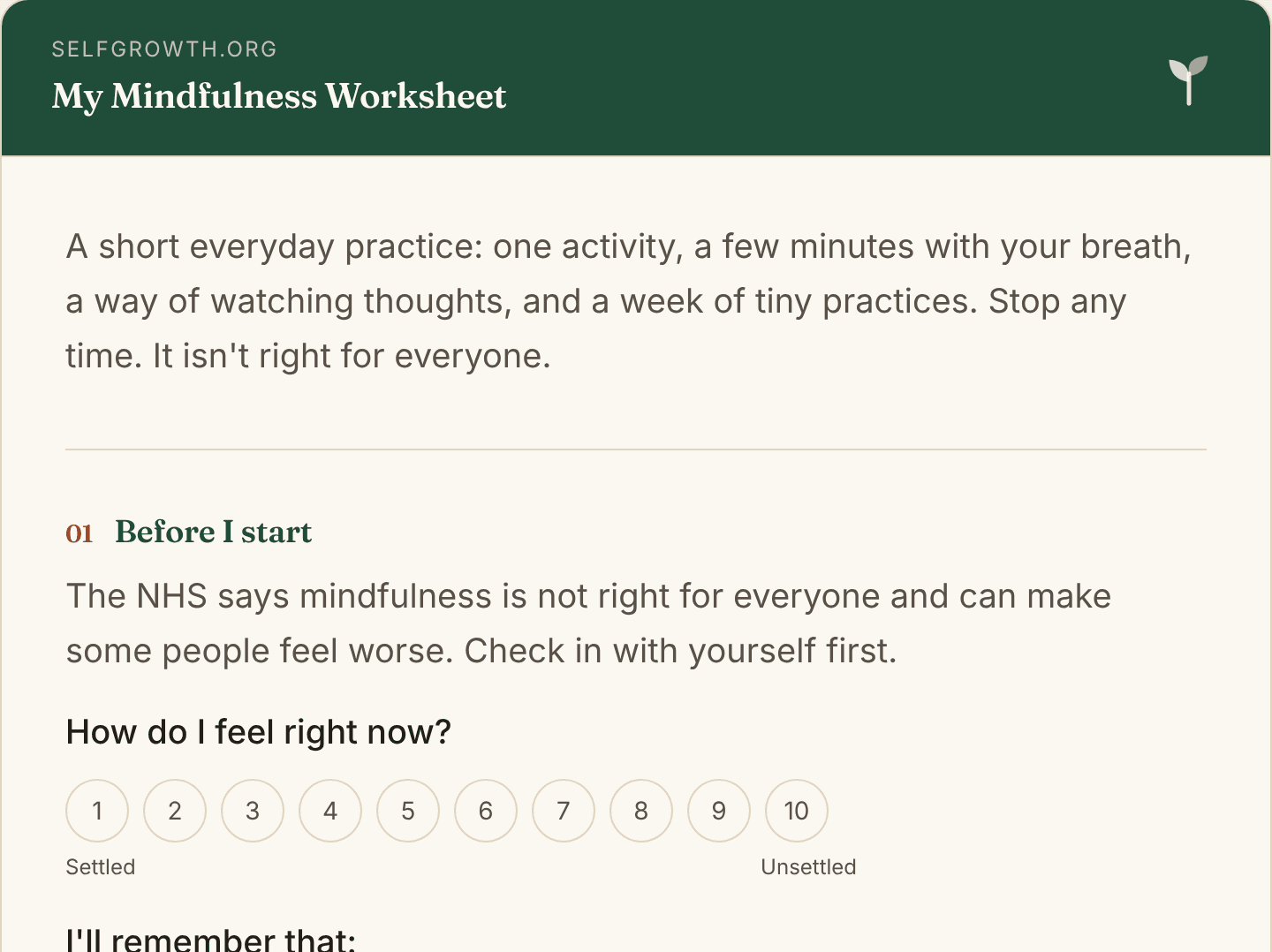
Mindfulness Worksheet
A free mindfulness worksheet: one everyday activity, a few minutes with your breath, a way to watch thoughts and a week of tiny practices. Not for everyone.
Open worksheet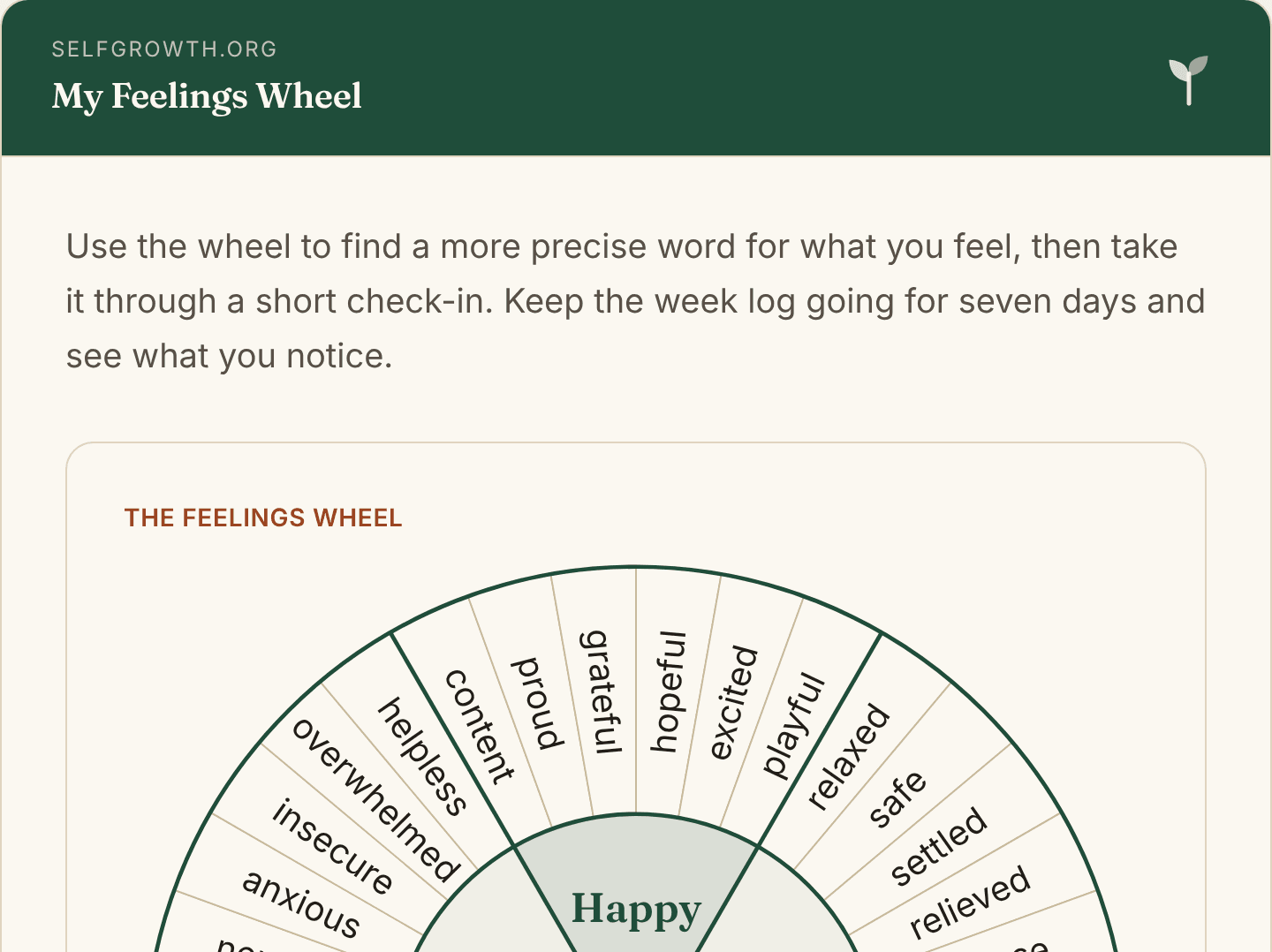
Feelings Wheel
A free printable feelings wheel (emotion wheel) PDF: six core feelings and 36 more precise words, with a daily check-in and a week log to name what you feel.
Open worksheet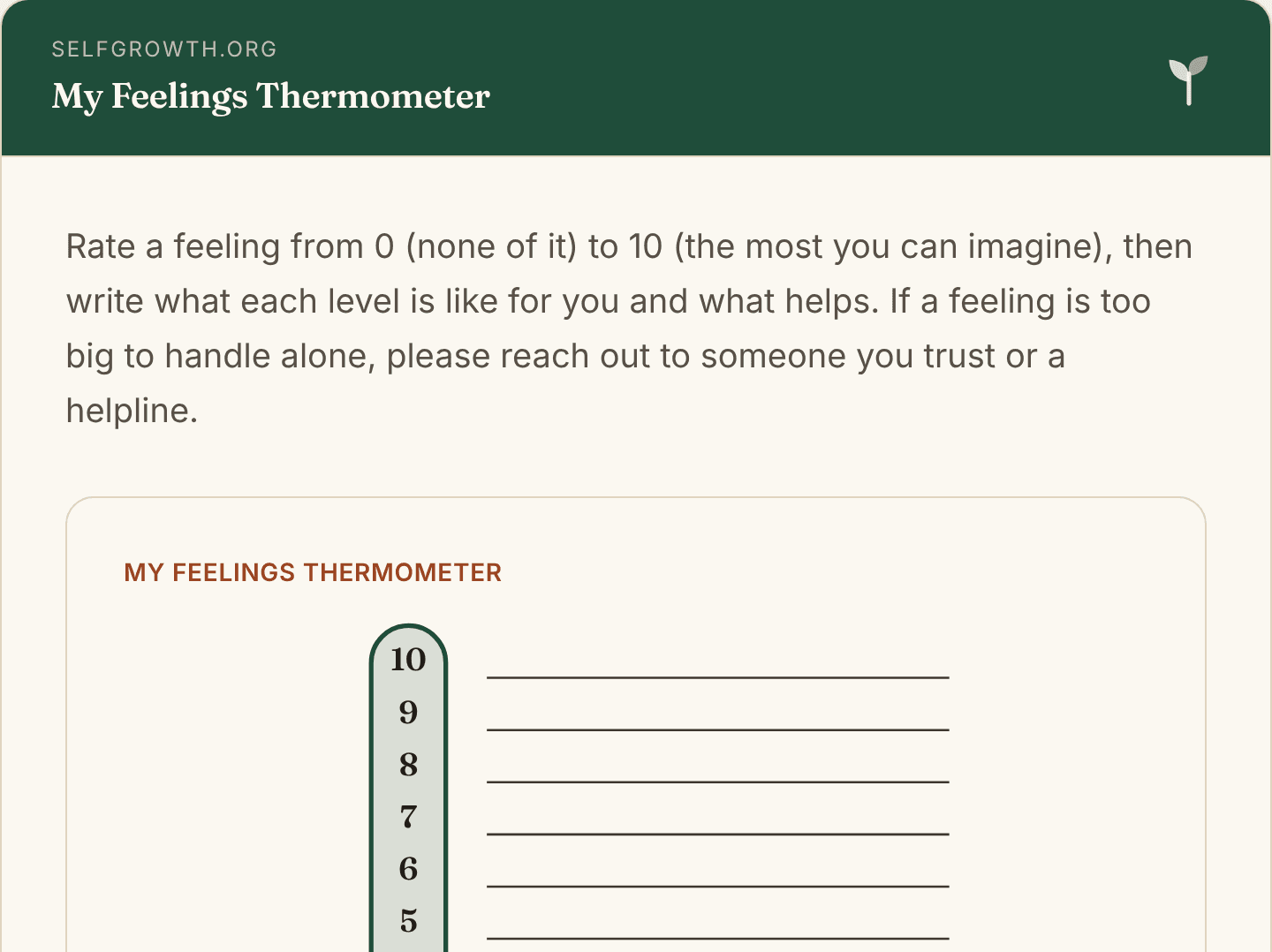
Feelings Thermometer
A free feelings thermometer: rate any feeling from 0 to 10, write what each level is like for you, and plan what helps. Works for adults and older kids. Free PDF.
Open worksheetNew worksheets, straight to your inbox
An occasional new worksheet or tool, sent only when there's something genuinely worth your time. No spam, no pressure, unsubscribe any time.