
Self-awareness
Feelings thermometer: a free printable 0 to 10 scale for any feeling
Updated 17 October 2026 · 6 min read · Free to print
A feelings thermometer is a 0 to 10 scale for how strong a feeling is, where 0 is none and 10 is the most you can imagine. Pick a feeling, rate it, then write what each level feels like for you and what helps there. This free printable works for any feeling, for adults and older children.
By the Self Growth team · drawn from emotion-labelling research · how we make these
Fill it in here (it saves in this browser, but not in a private window), print it, or download the PDF. Free, no sign-up.
Some feelings arrive as a whisper and some as a flood. When you're in the middle of one, it can be hard to tell how big it really is, or whether it's rising or settling. A number can help. Saying 'I'm at a 6' is easier to act on than 'I feel awful'.
A feelings thermometer gives the feeling a size. You choose the feeling (worry, sadness, stress, irritation, even excitement), rate it from 0 to 10, and then fill in the levels in between with your own signs: what your body does, what your mind says, what you tend to do. Over time you may start to spot a 4 before it becomes an 8, while you still have more choices.
A 10 isn't 'bad' and a 0 isn't 'good'. The number is only information, and there's no right answer. You can use it as an adult, or with a teenager or older child. With a younger child, sit alongside them and let them pick the words.
This is a self-reflection tool, not therapy. If a strong feeling is staying with you for days, getting in the way of sleep, work or relationships, or you're thinking about harming yourself, please talk to your GP or a mental health professional. If you're in crisis, call Samaritans on 116 123 (UK and Ireland), call or text 988 (US), or find a helpline at findahelpline.com. The helplines page on this site lists more countries.
How to use this worksheet
- 1Pick one feeling to measure. You can come back and do another feeling on a fresh copy.
- 2Rate it right now, then build your own thermometer. The numbers matter less than the words you choose for each level.
- 3Fill in what turns the number up and what turns it down. Be specific, and be kind to yourself.
- 4Use the week of readings to check in once or twice a day. Allow about 15 minutes to set it up, and a minute for each reading.
The worksheet
selfgrowth.org
My Feelings Thermometer
Rate a feeling from 0 (none of it) to 10 (the most you can imagine), then write what each level is like for you and what helps. If a feeling is too big to handle alone, please reach out to someone you trust or a helpline.
0 is none of the feeling and 10 is the most you can imagine. Write what each level is like for you beside it, or use the table below.
01Pick a feeling and rate it
Choose one feeling. If you aren't sure what to call it, the feelings wheel can help you find a word.
The feeling I'm measuring (for example worry, sadness, stress, irritation, excitement):
What's going on right now:
My number right now, from 0 (none) to 10 (the most I can imagine):
02Build my thermometer
Fill in what each stretch of the scale is like for you. Think about your body (a tight chest, a hot face, heavy legs), your thoughts, and what you do (go quiet, snap, pace, scroll). Then write what helps at that level.
Entry 1
Entry 2
Entry 3
Entry 4
Entry 5
The number where it gets hard for me to think clearly or choose what I do:
03What moves my number
Think about the last few times this feeling went up or came down. What was going on?
Entry 1
Entry 2
Entry 3
Entry 4
04Try something and check again
Pick one thing from the list or add your own. Do it for a few minutes, then rate the feeling again. It may not move, and that is useful to know too.
Things I could try:
What I tried, and my number before and after:
05A week of readings
Check in once or twice a day for a week. A line or two is plenty. You're looking for patterns, not for a perfect score.
Entry 1
Entry 2
Entry 3
Entry 4
Entry 5
Entry 6
Entry 7
When you're done, a moment to reflect
- What do I notice first when this feeling starts to climb: my body, my thoughts or what I do?
- Is there a time of day, a person or a place where my number tends to be higher?
- What number could I catch it at, so that I still have choices?
- What would I say to a friend who told me they were at a 7?
Does putting a name to a feeling help?
Honestly, we don't know of any trial of a feelings thermometer worksheet, so we can't promise it works. The idea is simple: rate the feeling, spot your early signs, and decide in advance what you'll do at each level. What research there is points the same way as the first half of the sheet, which is putting the feeling into words.
In a set of four lab studies (Lieberman and colleagues, 2011), people who labelled the emotion they felt while looking at upsetting pictures reported less distress than people who simply watched them. The effect was similar to two other ways of coping, reappraisal (looking at the picture differently) and distraction. People in the study guessed labelling would make them feel worse, so it can feel odd to try. With pleasant pictures, labelling was linked to less reported pleasure, so naming a feeling may dampen it whichever way it points. These were short experiments with pictures, not everyday feelings, so treat them as a hint.
The 0 to 10 number and the table of levels are our own plain-English design, not a tested programme. If anger is the feeling you most want to work on, the anger management worksheet has a thermometer with a time-out plan. If you can't find the word for what you feel, start with the feelings wheel.
These are educational self-reflection tools, not therapy. See our editorial standards.
If you want to go deeper
- Lieberman, M. D., Inagaki, T. K., Tabibnia, G. & Crockett, M. J. (2011). Subjective responses to emotional stimuli during labeling, reappraisal, and distraction. Emotion, 11(3), 468-480.
Your questions, answered
- What is a feelings thermometer?
- It's a simple scale for how strong a feeling is, here from 0 to 10. You write what each level feels like for you, in your body, thoughts and actions, and what helps there. It turns a vague 'I feel awful' into a number and a plan you can use in the moment.
- What is the difference between a feelings thermometer and an anger thermometer?
- A feelings thermometer works for any feeling, including worry, sadness, stress and excitement. An anger thermometer is built around one feeling and ends in a time-out plan. If anger is the one you're working on, the anger management worksheet on this site has an anger thermometer with a time-out plan.
- Is there a free printable feelings thermometer?
- Yes. Use the Download PDF button for a print-ready copy with a blank 0 to 10 thermometer at the top of the sheet, or Print to print straight from the page. It's free, with no payment and no email needed. You can also fill it in on screen, and your answers save in your browser.
- How do I use an emotion thermometer with a child?
- Sit beside them and keep it light. Let them choose the feeling and the words for each level, and keep it to a few levels if 0 to 10 is too many. Your job is to listen, not to correct. Fill in your own at the same time if they would like that. For a very young child or a big worry, a GP or school can point you to proper support.
- Does putting a name to a feeling help?
- We know of no trial of a feelings thermometer or of rating feelings with numbers. There is some lab research on putting feelings into words, which is the first half of this sheet: in studies by Matthew Lieberman and colleagues, people who named what they felt reported less distress than people who just looked at upsetting pictures. Those studies used pictures, not worksheets, so treat it as a hint rather than proof.
- Is a feelings thermometer a substitute for therapy?
- No. It's an educational self-reflection tool, not therapy or medical advice. If a strong feeling lasts for days, keeps you awake, gets in the way of daily life, or you feel hopeless, please speak to your GP or a mental health professional. In a crisis, call Samaritans on 116 123 (UK and Ireland), call or text 988 (US), or find a helpline at findahelpline.com.
Keep going, related worksheets
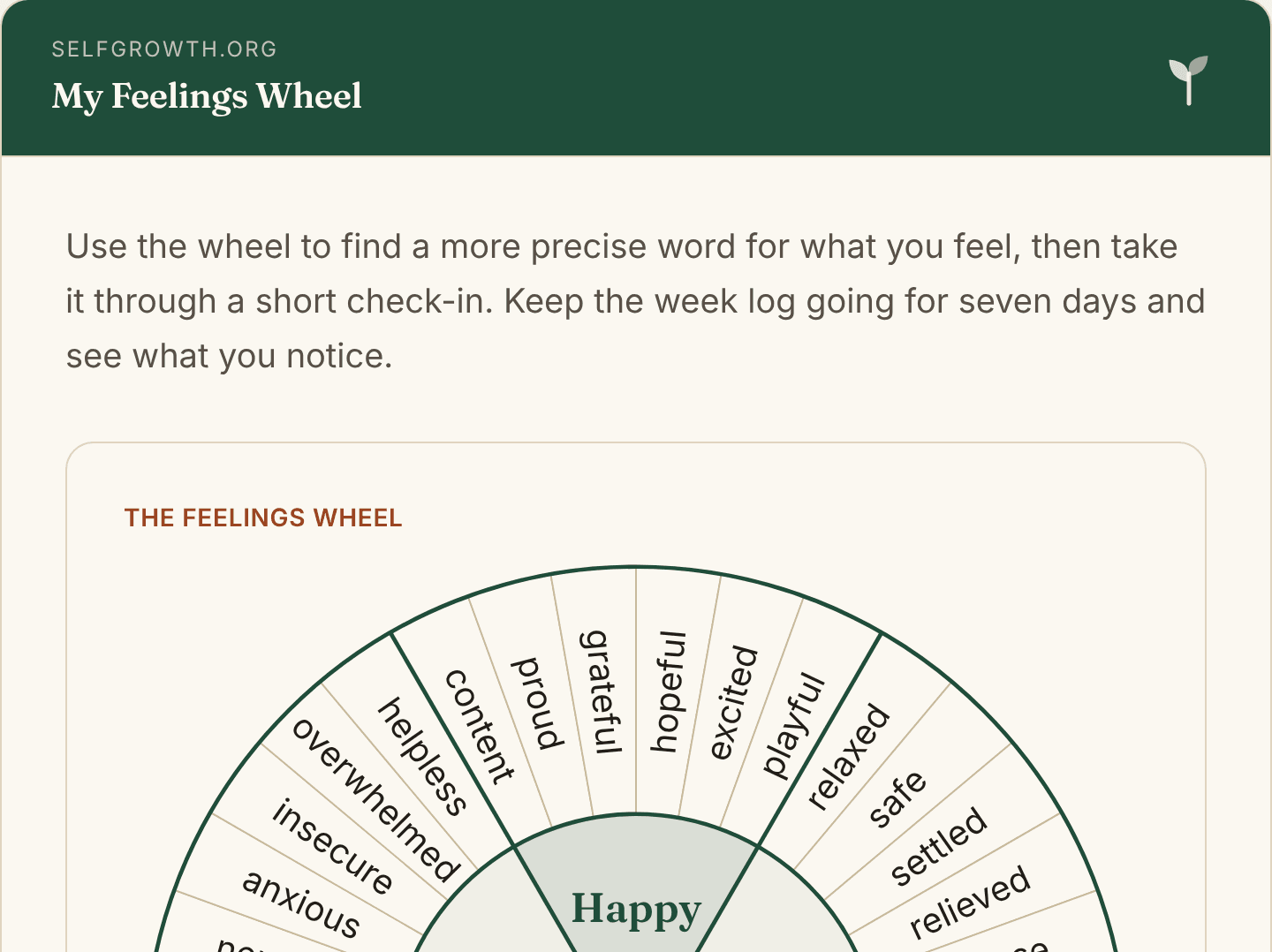
Feelings Wheel
A free printable feelings wheel (emotion wheel) PDF: six core feelings and 36 more precise words, with a daily check-in and a week log to name what you feel.
Open worksheet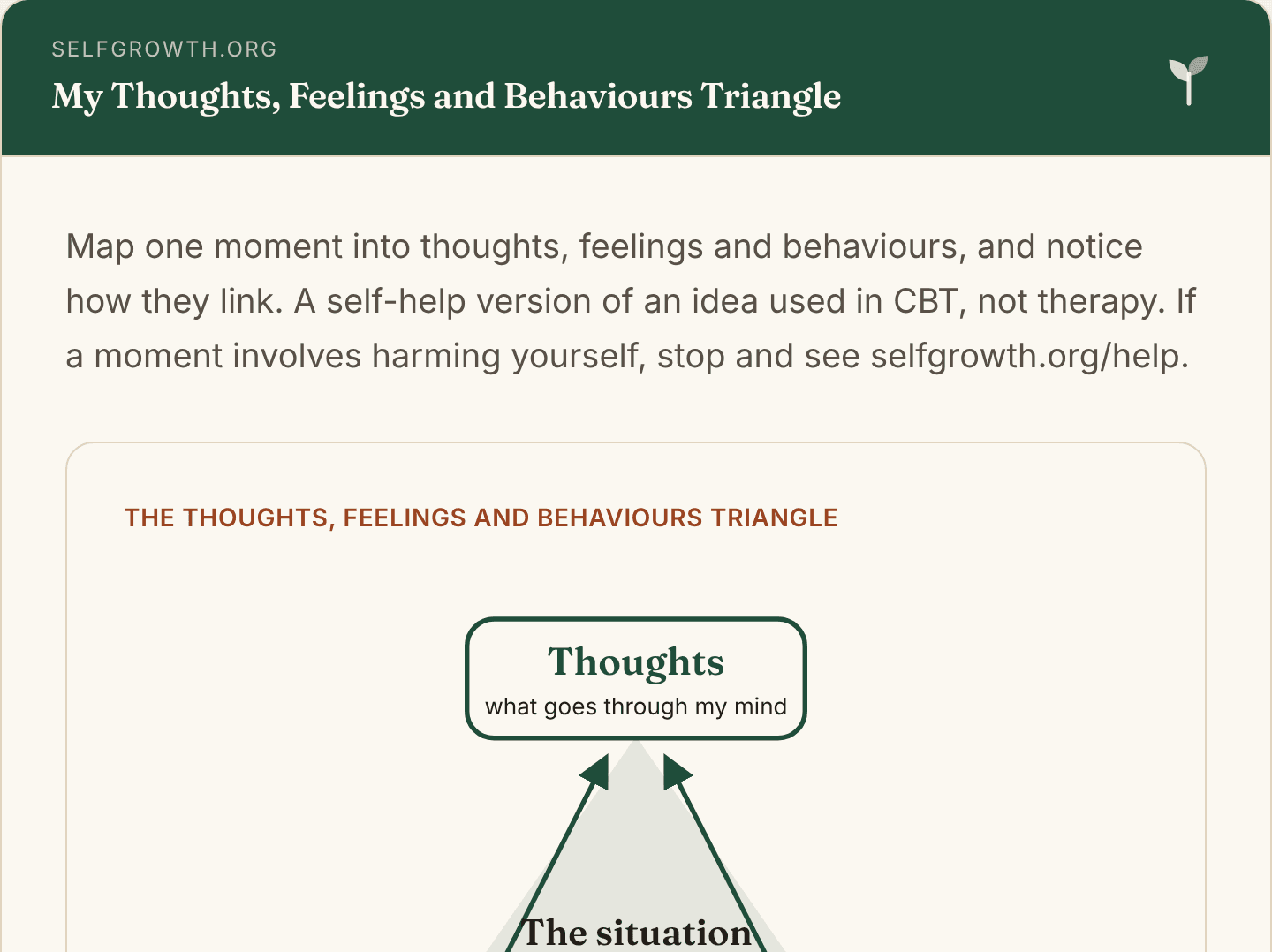
CBT Triangle Worksheet
Free CBT triangle worksheet: map one moment into thoughts, feelings and behaviours and see how they link. Self-help, not therapy. Free printable PDF.
Open worksheet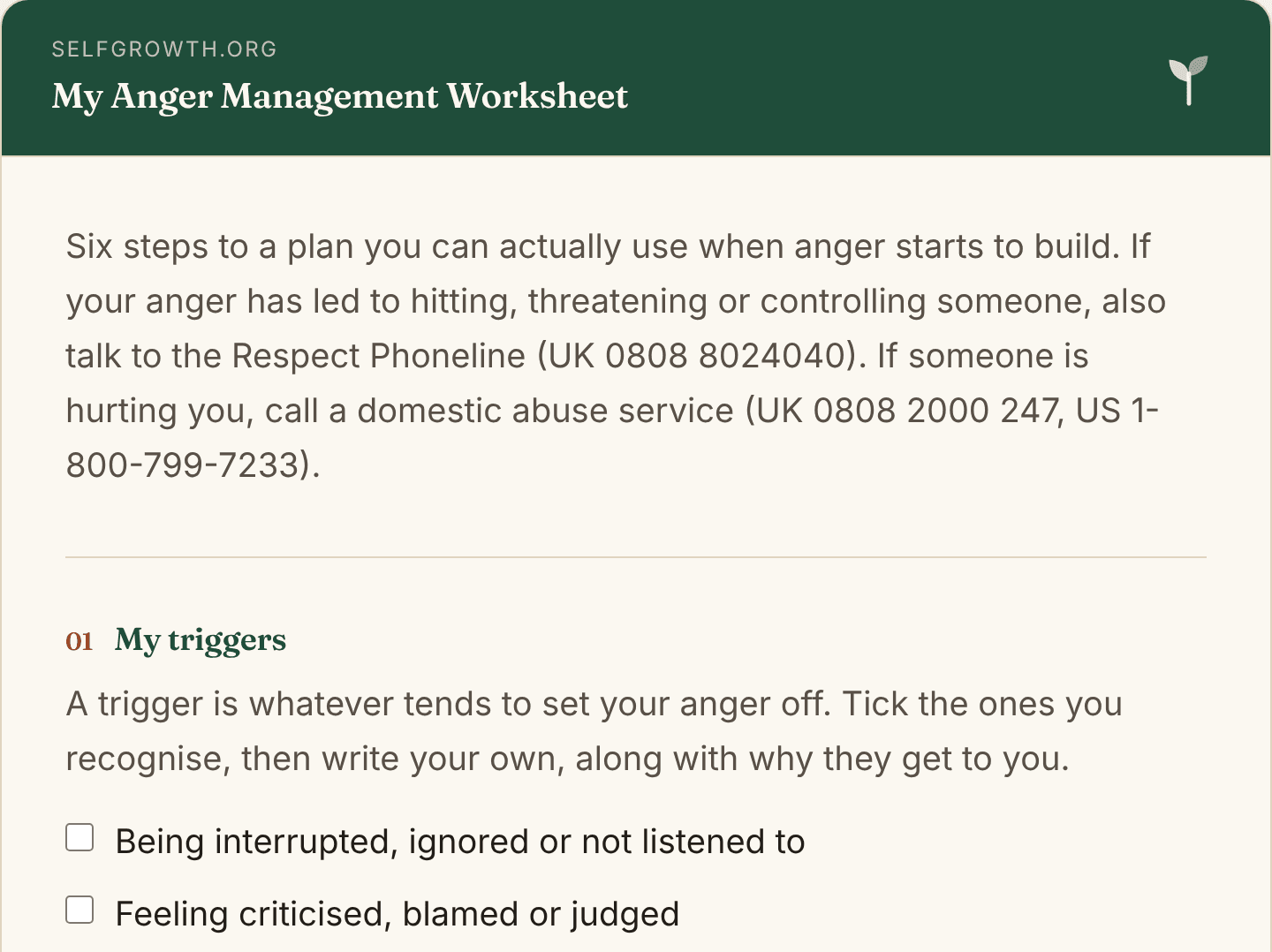
Anger Management Worksheet
A free anger management worksheet for adults: your triggers, an anger thermometer with your own warning signs, a time-out plan and calming skills. Free PDF.
Open worksheetNew worksheets, straight to your inbox
An occasional new worksheet or tool, sent only when there's something genuinely worth your time. No spam, no pressure, unsubscribe any time.