
Self-awareness
Sentence completion worksheet: free printable prompts to get to know yourself
Updated 17 October 2026 · 8 min read · Free to print
A sentence completion worksheet gives you the first half of a sentence, such as 'I feel most like myself when...', and you finish it in your own words. This free printable has about 30 stems on you, your feelings, your relationships and your future. There's no scoring and no right answer, and it is not a clinical test.
By the Self Growth team · a self-reflection exercise based on the sentence-stem format · how we make these
Fill it in here (it saves in this browser, but not in a private window), print it, or download the PDF. Free, no sign-up.
Sometimes you don't know what you think until you start writing. A blank page can feel too big, but half a sentence is easy to finish. 'I feel most like myself when...' and the words can come before you've had time to edit them.
That is all this worksheet is. It gives you stems and you finish them. There's nothing to add up, no type to land on and no right answer. Skip any you don't want to answer. Write the first honest thing that comes, then move on, and come back later if you want to go deeper.
One thing to be clear about: you may have heard of sentence completion tests that psychologists use. This is not one of them. Those are assessment tools, given and interpreted by a trained professional. Here, you're the only reader and you decide what your answers mean. We don't score them, and we can't tell you what they say about you.
This is a self-reflection tool, not therapy. Some stems may bring up something painful. If they do, stop, and be gentle with yourself. If feelings stay heavy, talk to your GP or a mental health professional. If you're in crisis, call Samaritans on 116 123 (UK and Ireland), call or text 988 (US), or find a helpline at findahelpline.com.
How to use this worksheet
- 1Work through it in one sitting, or one section at a time. Allow about 30 minutes for all of it.
- 2Finish each stem quickly, with the first honest thing that comes to mind. You can change it later.
- 3Skip any stem you don't want to answer. Leaving a blank is fine.
- 4Printed sheets may be seen by others, so keep it somewhere private, or leave out anything you'd rather not have on paper.
- 5Read your answers back once you're done and notice anything that stands out. There's no score and no meaning to look up. If something stays with you, the reflection questions at the end can help you think it through.
The worksheet
selfgrowth.org
My Sentence Completion Worksheet
Finish each sentence in your own words. There are no right answers, and nothing here is scored. Skip any stem you don't want to answer, and stop if something feels too heavy.
01About me
Start with the easy ones. Say what's true, not what sounds good.
I feel most like myself when...
One thing people might not know about me is...
I'm good at...
People who know me well would say I am...
I'm happiest when I'm...
02How I feel
Feelings aren't right or wrong. Just name them.
Lately I've been feeling...
What worries me most is...
I feel calm when...
I get frustrated when...
Something I'd like to feel more often is...
03What matters to me
Your values and what you're drawn to.
What matters most to me is...
I lose track of time when...
I admire people who...
I'd like to spend more time on...
I'd like to spend less time on...
04Me and other people
How you are with the people in your life. Leave out anyone you'd rather not write about.
I feel supported when...
I find it hard to ask for...
I wish people understood that I...
When someone I care about is upset, I usually...
Something I'd like to say to someone, but haven't, is...
05Looking after myself
When I'm struggling, what helps me is...
I'm hardest on myself about...
A kinder thing I could say to myself is...
I need more...
I'm proud that I...
06Looking ahead
In a year, I'd like to be...
Something I'd like to try is...
What's holding me back is...
One small step I could take this week is...
I'm looking forward to...
When you're done, a moment to reflect
- Which stem was easiest to finish? Which was hardest, or the one I skipped?
- Was there an answer that surprised me when I read it back?
- Is there anything I wrote that I'd like to look at again in a month?
- Is there a stem I'd like to write more about on a blank page?
- What do I want to do with what I wrote: nothing, keep it, or talk it over with someone I trust?
Do sentence completion exercises help?
Sentence stems are an old and simple format. Psychologists have long used sentence completion tests as assessment tools, where a person finishes partial sentences and a trained professional interprets the answers. A survey of practitioners found the Rotter Incomplete Sentences Blank was the one they used most often, and that most didn't use formal scoring (Holaday, Smith and Sherry, 2000). A 2026 review of 51 studies of two such tests found the tests were fairly consistent and measured what they aimed to measure (called reliability and validity), but results varied widely with who was tested and how the answers were read (Ryan Coleman and colleagues). This worksheet borrows the format only. It isn't one of those tests, and it makes no attempt to score or interpret what you write.
What about the benefit of writing things down? A 2006 review by Joanne Frattaroli pooled 146 randomised studies in which people wrote or talked about personal, meaningful topics. It found a positive average effect, but a small one. Those studies asked people to write about personal, meaningful topics, so they don't test this worksheet. We don't know of any trial that does. It's reasonable to treat the worksheet as a nudge to think, not a treatment.
If you'd like to go further, the self-reflection worksheet and the who am I worksheet go deeper on the same ground, and the self-awareness guide explains where to start. If you want something more open, the self-discovery journal prompts leave more room to write.
These are educational self-reflection tools, not therapy. See our editorial standards.
If you want to go deeper
- Holaday, M., Smith, D. A. & Sherry, A. (2000). Sentence completion tests: A review of the literature and results of a survey of members of the Society for Personality Assessment. Journal of Personality Assessment, 74(3), 371-383.
- Coleman, R. and colleagues (2026). Sentence completion tests with an empirical foundation: A systematic review. Assessment (doi:10.1177/10731911261430262).
- Frattaroli, J. (2006). Experimental disclosure and its moderators: A meta-analysis. Psychological Bulletin, 132(6), 823-865.
Your questions, answered
- What is a sentence completion worksheet?
- It's a page of unfinished sentences, such as 'I feel most like myself when...', that you finish in your own words. It's a way to get your thoughts and feelings onto paper without facing a blank page. This one is for self-exploration only. It has no scoring and no right answers.
- Is this the same as a sentence completion test?
- No. Sentence completion tests, such as the Rotter Incomplete Sentences Blank, are assessment tools that psychologists use and interpret. This worksheet is not a test. It doesn't score or interpret your answers, and it can't tell you anything about your personality or mental health. You are the only one who decides what your answers mean.
- What are examples of sentence stems for self-exploration?
- 'I feel most like myself when...', 'What matters most to me is...', 'I get frustrated when...', 'I find it hard to ask for...', 'When I'm struggling, what helps me is...' and 'One small step I could take this week is...'. This worksheet has about 30, in six groups.
- Do sentence completion exercises help?
- Writing about personal, meaningful things has been tested a lot. A 2006 review of 146 randomised studies by Joanne Frattaroli found a positive but small average effect. Those studies asked people to write or talk about meaningful topics, and weren't about this exact worksheet, so treat it as a gentle suggestion rather than a promise.
- Is there a free sentence completion worksheet PDF?
- Yes. Use the Download PDF button for a print-ready copy, or Print to print straight from the page. It's free, with no payment and no email needed. You can also fill it in on screen, and your answers save in your browser.
- Is this worksheet a substitute for therapy?
- No. It's an educational self-reflection tool, not therapy or medical advice, and it can't diagnose anything. If something you write brings up distress that doesn't ease, or you feel hopeless, please speak to your GP or a mental health professional. In a crisis, call Samaritans on 116 123 (UK and Ireland), call or text 988 (US), or find a helpline at findahelpline.com.
Keep going, related worksheets
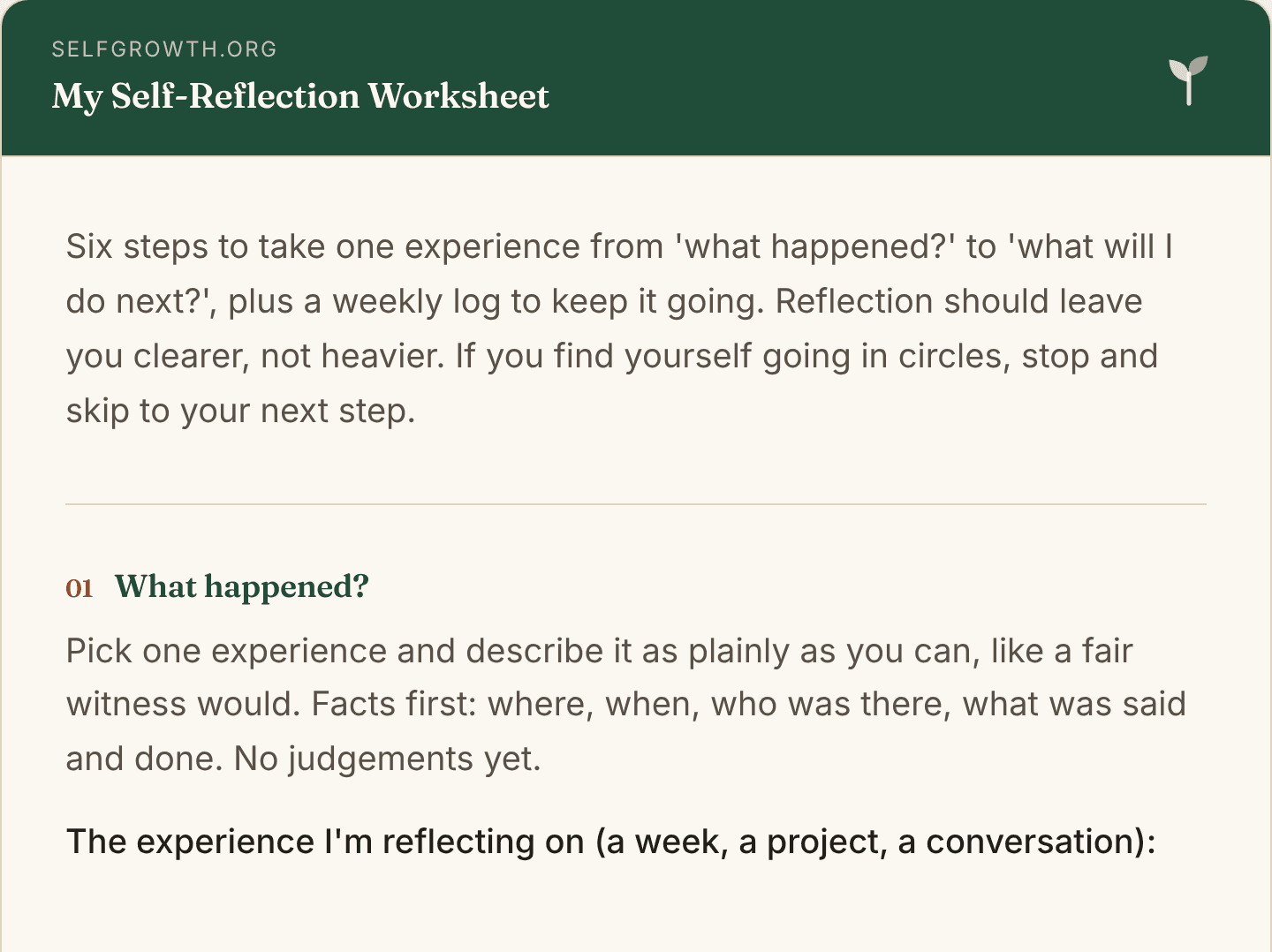
Self-Reflection Worksheet
A free, printable self-reflection worksheet: take one experience through Gibbs' reflective cycle, find your next step and keep a 10-minute weekly log.
Open worksheet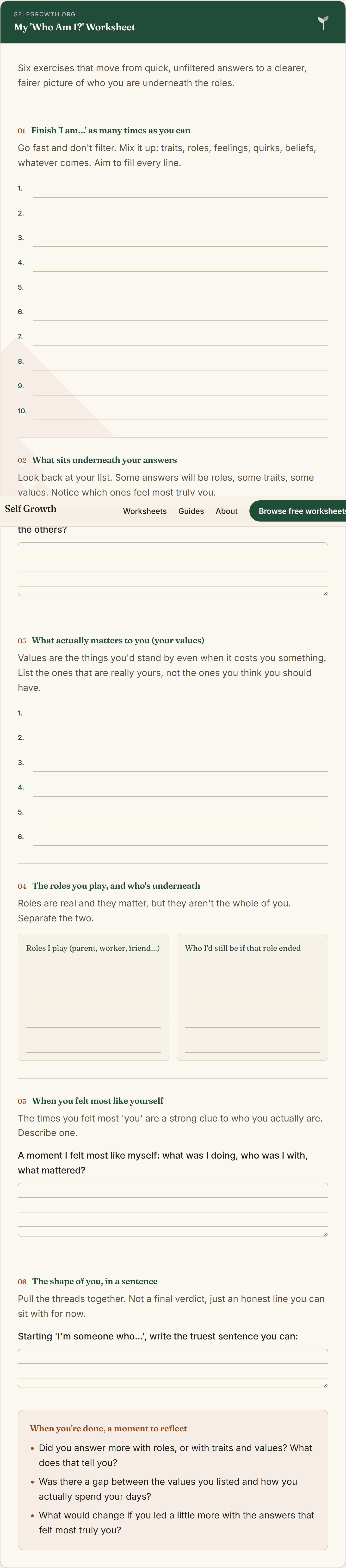
Who Am I? Worksheet
A free, printable 'Who am I?' worksheet to explore your identity, values and the person underneath your roles, with the classic twenty-statements exercise and guided prompts.
Open worksheet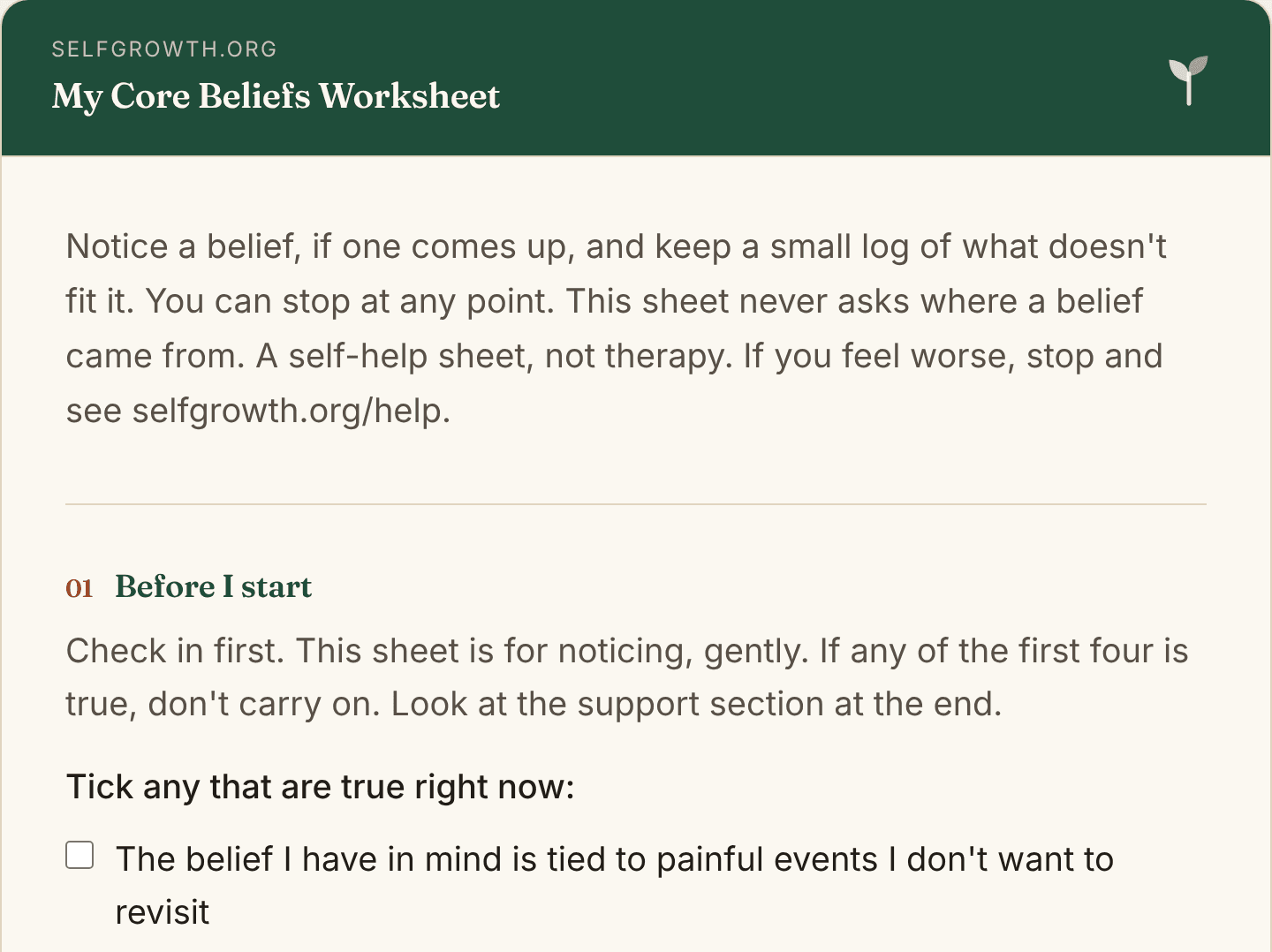
Core Beliefs Worksheet
A gentle, free core beliefs worksheet: notice one belief about yourself, keep a small log of what doesn't fit it, and know when to stop. Not therapy. Free PDF.
Open worksheetNew worksheets, straight to your inbox
An occasional new worksheet or tool, sent only when there's something genuinely worth your time. No spam, no pressure, unsubscribe any time.