
Self-respect
Self-respect worksheet: check your actions against your own standards
Updated 23 October 2026 · 6 min read · Free to print
Self-respect is acting in line with your own values and standards: keeping promises to yourself, saying no when you mean no, speaking to yourself fairly and choosing who gets your time. This free, printable worksheet helps you check your actions, log small respect receipts and change one boundary or habit.
A way to act in line with what matters to you · Part of self-esteem and confidence
Fill it in here (it saves in this browser, but not in a private window), print it, or download the PDF. Free, no sign-up.
Self-respect is not a feeling you wait for. It shows up in small choices: the promise you kept to yourself, the no you said out loud, the way you spoke about yourself after a mistake, the people you chose to spend an evening with.
That makes it different from self-esteem or self-worth, which are about how you feel about yourself. This worksheet is about what you do. You can have a wobbly day and still act in a way you respect.
You will look at everyday areas, check your actions against your own values, keep a short log of respect receipts, and pick one boundary or habit to change. There are no right answers, and nobody else needs to see it.
How to use this worksheet
- 1Set aside about 20 minutes somewhere quiet.
- 2Use your own standards, not what you think you should want.
- 3Be specific and small. 'I replied to that message I had been avoiding' counts.
- 4Come back to the receipts section across a week and add to it.
The worksheet
selfgrowth.org
My self-respect worksheet
Check how your everyday actions match what matters to you, log small respect receipts, and choose one change to make.
01Where am I now?
Rate how closely your recent actions match what you say matters to you.
How well do my actions match my own standards at the moment?
In a few words, what is making it that number?
02Everyday areas
Tick the lines that are true for you at the moment. Leave the rest blank. If someone you live with or depend on controls, frightens or hurts you, talk to a domestic abuse service first: National Domestic Abuse Helpline in England 0808 2000 247, Scotland 0800 027 1234, Wales 0808 80 10 800, Northern Ireland 0808 802 1414, US 1-800-799-7233. Elsewhere, see selfgrowth.org/help. If you are in immediate danger, call your local emergency number (999 UK, 911 US). A harsh voice in your head can be a sign you need more support. If it ever includes thoughts of harming yourself or ending your life, those thoughts are serious: Samaritans 116 123 (UK and Ireland), 988 (US), findahelpline.com elsewhere.
Keeping promises to myself
Saying no
How I speak about myself
Who I spend time with
03Values in action
Pick some things that matter to you, such as honesty, health, family or creativity. For each, write what you actually did this week, and one small thing that would match it better.
Entry 1
Entry 2
Entry 3
Where is the biggest gap between what I value and what I do?
04Respect receipts
A receipt is a small, real record of an action you respect in yourself. Write what you did, not how you felt about it. Add to it across the week.
Entry 1
Entry 2
Entry 3
Entry 4
Entry 5
Entry 6
Entry 7
05One change to make
Choose one boundary or habit. Keep it small enough to do this week, and write it as something you will do.
The change is about:
The boundary or habit, in one sentence:
For example: 'I will take a 20 minute walk on the three days I planned to.' If it involves another person, use a role, not a name.
If it gets hard, I will:
How likely am I to do it this week?
When you're done, a moment to reflect
- Which of the areas is easiest to respect yourself in, and what makes it easier?
- When do you break a promise to yourself, and what is going on just before?
- What would you say to a friend whose actions matched their values only half the time?
- Is any relationship asking you to give up a standard you care about?
- What is one receipt you would like to add more of next week?
Done for now?
Save today's answers as a dated entry. You can come back, fill it in again and compare the two side by side.
What is behind this worksheet?
This is a reflection exercise. It asks you to name what matters to you, notice what you did, and choose one change. Two of its ideas match NHS advice on raising low self-esteem: being kind to yourself, the way you would speak to a friend, and choosing time with people who are supportive.
The receipts are there so you have your own evidence to look at, instead of a feeling about how you are doing. This is a reflection exercise, so use your own notes as the test.
These are educational self-reflection tools, not therapy.
If you want to go deeper
- NHS. Raise low self-esteem. https://www.nhs.uk/mental-health/self-help/tips-and-support/raise-low-self-esteem/
Your questions, answered
- What is self-respect?
- Self-respect is treating yourself in line with your own values and standards. It shows in everyday actions: keeping promises to yourself, saying no when you mean no, how you speak about yourself and who you spend time with. It is about what you do more than how you feel.
- How do I build self-respect?
- Start small and be specific. Keep one promise to yourself this week, say one honest no, and notice how you speak about yourself after a mistake. Write each one down as a receipt. This worksheet helps you check your actions against your values and pick one boundary or habit to change.
- What is the difference between self-respect and self-esteem?
- Self-esteem is how you feel about yourself. Self-respect is how you act towards yourself. You can have low self-esteem on a bad day and still act in ways you respect, and those actions can support how you feel over time. For the feelings side, see the self-esteem and self-worth worksheets.
- Does a self-respect worksheet work?
- It is a reflection exercise: it helps you notice what you do, compare it with what you value, and plan one change. Think of it as a prompt for your own thinking, not a treatment.
- Is saying no a form of self-respect?
- It can be. Saying no when you mean no keeps your actions in line with your own limits. It is not the only way, and it does not mean being harsh. A short, kind no is enough. The boundaries worksheet helps you plan the words.
- Is there a self-respect worksheet PDF?
- Yes. Use the Download PDF button for a clean, print-ready copy, or Print to print straight from the page. It is completely free, with no payment and no email needed. Typed answers save in your browser and, if you are signed in, also to your account.
- Is this worksheet a substitute for therapy?
- No. It is a self-help tool, not therapy or medical advice. If low self-respect is tied to low mood, a controlling relationship or something painful, a GP or counsellor can help. Thoughts like these are serious: if you ever feel unsafe or have thoughts of harming yourself, call Samaritans on 116 123 (UK and Ireland), 988 (US), or find a line at findahelpline.com. More support is at selfgrowth.org/help. If someone controls, frightens or hurts you, talk to a domestic abuse service first (England 0808 2000 247, Scotland 0800 027 1234, Wales 0808 80 10 800, Northern Ireland 0808 802 1414, US 1-800-799-7233). Elsewhere, see selfgrowth.org/help. If you are in immediate danger, call your local emergency number (999 UK, 911 US).
Keep going, related worksheets
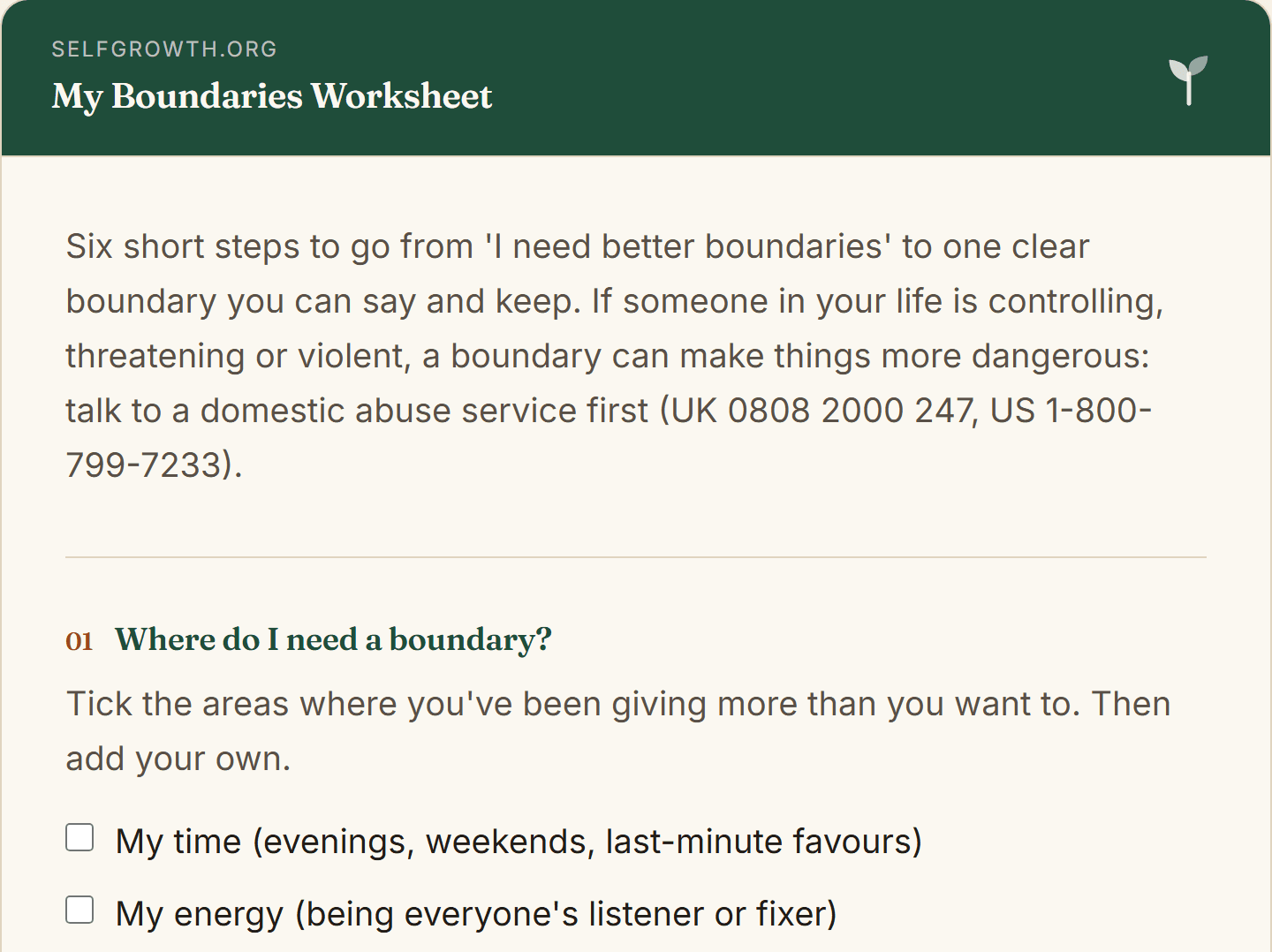
Boundaries Worksheet
A free, printable boundaries worksheet: spot where you need a limit, write it as something you'll do, plan the exact words, and decide what you'll do if it's crossed.
Open worksheet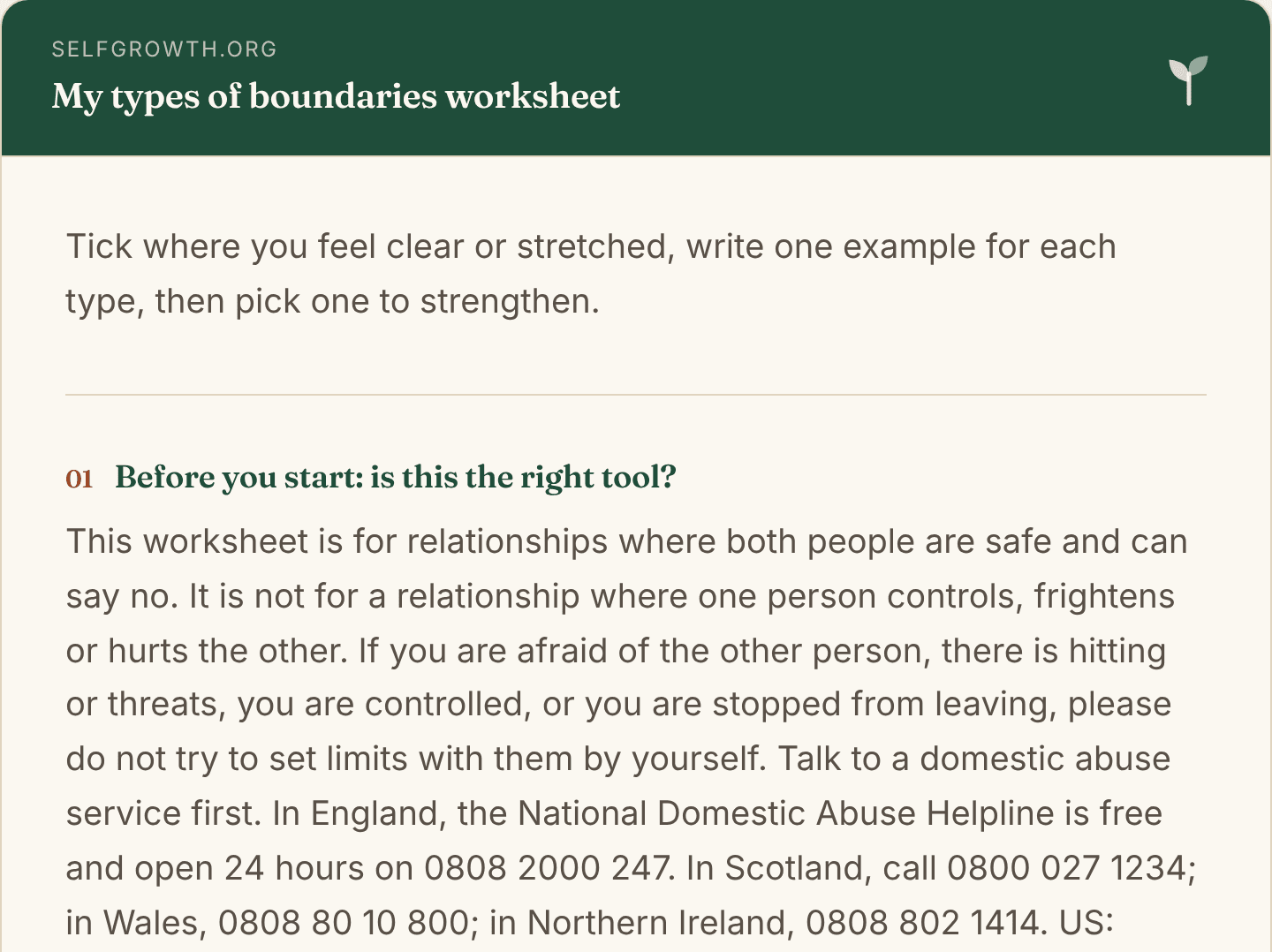
Types of Boundaries Worksheet
A free, printable types of boundaries worksheet: physical, emotional, time, material, digital and mental. Tick where you feel clear or stretched and pick one to strengthen.
Open worksheet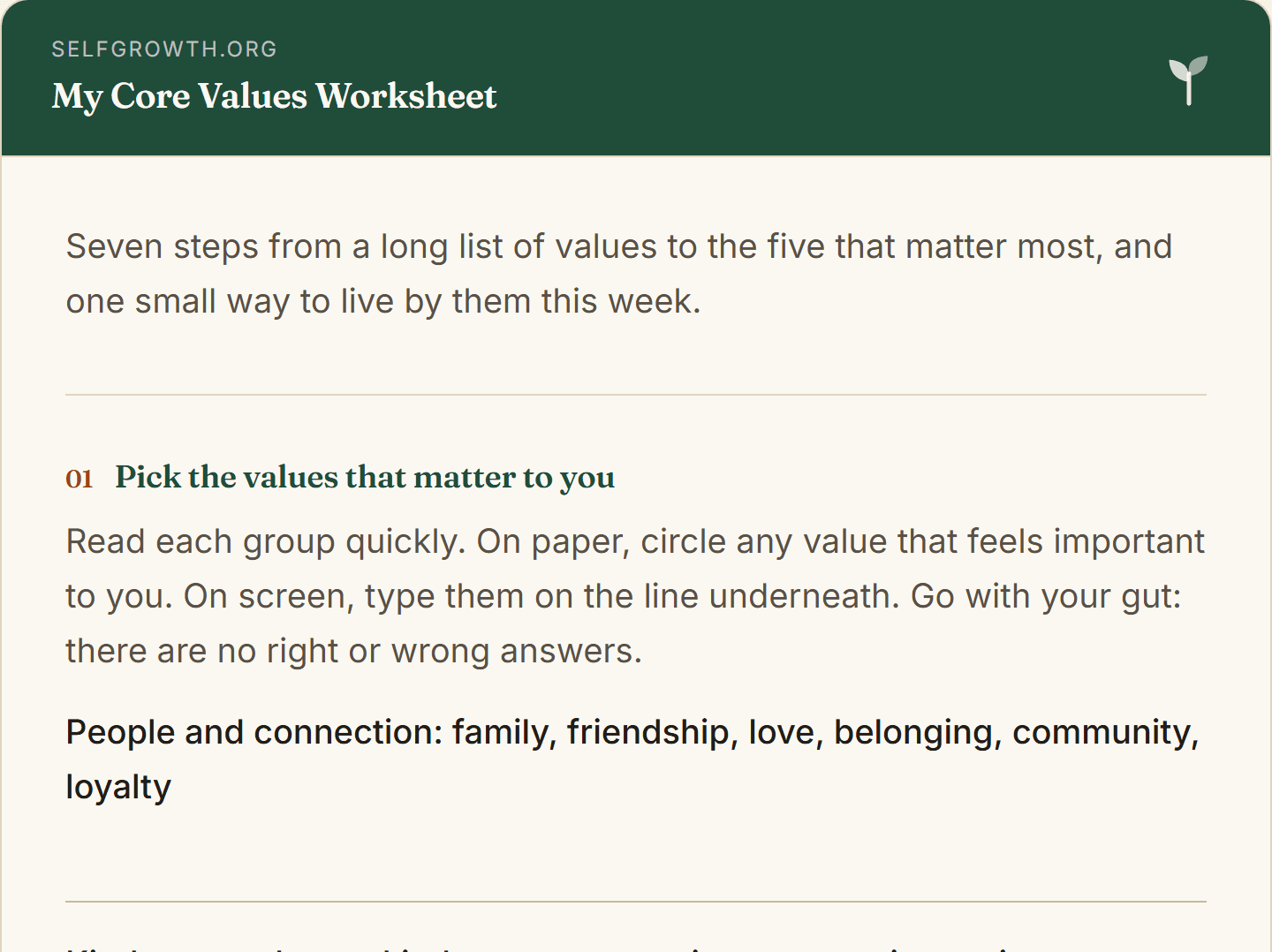
Core Values Worksheet
A free, printable core values worksheet: pick values from a list, narrow them to your top five, put them in your own words and plan one step to live by them.
Open worksheetNew worksheets, straight to your inbox
An occasional new worksheet or tool, sent only when there's something genuinely worth your time. No spam, no pressure, unsubscribe any time.