
Self-advocacy
Self-advocacy worksheet for teachers: free printable for helping pupils speak up
Updated 23 October 2026 · 7 min read · Free to print
A self-advocacy worksheet for teachers helps you build a pupil's ability to ask for what they need in lessons. This free, printable page gives you a class routine, a way for pupils to ask for adjustments, a one-pupil profile, practice scripts, and a way to bring the pupil's voice into their own review.
Drawn from a published self-advocacy framework for students · Part of self-esteem and confidence
Fill it in here (it saves in this browser, but not in a private window), print it, or download the PDF. Free, no sign-up.
Self-advocacy means speaking up for yourself: knowing what helps, asking for it, and saying no or 'not like that' when something isn't working. A pupil who can say 'I need the instructions written down' or 'can I have a break before I answer?' can make the lesson easier for both of you. It is a skill, so it can be taught in small, repeatable moves.
A well-known framework from Test, Fowler, Wood, Brewer and Eddy (2005) breaks self-advocacy into four parts: knowledge of self, knowledge of rights, communication and leadership. This worksheet turns those four parts into things you can do in a classroom: a short routine for the whole group, a profile built with one pupil, scripts to rehearse, and a way to bring the pupil's own view into a review.
It is written for you, the adult. It includes pupils with additional needs or disabilities, without asking you to work out what a pupil 'has'. It is a planning and observation tool, not an assessment, not therapy, and not a substitute for your school's own SEND (special educational needs and disabilities) process.
How to use this worksheet
- 1Start with the safety box and the class routine. They take a few minutes and need no preparation.
- 2Build the one-pupil profile in a short one-to-one chat. The pupil answers, you write down their words, and they decide what goes on the final page, except safeguarding concerns.
- 3Use the scripts and role-play card in small groups or with a partner, at a calm time, not in the middle of a difficulty.
- 4Fill in the review preparation before a review meeting, and keep the observation log for two or three weeks.
- 5Anything you type on screen saves in your browser and, if you are signed in, also to your account, so never type pupil details: write them on the printout.
- 6Share anything about a pupil with colleagues only as your school's policy allows, and ask the pupil first where you can. Print only what you need.
The worksheet
selfgrowth.org
Self-advocacy: a teacher's worksheet
A class routine, a profile to build with one pupil, scripts, a role-play card, review preparation and a short log. Use the parts that fit your class.
011. Before you start: safety and support
If a pupil tells you someone is hurting them, or you are worried about their safety, this worksheet is not the tool. If a pupil tells you something that worries you, take it seriously and tell your designated safeguarding lead (DSL) the same day. In the US you are a mandated reporter: follow your school's reporting procedure and report to your state's child protective services or the police. Childhelp (1-800-422-4453, not a reporting line) can help you find the right agency. Follow your school's safeguarding policy. If a child is in immediate danger, call 999 (UK), 911 (US) or your local emergency number. If you are worried about a child outside school, the NSPCC helpline is 0808 800 5000 (UK) and Childhelp (not a reporting line) is 1-800-422-4453 (US). This sheet is not a professional assessment. If a pupil's difficulties persist, speak to your SENCo (special educational needs coordinator, UK) or school counsellor or psychologist (US) about getting support looked at.
Names and rooms I can go to: DSL, SENCo or counsellor
022. A short routine for the whole class
Pick one small move and run it for a few weeks so it becomes normal to ask. Pupils who already ask for help are not singled out, and those who find it hard get used to hearing it.
The one move I will try first, and when in the week:
Wording I will use for my class's 'ask for help' menu:
033. A strengths-and-needs profile (one pupil)
Do this with one pupil, in their words. You are the scribe. Ask, wait, write what they say. 'I don't know' is an answer: you can try again another day, or offer a choice ('does it help more when it's quiet or when you have music?'). This links to the first of the four parts of the framework, knowing yourself. Type no names or initials on screen. Write pupil details on the printout only. If a child tells you something that worries you about their safety: stay calm, listen, do not promise to keep it secret, do not press for detail, write down their words, and use the numbers in the safety section at the top of this page today.
Pupil (write on the printout, not here):
Things I'm good at or like doing (pupil's words)
- 1.
- 2.
- 3.
Things that make learning easier for me
For example: written steps, a quieter spot, a break, seeing an example first, more time.
- 1.
- 2.
- 3.
Things that make learning harder for me
For example: lots of noise, being asked to answer fast, long instructions said out loud.
- 1.
- 2.
- 3.
Entry 1
Entry 2
Entry 3
044. A 'how I learn best' one-page profile
Turn the profile into a page the pupil can hand to a new teacher or keep in their planner. Short, positive, specific, and the pupil signs off every line. Type no names or initials on screen. Write pupil details on the printout only.
Three things people should know about me:
What helps me do my best work:
What to try if I look stuck or upset (and what to leave alone):
055. Practice scripts and a role-play card
Rehearse when it is calm. The pupil plays themselves, and you (or a partner) play the teacher, then swap. Keep it light. Pupils pick the script and change the words to sound like them. This is the 'communication' part of the framework.
Entry 1
Entry 2
Entry 3
Entry 4
Starter scripts to offer (pupils choose)
Role-play card. Write one scene: who, where, what the pupil wants to ask for.
Round 1: pupil asks, adult says yes. Round 2: adult says 'not right now', pupil asks again calmly or finds another way. Round 3: swap roles. Finish by asking: what felt easiest?
After the role-play, how confident did the pupil feel asking? (pupil's own rating)
066. Preparing a pupil for their own review
In England, support for pupils with SEND is given in school, and an education, health and care (EHC) plan is for children and young people up to 25 with more complex needs, according to the government's 'Children with special educational needs and disabilities (SEND)' page on gov.uk. In the US, the federal regulation on IEP teams (34 CFR 300.321) lists the child as a member of the team 'whenever appropriate'. What the school must do is set out on those official pages, not here. Rules differ by country, school and local authority, so check your own policy and work with your SENCo or IEP team. This is not legal advice. Type no names or initials on screen. Write pupil details on the printout only. If a child tells you something that worries you about their safety: stay calm, listen, do not promise to keep it secret, do not press for detail, write down their words, and use the numbers in the safety section at the top of this page today.
Ways to bring the pupil's view into the meeting
What the pupil wants the meeting to hear (their words):
Questions I want to ask colleagues or the SENCo about this pupil's support:
077. Observation log
Spend two or three weeks watching for moments when a pupil asked, or almost asked. Note what you did that helped. Record what you see, not what you think a pupil 'is'. Keep notes factual and kind, as they may be seen by the pupil's family. The log also gives you class evidence of pupil voice. Type no names or initials on screen. Write pupil details on the printout only.
Entry 1
Entry 2
Entry 3
Entry 4
Entry 5
Across the class this fortnight, how easy is it becoming to ask for help? (my own observation)
Where I'm stuck or want to talk to a colleague:
One thing I'll do to look after myself this week:
When you're done, a moment to reflect
- When did a pupil last ask you for something, and how did your face and voice respond?
- Which pupils never ask, and what might make asking feel safer for them?
- What would you want a new teacher to know about how you learn best?
- Is there anything in your routine that rewards quiet compliance more than honest asking?
- Who in school could help you if a pupil's needs seem bigger than a classroom routine can meet?
Done for now?
Save today's answers as a dated entry. You can come back, fill it in again and compare the two side by side.
What is self-advocacy, and where do the four parts come from?
Self-advocacy is a pupil speaking up for themselves: knowing what helps, asking for it, and understanding their own support. The structure here borrows from a framework published by David Test, Catherine Fowler, Wendy Wood, Denise Brewer and Steven Eddy in Remedial and Special Education in 2005. The authors read the research and asked people involved, then described four parts: knowing yourself, knowing your rights, communicating, and leadership (speaking up and taking part in decisions about your own support). They offered it to guide teaching, curriculum design and assessment. The class routine, profile, scripts, role-play card and log on this page are plain-English tools built around those four parts. They are not the authors' materials.
No study has tested this exact worksheet. The log lets you judge for yourself. The rights and plan information on this page is only a pointer to official sources: the gov.uk page 'Children with special educational needs and disabilities (SEND)' for England, and the US federal regulation 34 CFR 300.321 on who is on an IEP team. Check what applies to your school on those pages and in your own policy. Rules differ by country, school and local authority.
These are educational self-reflection tools, not therapy.
If you want to go deeper
- Test, D. W., Fowler, C. H., Wood, W. M., Brewer, D. M. & Eddy, S. (2005). A conceptual framework of self-advocacy for students with disabilities. Remedial and Special Education, 26(1), 43-54. https://doi.org/10.1177/07419325050260010601
- GOV.UK. Children with special educational needs and disabilities (SEND). https://www.gov.uk/children-with-special-educational-needs
- US Code of Federal Regulations, Title 34, section 300.321: IEP Team. https://www.law.cornell.edu/cfr/text/34/300.321
Your questions, answered
- What is self-advocacy for pupils?
- It means a pupil speaking up for themselves: knowing their strengths and needs, asking for help or an adjustment in a lesson, saying no, and understanding their own support plan. Test and colleagues (2005) describe four parts: knowledge of self, knowledge of rights, communication and leadership.
- How do I teach self-advocacy in the classroom?
- Start small. Run one routine, such as an 'ask for help' menu or an end-of-lesson 'what helped?' check. Then build a profile with a single pupil, rehearse a few sentences with them at a calm time, and thank them when they ask. The class routine, profile and scripts in this worksheet walk you through each step.
- Does teaching self-advocacy work?
- Test and colleagues (2005) built their framework by reading the research and asking people involved, to guide teaching and assessment. No results are promised here. Treat the worksheet as a structured way to practise a skill and watch what happens in your own class, using the observation log.
- How do I include a pupil in their own review or support-plan meeting?
- Ask what they want the adults to know, let them choose how to take part (in person, a note, a drawing or a recording), and tell them afterwards what was decided. Check your own policy: in England the SENCo can advise, and in the US the IEP team regulation (34 CFR 300.321) includes the child 'whenever appropriate'. Rules differ by country, school and local authority.
- Does this mean I should work out what support a pupil needs?
- No. This worksheet records what the pupil says helps and what you observe. It doesn't diagnose or assess anyone. If you think a pupil needs more support, talk to your SENCo (UK) or school counsellor or psychologist (US) and follow your school's process.
- Is there a self-advocacy worksheet PDF for teachers?
- Yes. The Download PDF button gives you a clean copy for your class folder or a colleague, and Print works straight from the page. It is free, with no payment and no email needed. Anything you type on screen saves in your browser and, if you are signed in, also to your account, so never type pupil details.
- Is this worksheet a substitute for therapy or a professional assessment?
- No. It is a classroom planning tool, not therapy, medical advice or an assessment. If you are worried about a child's safety, follow your school's safeguarding policy at once. If a pupil tells you something that worries you, take it seriously and tell your designated safeguarding lead the same day. In the US you are a mandated reporter: follow your school's reporting procedure and report to your state's child protective services or the police. Childhelp (1-800-422-4453, not a reporting line) can help you find the right agency. If a child is in immediate danger, call 999 (UK), 911 (US) or your local emergency number. For urgent advice about a child's health in the UK, call NHS 111; in the US, 988 is the Suicide and Crisis Lifeline. If you are struggling yourself, Samaritans is on 116 123 (UK and Ireland), call or text 988 (US), or find a line at findahelpline.com.
Keep going, related worksheets
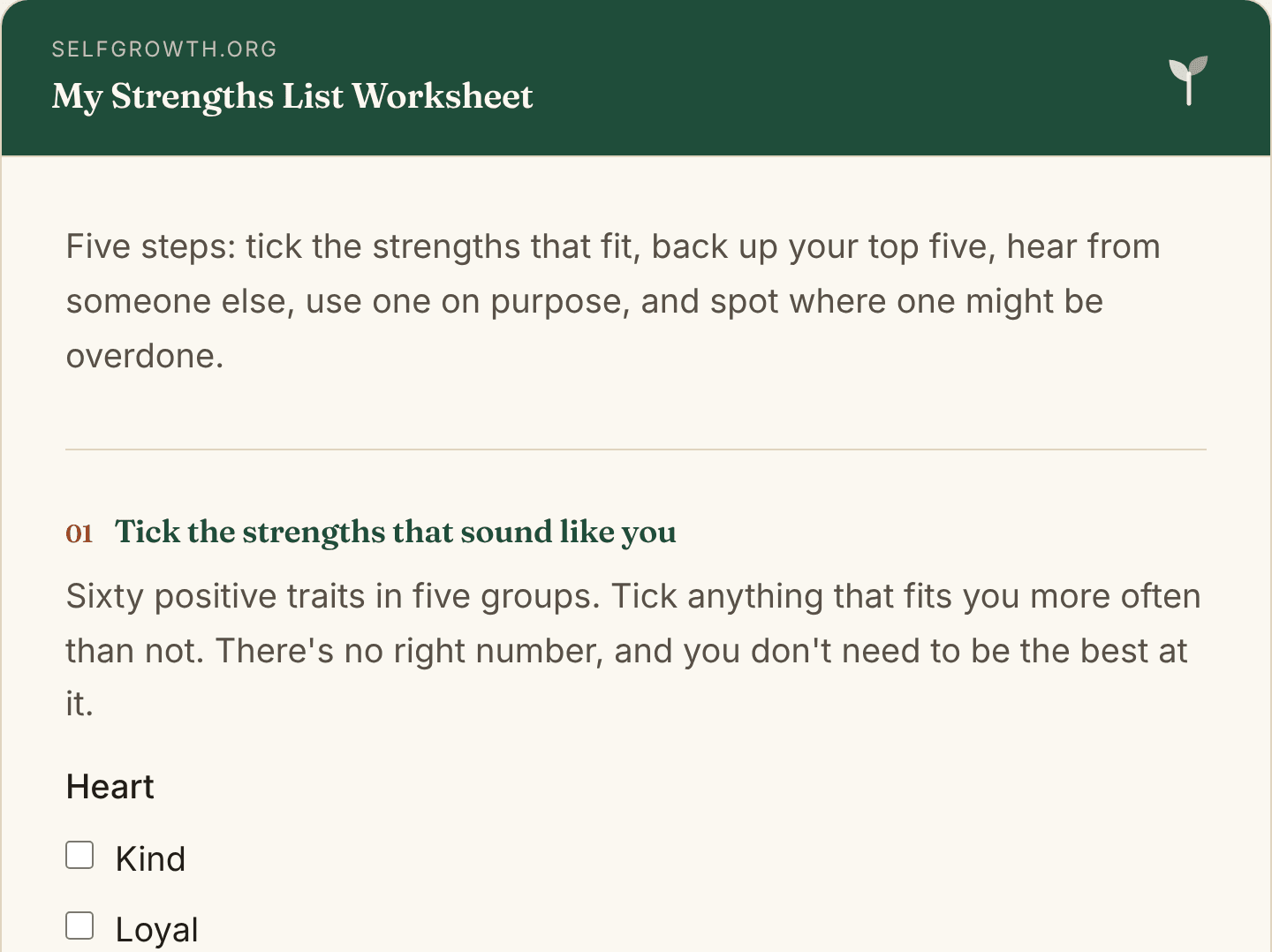
Strengths List Worksheet
A free list of 60 positive character traits and strengths to tick, with space for evidence, what others see in you and one strength to use on purpose this week.
Open worksheet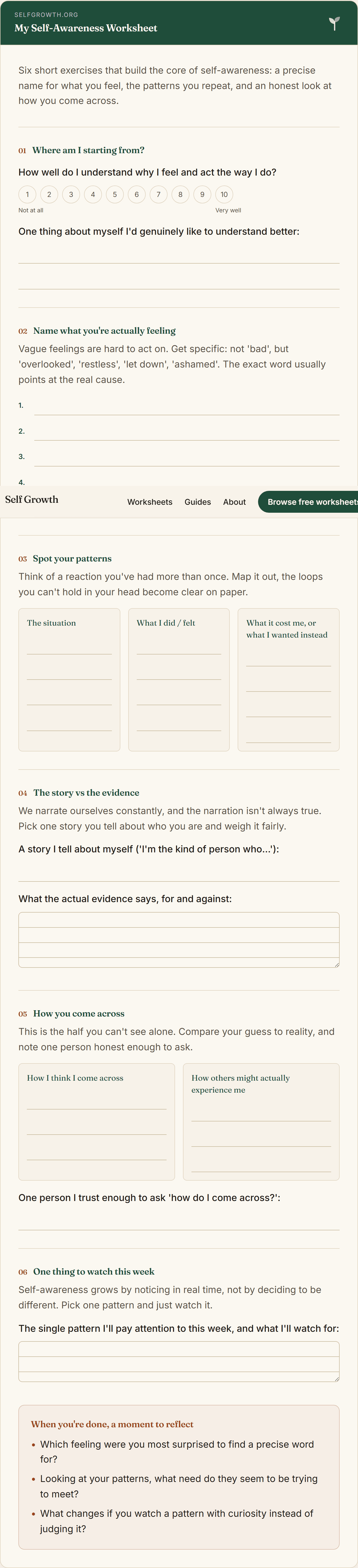
Self-Awareness Worksheet
A free, printable self-awareness worksheet with guided exercises to name your feelings, spot your patterns, and see how you come across, so you understand yourself better.
Open worksheet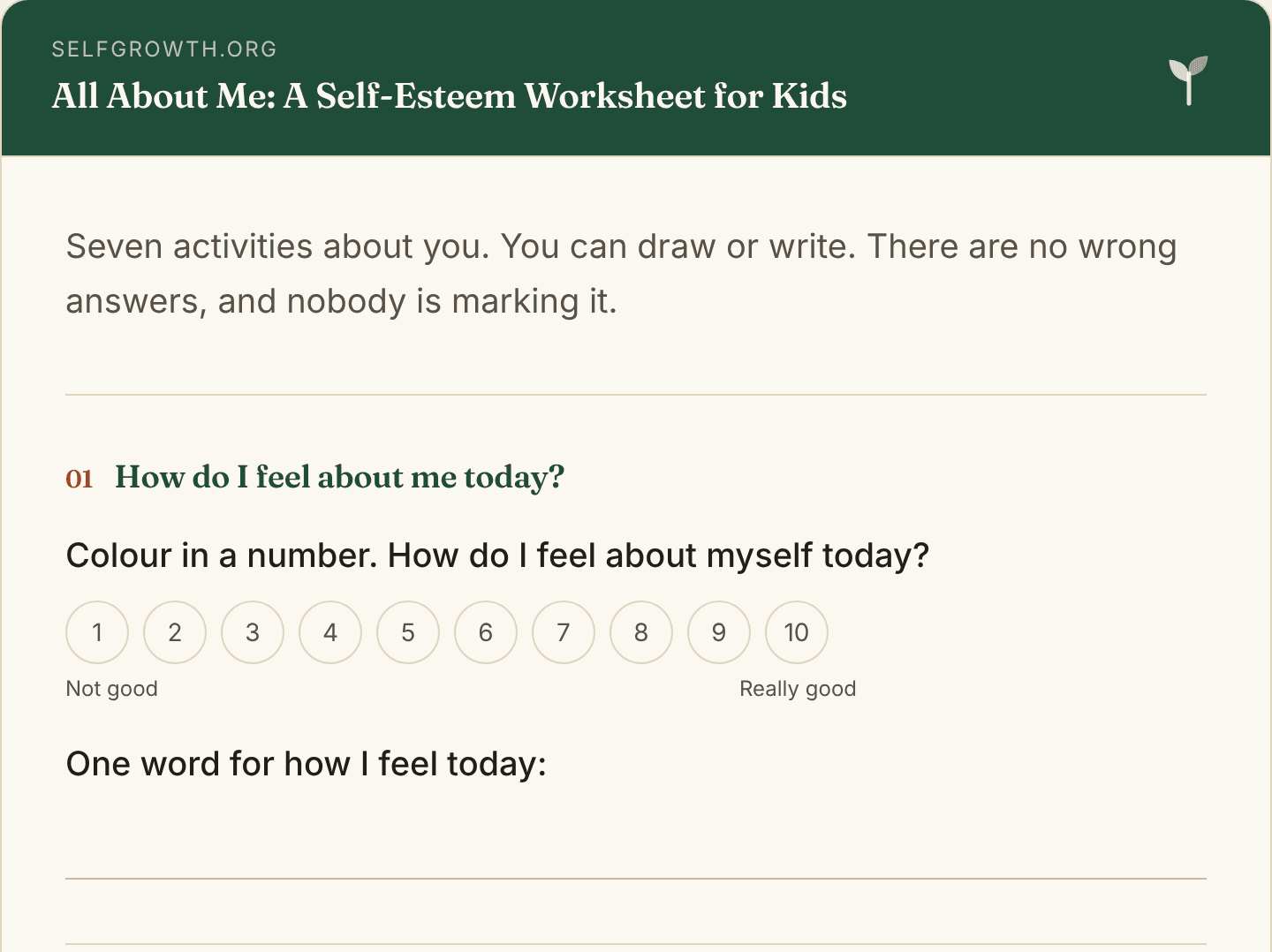
Self-Esteem (Kids)
Free printable self-esteem worksheet for kids aged 7 to 12: draw or write about strengths, kind self-talk and people who help, with tips for parents.
Open worksheetNew worksheets, straight to your inbox
An occasional new worksheet or tool, sent only when there's something genuinely worth your time. No spam, no pressure, unsubscribe any time.