
Inner critic
Fact or opinion worksheet: a free printable to sort your thoughts
Updated 23 October 2026 · 7 min read · Free to print
To tell a fact from an opinion, ask what a camera would record: a fact can be seen, heard or checked, while an interpretation, prediction or feeling cannot. This free worksheet helps you sort a few real thoughts into fact, interpretation, prediction or feeling, then reword each one more fairly.
Drawn from cognitive behavioural therapy · Part of self-talk and the inner critic
Fill it in here (it saves in this browser, but not in a private window), print it, or download the PDF. Free, no sign-up.
A thought can feel completely certain and still be an interpretation. 'She ignored me' might be a fact (she did not reply). 'She thinks I'm boring' is a guess about someone else's mind. Both can arrive with the same weight, which is why it helps to slow down and sort them.
This worksheet asks you to write down a few real thoughts and put each one in a box: fact, interpretation (an opinion or a reading of events), prediction (about the future) or a feeling. Then you run the camera test, ask what a camera would actually record, and write a fairer version. The aim is accuracy, not positivity.
Some thoughts are not for sorting. If a thought is about being unsafe or being harmed, treat it as real and get help. This sheet is not therapy and is not for danger.
How to use this worksheet
- 1Write the thought as you heard it in your head, in your own words.
- 2Sort it, then run the camera test. If a camera could not record it, it is not a plain fact.
- 3Write a fairer rewording that keeps what is true. Do not force a cheerful one.
- 4Use everyday thoughts. Leave out anything about danger, abuse or harming yourself and follow the safety note instead.
The worksheet
selfgrowth.org
My fact or opinion worksheet
Write a few real thoughts, sort each one, run the camera test and reword it more fairly. A thought can feel certain and still be an interpretation.
01Safety first
Some thoughts are about real danger. If a thought is about being unsafe or being harmed, do not argue with it here: treat it as real and get help. Thoughts like these are serious. Call Samaritans on 116 123 (UK and Ireland), call or text 988 (US), find a line at findahelpline.com, or see selfgrowth.org/help. If another person scares you, this worksheet is not for that.
The person or line I will turn to first if I need help:
02Write down my thoughts
List a few thoughts you had recently, one per line. Use real ones.
Thoughts I want to check
For example: 'I always mess this up' or 'He is annoyed with me'.
- 1.
- 2.
- 3.
- 4.
- 5.
03Sort each thought
Write the number of each thought under the box that fits best. A fact can be checked. An interpretation is a reading of what happened. A prediction is about the future. A feeling is what you feel, not what you think.
Fact
Can be seen, heard or checked
Interpretation
Opinion, meaning or reading
Prediction
About what will happen
A feeling
What I feel inside
04The camera test
Pick the thought that bothers you most. Ask: what would a camera record? Describe only what could be seen or heard, with no meaning added.
The thought:
What a camera would record (what happened, who said or did what):
What I added that a camera could not record:
How strongly do I believe the thought right now?
05Evidence and other readings
Be fair, not kind. Real facts count even when they are uncomfortable, so write them down.
Facts that support the thought:
Facts that do not fit the thought:
Another reading that fits the same facts:
06A fairer rewording
Write a version that keeps what is true and drops the guesswork. 'I always mess up' might become 'This went badly, and I have handled harder things.'
My fairer version:
How strongly do I believe the original thought now?
Is there something I could check, ask or do next?
When you're done, a moment to reflect
- Which kind of thought do you mix up with facts most easily: interpretations, predictions or feelings?
- What did the camera test show that you had skipped past?
- Was there a thought that stayed a plain fact, even after sorting it? What does that tell you?
- Who could you ask to check an interpretation, instead of guessing?
- If a thought keeps coming back and weighs on you, would it help to talk to a GP or a therapist about it?
Done for now?
Save today's answers as a dated entry. You can come back, fill it in again and compare the two side by side.
Are thoughts facts, and does checking them help?
Checking a thought rather than accepting it as true is a core idea in cognitive behavioural therapy (CBT). The Beck Institute credits Aaron T. Beck's cognitive model, and describes therapists helping people identify distressing thoughts and assess how realistic they are. Mind Over Mood, a self-help CBT workbook by Dennis Greenberger and Christine Padesky, teaches the same habit in more depth.
The sort and the camera test are simple tools to try, not a standard method. No study tests this worksheet on its own.
Checking a thought is not the same as dismissing it. Real facts and real danger stay real, and the right response to them is action and support.
These are educational self-reflection tools, not therapy.
If you want to go deeper
- Beck Institute for Cognitive Behavior Therapy. Understanding CBT (the cognitive model developed by Aaron T. Beck). beckinstitute.org.
- Greenberger, D. & Padesky, C. A. (2015). Mind Over Mood: Change How You Feel by Changing the Way You Think (2nd ed.). Guilford Press.
Your questions, answered
- What is the difference between a fact and an opinion?
- A fact can be checked: seen, heard, measured or recorded. An opinion or interpretation is a reading of the facts, such as what someone meant or what something says about you. The camera test helps: if a camera could not record it, it is not a plain fact, however certain it feels.
- How do I use this fact or opinion worksheet?
- Write down a few real thoughts, then sort each into fact, interpretation, prediction or feeling. Run the camera test on the one that bothers you most, then write a fairer rewording. Rate how much you believe the thought before and after. Work through the sections in order, one at a time.
- Are thoughts facts?
- Not automatically. CBT, a family of talking therapies, teaches that how you read a situation shapes how you feel, and that thoughts can be checked rather than accepted as true. Some thoughts are accurate, though, and real danger is not an opinion. If a thought is about being unsafe or harmed, treat it as real and get help.
- What if the thought is actually true?
- Then write it as a fact and keep it. This worksheet is for separating facts from guesses, not for arguing yourself out of real problems. A true fact may call for action or support, not rewording.
- Does sorting thoughts like this work?
- Checking thoughts against evidence is a core part of CBT. No study tests this worksheet on its own. Treat it as a self-help habit and use the ratings to judge whether it helps you.
- Is there a fact or opinion worksheet PDF?
- Yes. Use the Download PDF button for a clean, print-ready copy, or Print to print straight from the page. It is completely free, with no payment and no email needed. You can also fill it in on screen, and your answers save in your browser.
- Is this worksheet a substitute for therapy?
- No. It is a self-help tool for everyday thoughts, not therapy or medical advice. If worry or low mood is getting in the way of life, a GP can point you towards talking therapies. Thoughts like these are serious if you feel unsafe or think about harming yourself: call Samaritans on 116 123 (UK and Ireland), call or text 988 (US), find a line at findahelpline.com, or see selfgrowth.org/help.
Keep going, related worksheets
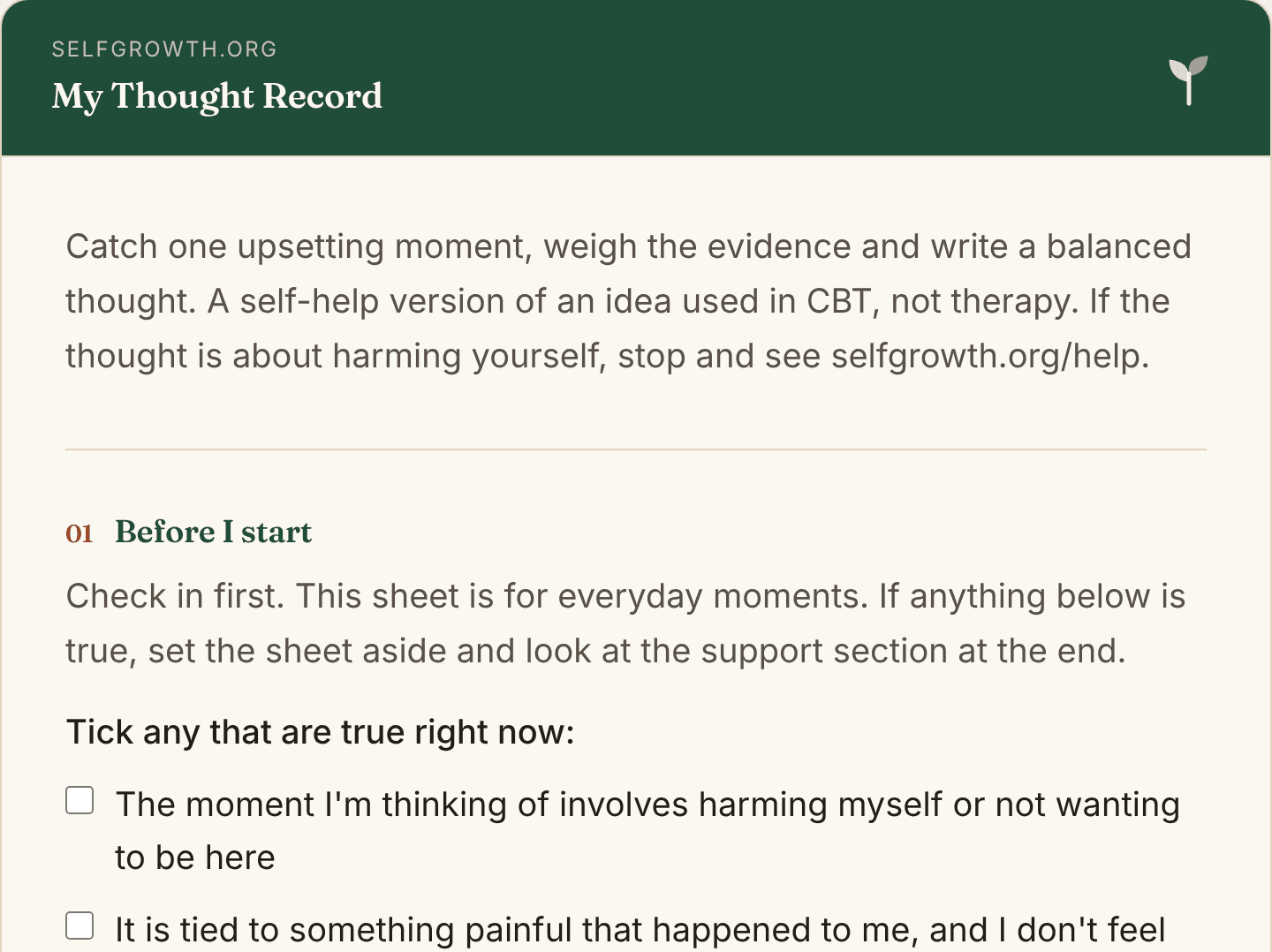
Thought Record Worksheet
Free thought record worksheet: note the situation, feeling and thought, weigh the evidence and write a balanced thought. Self-help, not therapy. Free PDF.
Open worksheet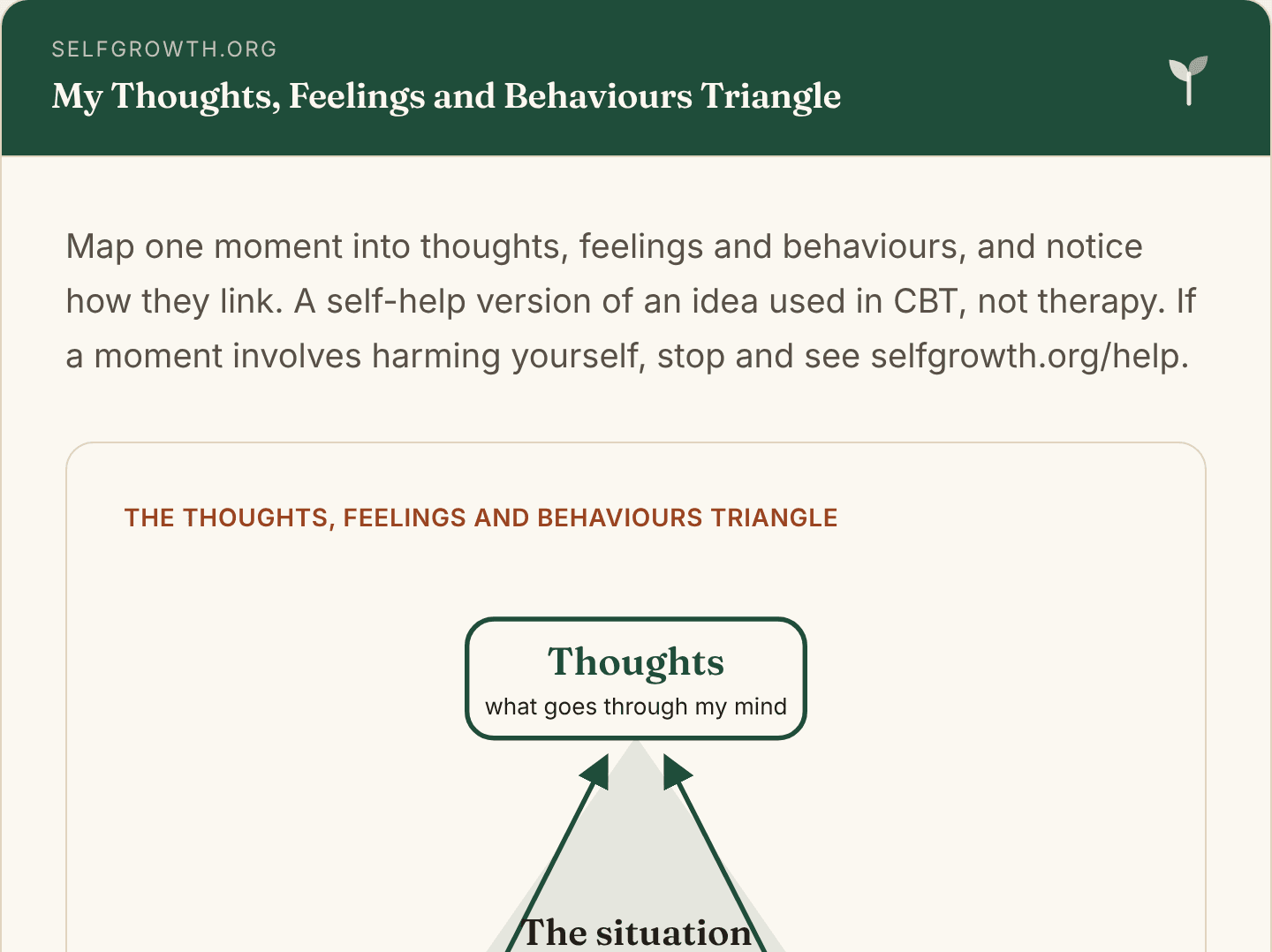
CBT Triangle Worksheet
Free CBT triangle worksheet: map one moment into thoughts, feelings and behaviours and see how they link. Self-help, not therapy. Free printable PDF.
Open worksheet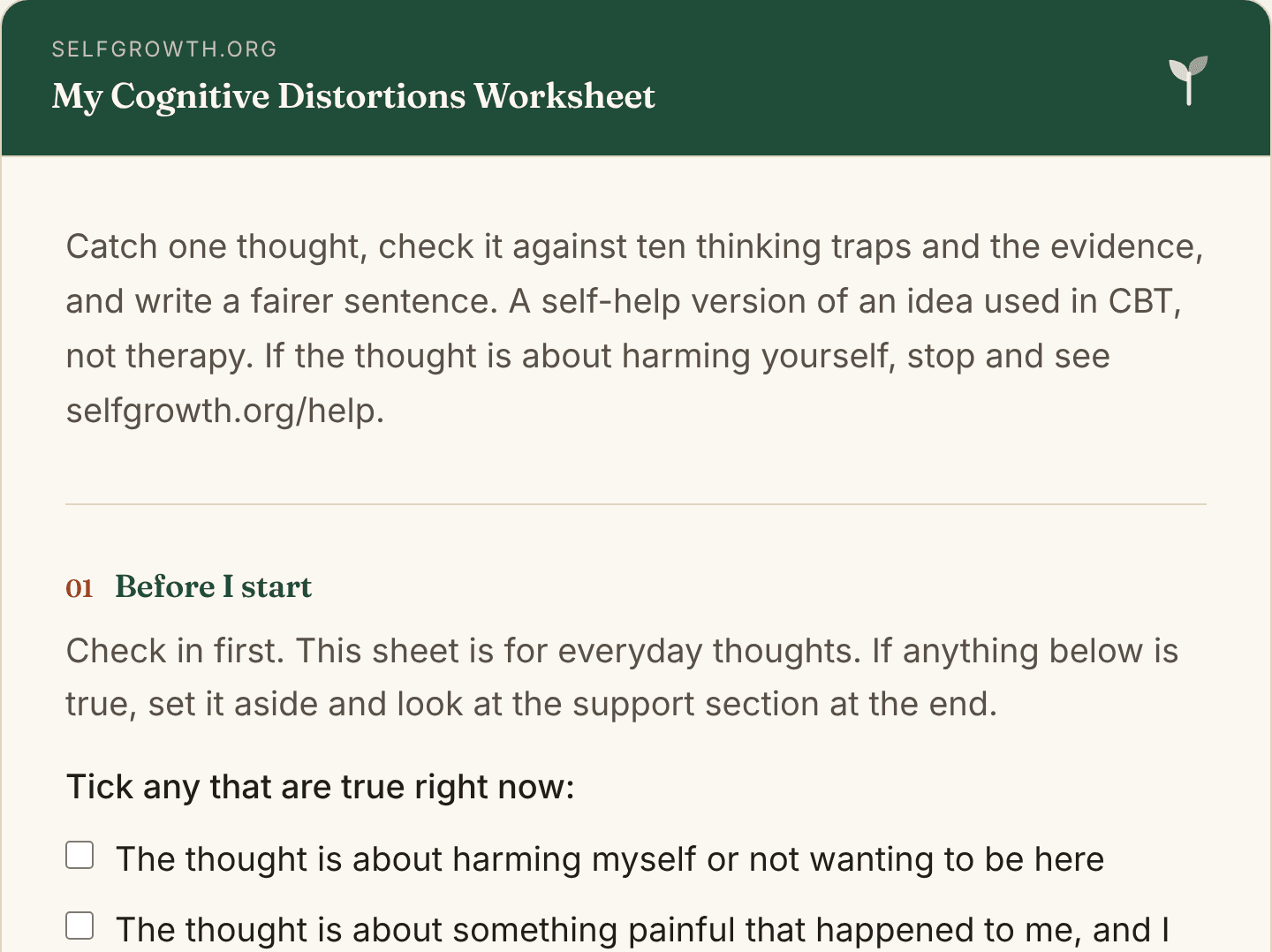
Cognitive Distortions Worksheet
Free cognitive distortions worksheet: check one thought against ten thinking traps, test the evidence and write a fairer sentence. Not therapy. Free PDF.
Open worksheetNew worksheets, straight to your inbox
An occasional new worksheet or tool, sent only when there's something genuinely worth your time. No spam, no pressure, unsubscribe any time.