
Self-love
Self-love affirmations: 40 kind, believable ones to choose from
Updated 11 October 2026 · 6 min read · Free to print
Self-love affirmations work best when you can actually believe them, like 'I'm allowed to rest before everything is done'. This free, printable page gives you 40 kind, specific affirmations grouped by theme, from worth to hard days. Tick the ones that feel true-ish, rewrite any that feel too big into something believable, and keep five of your own.
By the Self Growth team · drawn from research on positive self-statements and self-affirmation · how we make these
Fill it in here (it saves in this browser, but not in a private window), print it, or download the PDF. Free, no sign-up.
If you've ever stood in front of a mirror saying 'I love myself' and felt a small voice reply 'no you don't', you're not doing it wrong. Big, glowing affirmations can feel like a lie when you're already low, and your mind is quick to argue back. That argument can leave you feeling worse than before you started.
So this page offers something gentler: 40 affirmations written to be believable. They're balanced and specific, the kind of thing a fair friend would say, like 'I'm allowed to rest before everything is done' or 'I made a mistake, and that doesn't make me a mistake'. You don't have to believe them completely. You're looking for the ones that feel at least a little bit true.
You'll tick the ones that fit, rewrite any that feel too big, pick five of your own and plan when you'll use them. If you'd rather start from the words you already say to yourself and rework those, the positive self-talk worksheet does exactly that, and pairs well with this one.
How to use this worksheet
- 1Read each list slowly and tick only the affirmations that feel true-ish today. Skipping most of them is fine.
- 2Notice your reaction. If an affirmation makes you wince or argue back, leave it, or take it to the rewrite step and shrink it.
- 3Change the wording freely. An affirmation works better in words that sound like you.
- 4Keep your final five somewhere you'll see them, and come back to the lists on a different day. What feels true can change.
The worksheet
selfgrowth.org
My Self-Love Affirmations
Forty believable affirmations to choose from, a place to shrink the ones that feel too big, and room for five of your own.
01Affirmations about your worth and your mistakes
Tick any that feel even a little bit true right now. You don't need to believe them fully, just enough that part of you nods rather than argues.
On my worth
On mistakes
02Affirmations for your body and for rest
These aren't about loving how you look or never being tired. They're about treating yourself fairly while you feel however you feel.
On my body
On rest
03Affirmations for boundaries and hard days
Pick the ones you'd want to hear before a hard conversation, or at the end of a day that went badly.
On boundaries
On hard days
04Affirmations for growth, and your shortlist
Tick any that fit, then look back over every list on this page and pull out the few that felt most true.
On growth
The three that felt most true to me:
- 1.
- 2.
- 3.
05Shrink a too-big affirmation into a believable one
Think of an affirmation you've heard or tried that made you cringe, like 'I love everything about myself' or 'I am confident'. Write a smaller version you can actually believe, then rate how believable it feels from 0 to 10. Ways to shrink it: add 'I'm learning to', add 'and' ('I can feel nervous and still do it'), make it about what you do rather than how you feel, or make it about today only.
Entry 1
Entry 2
Entry 3
Entry 4
If a rewrite still scored low, how could I make it smaller or more specific?
06My own five, and when I'll use them
Choose five affirmations to keep: from the lists, from your rewrites, or written fresh. Then decide when you'll actually see or say them. There's no proven schedule, so pick moments that fit your day rather than a rule.
My five affirmations, in my own words:
- 1.
- 2.
- 3.
- 4.
- 5.
When I might use them (tick any that fit):
Where I'll keep them so I see them (for example a phone note, a mirror, the inside of a notebook):
07A different kind of affirmation: your values
In psychology, 'self-affirmation' usually means something else: writing for a few minutes about a value that matters to you. It doesn't ask you to say anything nice about yourself at all. Try it here, especially before something stressful.
One value that matters a lot to me (for example kindness, family, honesty, creativity, learning):
Why it matters to me, and a time I lived by it, even in a small way:
When you're done, a moment to reflect
- Which affirmation made you argue back the hardest? What does that argument say, and is it fair?
- Which one would you say to a friend without a second thought, but struggle to say to yourself?
- When did you last act in a way that matched one of your ticked affirmations, even briefly?
- If you came back to these lists in a month, which do you hope would feel more true?
Do self-love affirmations actually work?
The honest answer is that it depends on the affirmation, and on you. In a study published in Psychological Science, Joanne Wood and her colleagues Perunovic and Lee (2009) asked people to repeat the statement 'I'm a lovable person'. People with low self-esteem who repeated it felt worse than those who didn't. People with high self-esteem felt better, but only to a limited degree. The authors' conclusion was that positive self-statements may help some people but backfire for the very people who most need them.
That study shapes every line on this page. The 40 affirmations are written to be balanced and specific rather than glowing, so there's less for your mind to argue with. The rewrite step and the 0 to 10 believability rating exist for the same reason. In Wood's study, people with low self-esteem who were asked to think about how the statement was both true and not true didn't take the same hit as those who focused only on how it was true. We haven't tested this list in a study. It's built to follow that finding, not proven by it.
'Self-affirmation' in psychology research means something different from saying nice things about yourself. Geoffrey Cohen and David Sherman's 2014 review in the Annual Review of Psychology describes exercises where people write about the values that matter most to them. The idea is that remembering what matters to you gives you a broader sense of yourself, so a single threat (a hard exam, a criticism) feels less like a verdict on your whole worth. The review reports that, done at the right moment, this kind of writing has helped with some school, health and relationship results. The last section of this worksheet is a short version of that, and the core values worksheet goes much further if you want to find your values first.
This is an educational tool for everyday self-esteem, not therapy. If kind words feel impossible to say to yourself at all, that's worth taking seriously, and a good therapist can help in ways a list can't.
These are educational self-reflection tools, not therapy. See our editorial standards.
If you want to go deeper
- Wood, J. V., Perunovic, W. Q. E. & Lee, J. W. (2009). Positive self-statements: Power for some, peril for others. Psychological Science, 20(7), 860-866.
- Cohen, G. L. & Sherman, D. K. (2014). The psychology of change: Self-affirmation and social psychological intervention. Annual Review of Psychology, 65, 333-371.
Your questions, answered
- What are some good self-love affirmations?
- Good ones are kind and believable at the same time. Try: 'I'm allowed to rest before everything is done', 'I made a mistake, and that doesn't make me a mistake', 'I can say no and still be a kind person', 'I don't have to love how I look to treat my body kindly' and 'I've got through hard days before'. The best affirmation is one that feels at least a little true to you.
- Do affirmations work for low self-esteem?
- Big, glowing ones may not. In a 2009 study by Joanne Wood and colleagues, people with low self-esteem who repeated 'I'm a lovable person' felt worse than those who didn't, while people with high self-esteem felt only a little better. People with low self-esteem who thought about how the statement was both true and not true didn't take the same hit. That's why the affirmations here are balanced and believable rather than glowing.
- Why do affirmations make me feel worse?
- Often because they're too far from how you feel right now. If you say 'I love myself' while part of you strongly disagrees, the gap can make your mind argue back and remind you of everything that seems to prove otherwise. That's a sign the affirmation is too big, not that you're failing. Shrink it: 'I'm learning to be kinder to myself' is easier to believe.
- How often should you say affirmations?
- There's no proven schedule, so be wary of anyone who promises results from saying them a set number of times a day. A sensible approach is to use them at moments when they're useful, such as before something stressful or straight after a mistake, and to keep them somewhere you'll see them. If one stops feeling true, change it.
- What's the difference between affirmations and self-affirmation?
- Everyday affirmations are positive statements about yourself, like 'I am enough'. In psychology, self-affirmation usually means writing about a value that matters to you, such as family or honesty. Research reviewed by Geoffrey Cohen and David Sherman (2014) suggests that values writing, done at a stressful time, can help people cope with threats to how they see themselves. The last section of this worksheet lets you try it.
- Is there a printable list of self-love affirmations?
- Yes. Use the Download PDF button for a clean, print-ready copy of all 40 affirmations and the exercises, or Print to print straight from the page. It's completely free, with no payment and no email needed. You can also tick and fill it in on screen, and your answers save in your browser.
- Is this a substitute for therapy?
- No. It's an educational self-reflection tool for everyday self-esteem, not therapy or medical advice. If you feel worthless most of the time, if you feel hopeless, or if you have thoughts of harming yourself, please talk to a GP or family doctor or a qualified mental health professional. If you're in crisis, call Samaritans on 116 123 (UK), call or text 988 (US), or find a local line at findahelpline.com.
Keep going, related worksheets
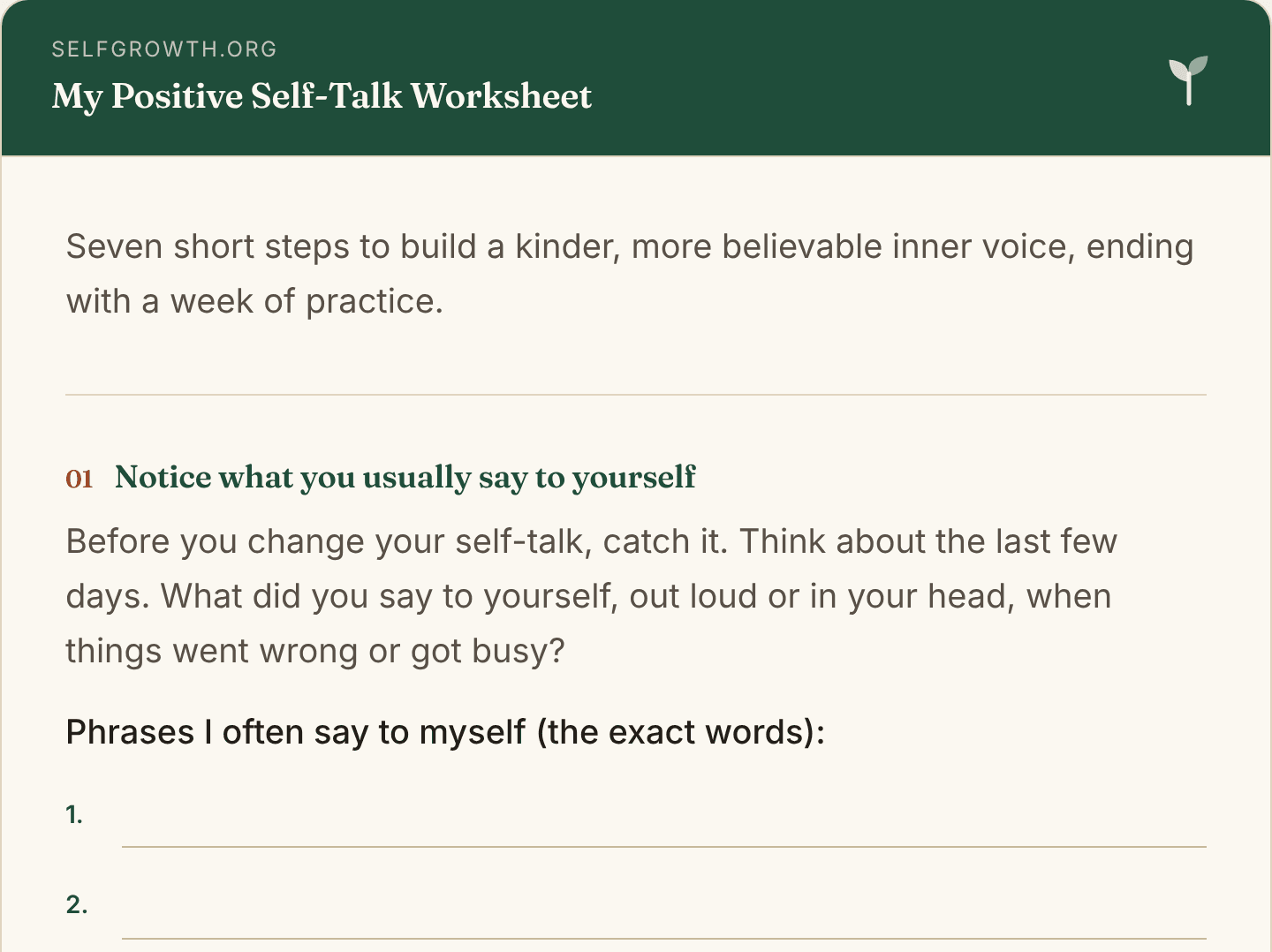
Positive Self-Talk Worksheet
A free, printable positive self-talk worksheet for adults: turn your usual phrases into kind, believable ones, write a pep talk and keep a 7-day practice log.
Open worksheet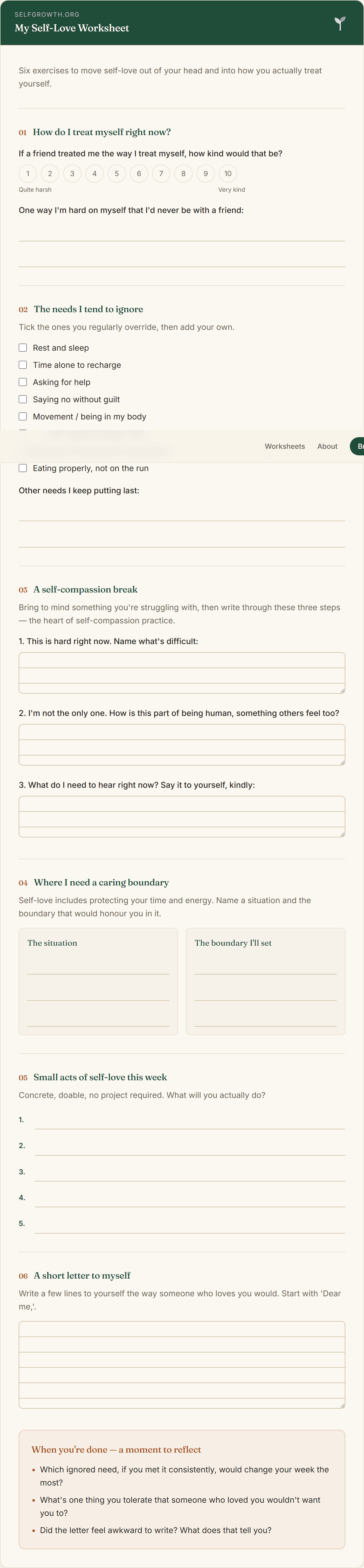
Self-Love Worksheet
Free printable self-love worksheets (PDF) that turn self-love into things you do: meet the needs you ignore, set one boundary and be kinder in a hard moment.
Open worksheet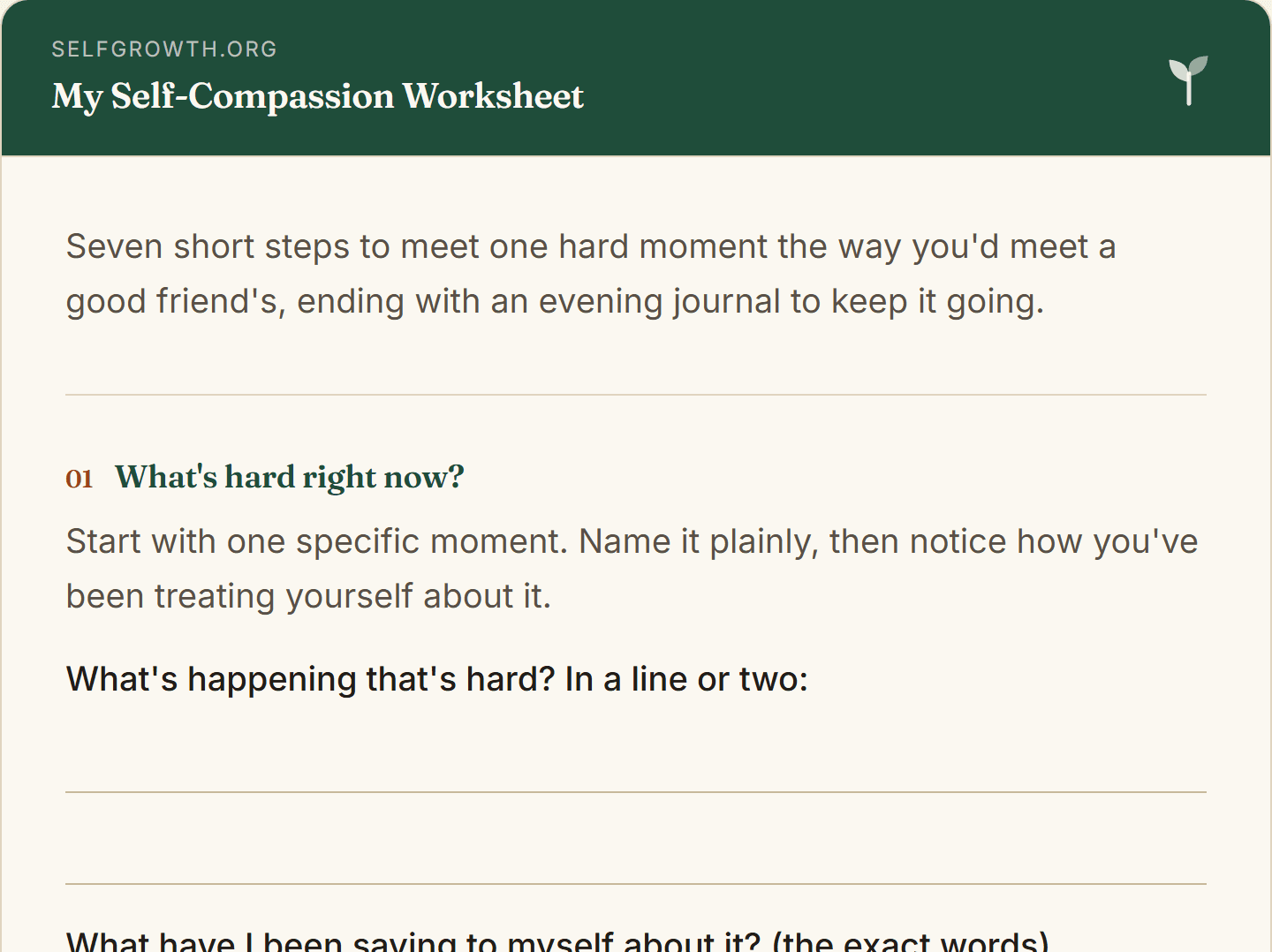
Self-Compassion Worksheet
A free, printable self-compassion worksheet: the self-compassion break, the friend test, a kind letter and journal prompts, based on Kristin Neff's research.
Open worksheetNew worksheets, straight to your inbox
An occasional new worksheet or tool, sent only when there's something genuinely worth your time. No spam, no pressure, unsubscribe any time.