
Relaxation
Guided meditation script: a free, printable breath meditation to read aloud
Updated 25 October 2026 · 7 min read · Free to print
A guided meditation script is a set of words you read slowly, or record and play back, to lead yourself through a short meditation. This free script focuses on the breath. It has a 5 to 10 minute version, a 3-minute version, a before-and-after check-in and a 7-day log.
Drawn from simple breath-focused mindfulness meditation · Part of feelings and calm
Fill it in here (it saves in this browser, but not in a private window), print it, or download the PDF. Free, no sign-up.
Sitting down to meditate with no instructions can feel like being handed a blank page. A script gives you the words. You read them slowly to yourself, or record your own voice reading them and press play when you are ready to sit. Either way, you are not working out what to do next. You are just following the next line.
This one is about the breath, which is the simplest place to start. You feel the air go in and out, your mind wanders off, and you bring it back. That is all of it. If you would rather move your attention around your body, try the body scan script. For other short practices, see the mindfulness exercises guide.
It is a self-guided exercise, not therapy, and it is not a treatment for anything. Some days it will feel calm. Some days it will feel restless. Both count as having done it.
How to use this worksheet
- 1Pick a time and a place where you will not be interrupted for ten minutes. Sit in a chair or on the floor, or lie down if you prefer. Choose a position where you can stay comfortable and awake.
- 2Read the script slowly, in a calm, low voice. Wherever you see (pause), stop for a few slow breaths before the next line. To record it, speak at about half your usual speed and leave those gaps in the recording.
- 3Do the check-in before you start and again afterwards. It is about your own feeling only, not a score to beat.
- 4Use the full script when you have time and the 3-minute version when you do not. Both are printed below.
- 5If anything upsetting comes up, stop. Open your eyes, look around the room and feel your feet on the floor. You can try again another day, or not at all.
The worksheet
selfgrowth.org
My Guided Meditation Script
A breath meditation to read aloud or record, in four parts, with a 3-minute version, a check-in and a week-long log. Wherever you see (pause), stop for a few slow breaths. If anything upsetting comes up, stop, open your eyes and ground yourself in the room around you.
01Before you start
Take a moment to check in. There is no right answer. This is only so that you can see, later, how the session went for you.
How calm do I feel right now?
In a few words, what is on my mind?
02Part 1: settling in
Sit or lie down so that you feel supported. Let your hands rest wherever they are comfortable. (pause) Close your eyes, or lower your gaze and rest it on one spot on the floor. (pause) Notice where your body meets the chair, the floor or the bed. Let it take your weight. (pause) For the next few minutes, there is nothing to fix and nothing to get right. You are only going to notice your breathing. (pause) Take one slow breath in through your nose, and let it out through your mouth, as slowly as you like. (pause) Now let your breathing go back to its own rhythm. You do not need to change it.
How did settling in feel?
03Part 2: following the breath
Find the place where you feel your breath most clearly. It might be the tip of your nose, your chest or your belly. (pause) Rest your attention there. Feel the air come in. (pause) Feel it pause for a moment at the top. (pause) Feel it go out. (pause) You do not need to make it deeper or slower. You are watching it, the way you might watch waves come in. (pause) If it helps, you can count silently: one on the breath in, two on the breath out, up to ten, and then start again. (pause) Stay with the breath for a few minutes. Take your time.
Where did I feel my breath most clearly?
04Part 3: when your mind wanders
At some point, your mind will wander. It might go to a plan, a worry, a memory or a sound. That is what minds do. It is not a mistake. (pause) When you notice that you have drifted, quietly say to yourself, 'wandering'. (pause) Then gently bring your attention back to the next breath. You do not need to be cross with yourself or start over. (pause) Noticing, and coming back, is the practice. You can do it as many times as you need to. (pause) Keep going like this, returning to the breath each time. (pause)
Where did my mind tend to go? (plans, worries, memories, sounds)
05Part 4: coming back
Now let go of the focus on your breath. (pause) Notice your whole body, sitting or lying here. (pause) Notice the sounds in the room around you. (pause) Take one slower breath in, and let it out. (pause) When you are ready, move your fingers and toes. Stretch if you want to. (pause) Open your eyes, or lift your gaze. Take a moment before you get up. Thank yourself for taking the time.
How did it feel to come back?
06The 3-minute version
For a busy day. Sit comfortably and close your eyes, or lower your gaze. (pause) Take one slow breath in, and let it out. (pause) Let your breathing find its own rhythm. Find the place where you feel it most, at your nose, chest or belly, and rest your attention there. (pause) Follow a few breaths in and out. (pause) When your mind wanders, say 'wandering' to yourself and come back to the next breath. (pause) Keep going for a minute or two. (pause) Now notice your whole body, and the sounds around you. Take one more slow breath. (pause) Open your eyes.
Today I used:
07Afterwards
There is no right result. A session where your mind wandered the whole time still counts as having done it.
How calm do I feel now?
What did I notice? (in my body, my breath, my thoughts)
Anything I want to do differently next time (the time of day, my position, the pace of the pauses):
08My 7-day log
Try it once a day for a week if you can, at a time you are unlikely to be interrupted. Short or imperfect sessions still count. There is nothing to fill in on days you skip.
Entry 1
Entry 2
Entry 3
Entry 4
Entry 5
Entry 6
Entry 7
When you're done, a moment to reflect
- What was it like to be told what to do, line by line, compared with sitting in silence?
- How many times did your mind wander, and what did it wander to most often?
- What time of day and which position suited you best?
- Did you prefer reading the script or hearing your own recording? Why might that be?
- What would make it easier to do this again tomorrow?
Done for now?
Save today's answers as a dated entry. You can come back, fill it in again and compare the two side by side.
Does a guided meditation actually work?
Breath-focused meditation is a simple, common form of meditation: you pay attention to the sensations of breathing and bring your attention back whenever your mind wanders. The NHS lists it among the ways to practise mindfulness, alongside paying attention to thoughts, sounds or parts of your body. Change any words so they suit you.
The research is about structured programmes, not single scripts. A 2014 review by Madhav Goyal and colleagues pooled 47 trials of meditation courses for adults with a health condition, with 3,515 participants. It found moderate evidence that mindfulness meditation programmes improved anxiety, depression and pain, and low evidence of improved stress and distress. For positive mood, attention, sleep, weight and some other outcomes, there was low evidence of no effect, or too little evidence to tell. The review found no evidence that the programmes were better than other active treatments such as drugs, exercise or behavioural therapies.
No study has tested this script. It is a way to try meditation, not a treatment, and it makes no promise about how you will feel. The NHS adds that mindfulness is not right for everyone and can make some people feel worse. Treat it as an experiment, and stop if it does not suit you.
These are educational self-reflection tools, not therapy.
If you want to go deeper
- NHS (n.d.). Mindfulness. nhs.uk, Mental health: self-help.
- Goyal, M. et al. (2014). Meditation programs for psychological stress and well-being: A systematic review and meta-analysis. JAMA Internal Medicine, 174(3), 357-368.
Your questions, answered
- What is a guided meditation script?
- It is the written words that lead you through a meditation, line by line. You can read them aloud to yourself, or record them and play the recording back while you sit. The NHS describes mindfulness meditation as sitting silently and paying attention to thoughts, sounds, the sensations of breathing or parts of your body, bringing your attention back whenever the mind starts to wander. This script uses the breath.
- How do you read a guided meditation script aloud?
- Slowly, in a calm, low voice, at about half your usual speed. Stop for a few breaths wherever you see (pause). If you are reading it live, read one part, then close your eyes and do it before reading the next. If you are recording it, leave those gaps in the recording and play it back when you are ready to sit.
- How long should a guided meditation be?
- There is no single right length. The full script here runs to about 5 to 10 minutes, depending on how long you leave the pauses, and there is a 3-minute version for busy days. A short session you will actually do is better than a long one you skip. You can make the pauses longer as it feels natural.
- What if I fall asleep or my mind keeps wandering?
- A wandering mind is part of the practice. Each time you notice it has drifted and come back to your breath, that is the exercise. If you keep falling asleep and would rather not, try sitting up with your eyes slightly open, or choose a time earlier in the day.
- What if meditating feels upsetting?
- Stop. Open your eyes, look around and name what you can see, and press your feet into the floor. The NHS says mindfulness is not right for everyone and that some people find it can make them feel worse. If it keeps happening, speak to a GP before you carry on. The 5-4-3-2-1 grounding worksheet is a gentler place to start.
- Is there a guided meditation script PDF?
- Yes. Use the Download PDF button for a clean, print-ready copy with the full script, the 3-minute version and the log, or Print to print straight from the page. It is free, with no payment and no email needed. You can also fill it in on screen, and your answers save in your browser.
- Is this a substitute for therapy?
- No. It is a self-help tool, not therapy or medical advice. If low mood, anxiety or stress is getting in the way of your daily life, please talk to a GP or a qualified mental health professional. If you ever feel unsafe or have thoughts of harming yourself, call Samaritans on 116 123 (UK and Ireland), 988 (US), or find a line at findahelpline.com.
Keep going, related worksheets
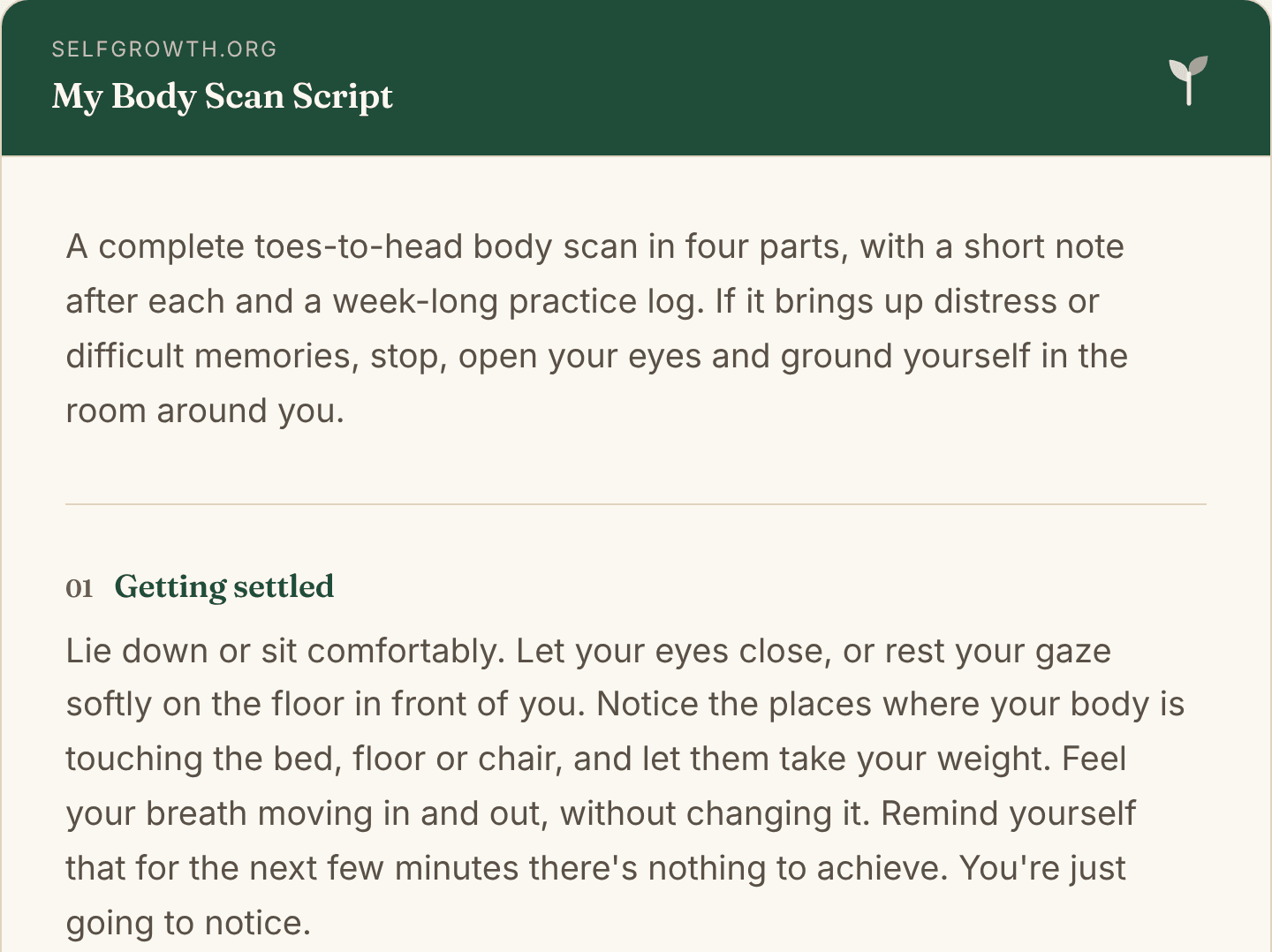
Body Scan Script
A free body scan meditation script in plain English: move your attention slowly from toes to head, noticing without changing, with reflection prompts and a log.
Open worksheet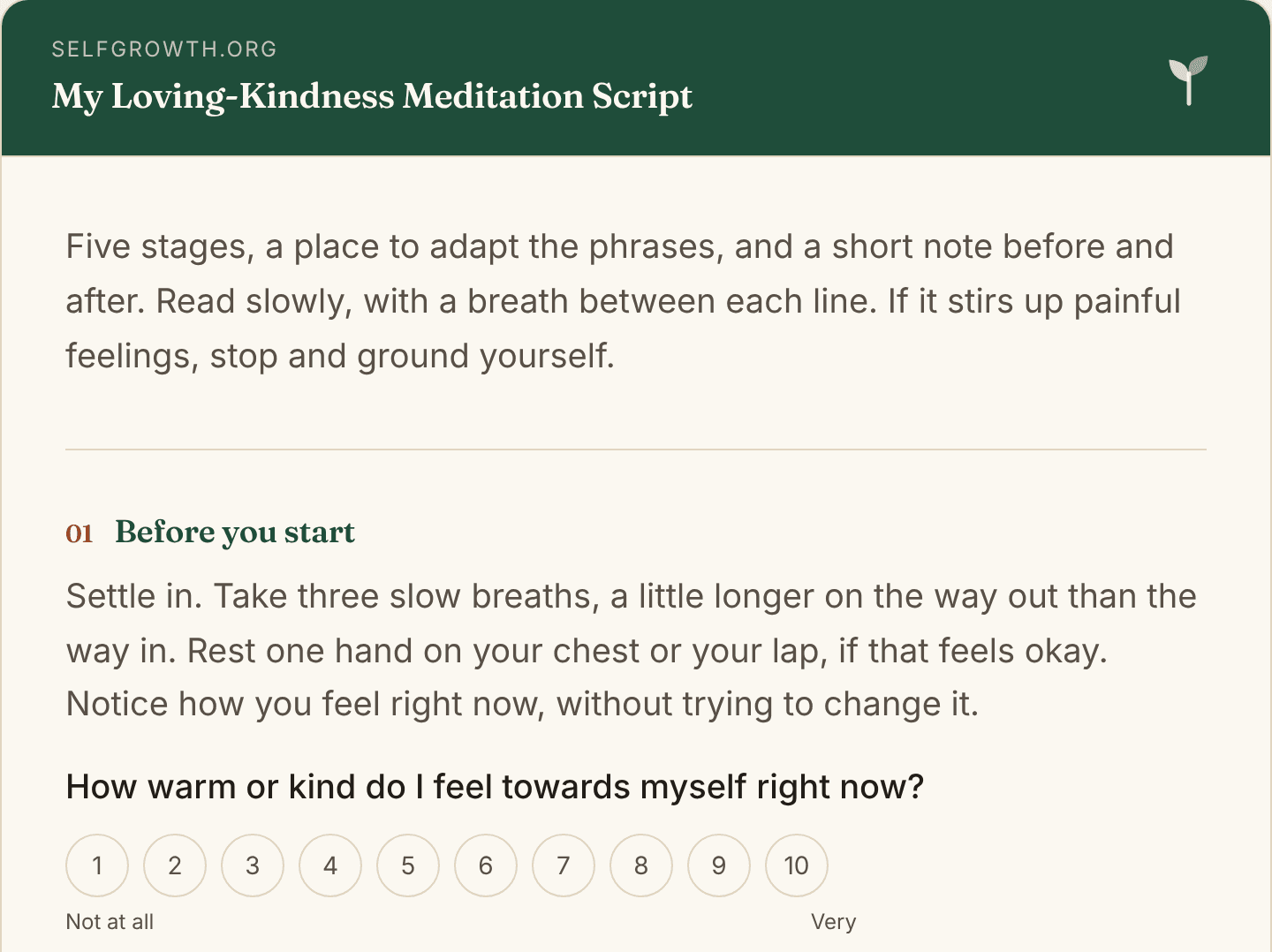
Loving-Kindness Meditation Script
A free loving-kindness (metta) meditation script in plain English: kind wishes for you, someone you love, a neutral person, someone difficult, everyone.
Open worksheet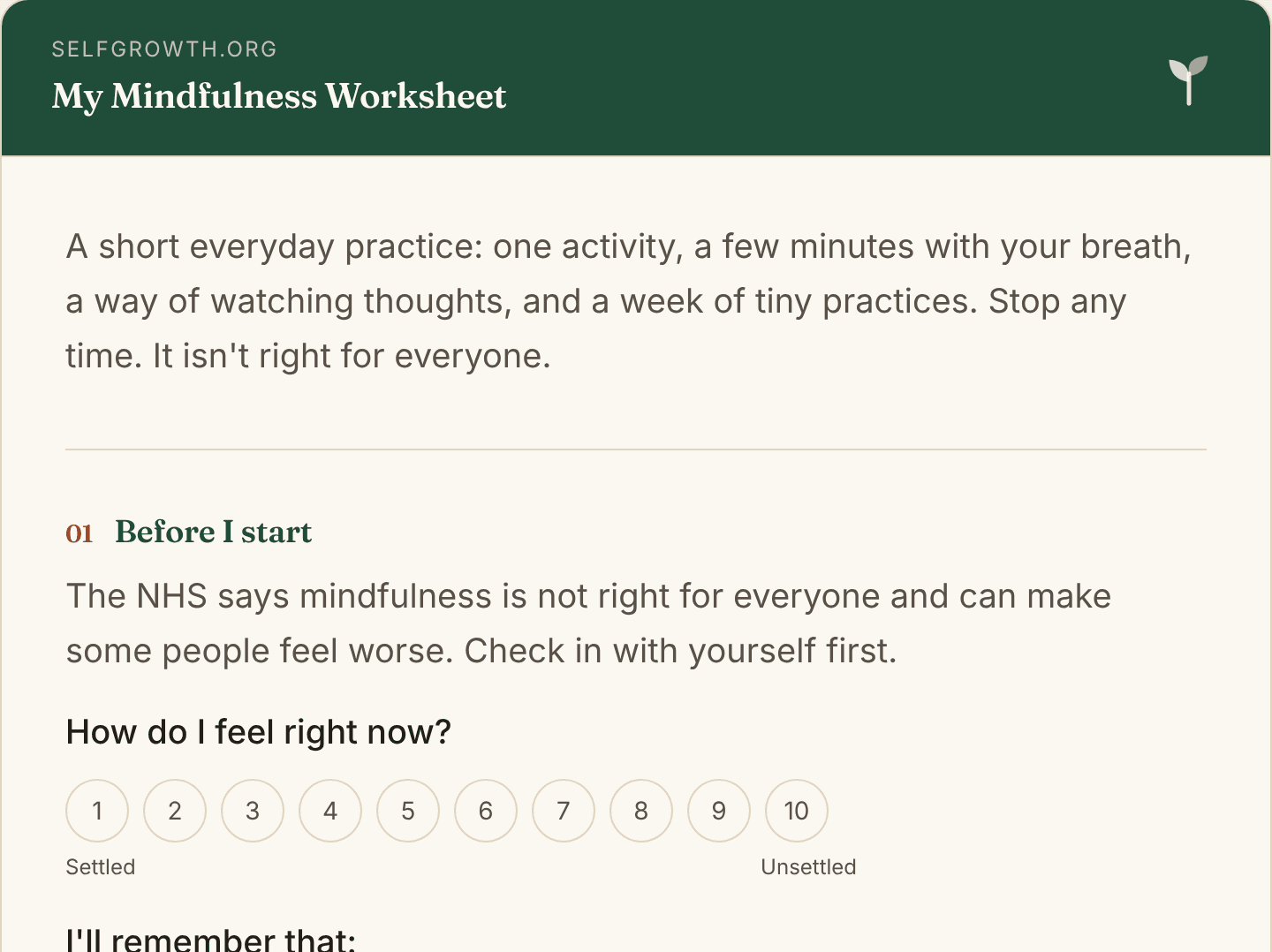
Mindfulness Worksheet
A free mindfulness worksheet: one everyday activity, a few minutes with your breath, a way to watch thoughts and a week of tiny practices. Not for everyone.
Open worksheetNew worksheets, straight to your inbox
An occasional new worksheet or tool, sent only when there's something genuinely worth your time. No spam, no pressure, unsubscribe any time.