
Anxious moments
Cognitive defusion worksheet: free, printable ways to step back from a sticky thought
Updated 23 October 2026 · 6 min read · Free to print
Cognitive defusion is a skill from Acceptance and Commitment Therapy (ACT) for stepping back from a thought instead of arguing with it. This free, printable worksheet gives you a menu of techniques, such as 'I'm having the thought that...', naming the story and thanking your mind, with a before and after rating.
Drawn from Acceptance and Commitment Therapy (ACT) · Part of feelings and calm
Fill it in here (it saves in this browser, but not in a private window), print it, or download the PDF. Free, no sign-up.
Some thoughts grip you. 'I'm going to mess this up.' 'I'm not good enough.' You can feel them as if they were plain facts, and arguing with them can keep you stuck in them. Cognitive defusion is a different move. You don't try to prove the thought wrong or push it away. You change how you relate to it: you see it as a thought, words passing through your mind, rather than the truth about you or about what will happen.
This worksheet is a menu of defusion techniques. You pick one sticky thought, rate how much it grips you, try a few of the techniques, then re-rate. Some will feel odd or silly. Others may not work for you at all, and that is useful information. Keep the ones that help.
It's a self-help skill, not therapy, and it won't fix what is underneath a thought. Please read the safety note below before you start.
How to use this worksheet
- 1Start with an everyday sticky thought, not the heaviest one you have. You can come back to harder ones with support.
- 2Defusion is not for ignoring real danger. If the thought is about harming yourself (thoughts like these are serious), or you are not safe where you are, put the worksheet down and use the support lines in the FAQ below or at selfgrowth.org/help.
- 3Try two or three techniques, not all of them at once. Say them out loud if you can, and expect some to feel awkward.
- 4Re-rate honestly. A thought that grips you a little less is a good result. It does not need to disappear.
The worksheet
selfgrowth.org
My Cognitive Defusion Worksheet
Pick one sticky thought and rate it. Try the techniques, re-rate, then note what helped and what did not.
01The thought, and how much it grips me
Choose an everyday thought that keeps coming back. If the thought is about harming yourself (thoughts like these are serious), or someone is frightening you, stop here and see selfgrowth.org/help.
The thought, in its own words:
For example: 'I'm going to make a fool of myself.'
How much do I believe it right now?
How much does it pull me around or upset me right now?
02Techniques to try
These are common defusion exercises from the ACT approach. Try two or three. You don't need to believe the thought is wrong for them to work, and they aren't meant to make the thought go away.
1. Add a prefix. Rewrite it as: 'I'm having the thought that...'
Then try: 'I notice I'm having the thought that...'. Say it slowly and notice whether it feels different.
2. Name the story. What would I call this one?
For example 'the I'll-fail story' or 'the not-good-enough story'. Then say: 'Ah, there's the ... story again.'
3. Thank your mind.
Write a short, light reply: 'Thanks, mind, I know you're trying to protect me.' You don't have to agree with it or obey it.
4. Change how the thought sounds or looks. Tick any I tried:
5. Ask: is holding this thought tightly helping me right now?
Not 'is it true?', but 'does acting on it, or fighting it, move me towards what matters to me?'
03How do I feel now?
Re-rate the same thought. A small change counts.
How much do I believe it now?
How much does it pull me around or upset me now?
Which technique helped most, which did nothing, and which made it worse?
04When the thought might be right
Defusion is for thoughts that are stuck, not for warnings you need to act on. Check before you use it.
Tick any that apply. If so, take action or get help first, and come back to this later:
The person or line I'll turn to first (a friend, my GP, Samaritans 116 123, 988 in the US) is:
05My defusion log
Note each time you try one, so you can see which ones suit you. Rate how much the thought grips you from 1 to 10, before and after.
Entry 1
Entry 2
Entry 3
Entry 4
Entry 5
When you're done, a moment to reflect
- Which of my sticky thoughts show up again and again, and what story do they tell?
- Did any technique make the thought feel more like words and less like a fact?
- When I hold this thought tightly, what does it stop me doing?
- Is there a thought on my list that I should check against the facts or act on, rather than step back from?
- Who could I talk to if these thoughts are heavy, or are not easing?
Done for now?
Save today's answers as a dated entry. You can come back, fill it in again and compare the two side by side.
Does cognitive defusion work?
Cognitive defusion is one of the processes in Acceptance and Commitment Therapy (ACT), developed by Steven C. Hayes and colleagues. The core book is Hayes, Strosahl and Wilson's Acceptance and Commitment Therapy (1999, with a second edition in 2012), where defusion sits alongside acceptance, present-moment attention, values and committed action. The techniques on this sheet are taught in many slightly different versions. No single originator is agreed for the 'I'm having the thought that' wording, naming the story, or the silly voice.
The word-repetition technique has been tested. In a few small lab tests by Masuda, Hayes, Sackett and Twohig (2004), saying one word over and over made a bad thought feel less upsetting and less believable, more than distraction or trying to control the thought did. A 2012 review by Levin and colleagues combined 66 lab studies of ACT-style exercises and found positive effects for defusion compared with doing nothing.
Honest limits. These are short laboratory studies. The big ACT reviews, such as A-Tjak and colleagues (2015, 39 trials with 1,821 people), found ACT as a whole therapy beat control conditions and did not differ significantly from CBT. That tells you about the full therapy given by a therapist, not about a worksheet on its own. The evidence for defusion by itself, done alone at home, is limited. That is why this page asks you to rate how it works for you.
These are educational self-reflection tools, not therapy.
If you want to go deeper
- Hayes, S. C., Strosahl, K. D. & Wilson, K. G. (1999). Acceptance and Commitment Therapy: An Experiential Approach to Behavior Change. Guilford Press. (2nd ed., 2012, Acceptance and Commitment Therapy: The Process and Practice of Mindful Change.)
- Masuda, A., Hayes, S. C., Sackett, C. F. & Twohig, M. P. (2004). Cognitive defusion and self-relevant negative thoughts: Examining the impact of a ninety year old technique. Behaviour Research and Therapy, 42, 477-485.
- Levin, M. E., Hildebrandt, M. J., Lillis, J. & Hayes, S. C. (2012). The impact of treatment components suggested by the psychological flexibility model: A meta-analysis of laboratory-based component studies. Behavior Therapy, 43, 741-756.
- A-Tjak, J. G. L., Davis, M. L., Morina, N., Powers, M. B., Smits, J. A. J. & Emmelkamp, P. M. G. (2015). A meta-analysis of the efficacy of acceptance and commitment therapy for clinically relevant mental and physical health problems. Psychotherapy and Psychosomatics, 84(1), 30-36.
Your questions, answered
- What is cognitive defusion?
- It's a skill from Acceptance and Commitment Therapy (ACT). Instead of arguing with a thought or trying to push it away, you practise seeing it as a thought, a string of words in your mind, so it has less hold over what you do. The thought can still be there. The aim is to be less tangled up in it.
- How do you do cognitive defusion?
- Pick a sticky thought and try a technique on it: put 'I'm having the thought that...' in front of it, give the story a name, thank your mind, or say the thought in a silly voice. Rate how much the thought grips you before and after. Section 2 of this worksheet gives you a menu to try.
- Does cognitive defusion work?
- The research is limited. A 2004 study by Masuda and colleagues found that repeating a word over and over lowered the discomfort and believability of a negative thought more than distraction did. A 2012 review of 66 laboratory studies found positive effects for defusion exercises compared with doing nothing. But those are short lab studies, and the larger reviews of ACT study the whole therapy, not defusion alone. So treat it as something to test for yourself.
- What is the difference between cognitive defusion and cognitive restructuring?
- Cognitive restructuring (as in a CBT thought record) asks whether a thought is accurate and looks for a more balanced one. Defusion doesn't ask you to change the thought. It changes how you relate to it, so you can notice it without acting on it. One may fit you better than the other. You can try both.
- Is there a cognitive defusion worksheet PDF?
- Yes. Use the Download PDF button for a clean, print-ready copy, or Print to print straight from the page. It's completely free, with no payment and no email needed. You can also fill it in on screen, and your answers save in your browser.
- What if the worrying thought is true?
- Then it needs a different response. Defusion is not a way to ignore real danger or a real problem. If the thought points at something you can act on, act on it or ask someone for help. If you feel unsafe, or the thought is about harming yourself (thoughts like these are serious), reach out now, and see selfgrowth.org/help.
- Is this worksheet a substitute for therapy?
- No. It's a self-help tool, not therapy or medical advice. If thoughts are taking over your days, a GP can point you towards talking therapies, and ACT is one of them. If you ever feel unsafe or have thoughts of harming yourself, call Samaritans on 116 123 (UK and Ireland), 988 (US), or find a line at findahelpline.com.
Keep going, related worksheets
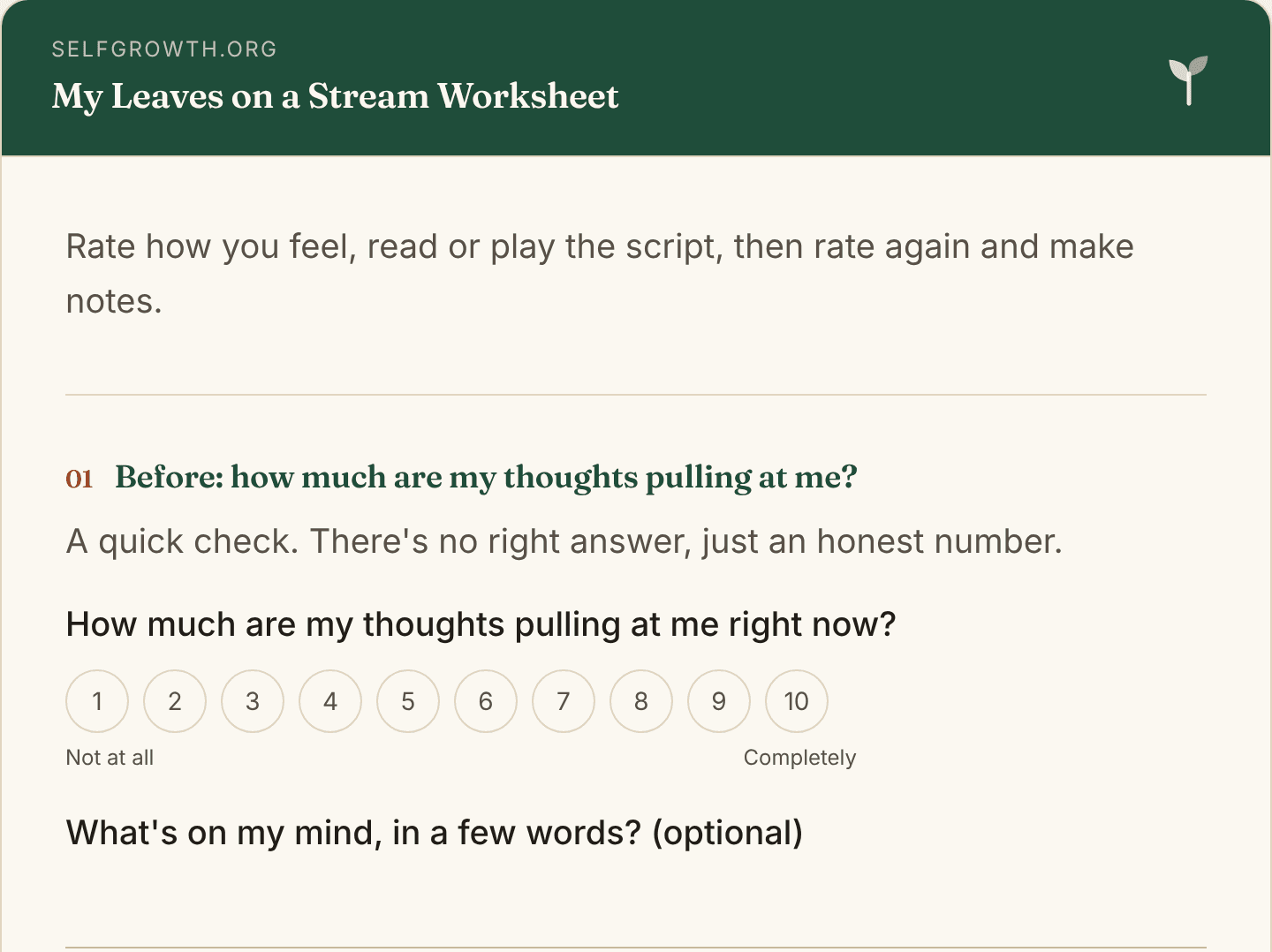
Leaves on a Stream Worksheet
A free, printable leaves on a stream worksheet: a short script to read slowly or record, with a before and after rating and space for notes.
Open worksheet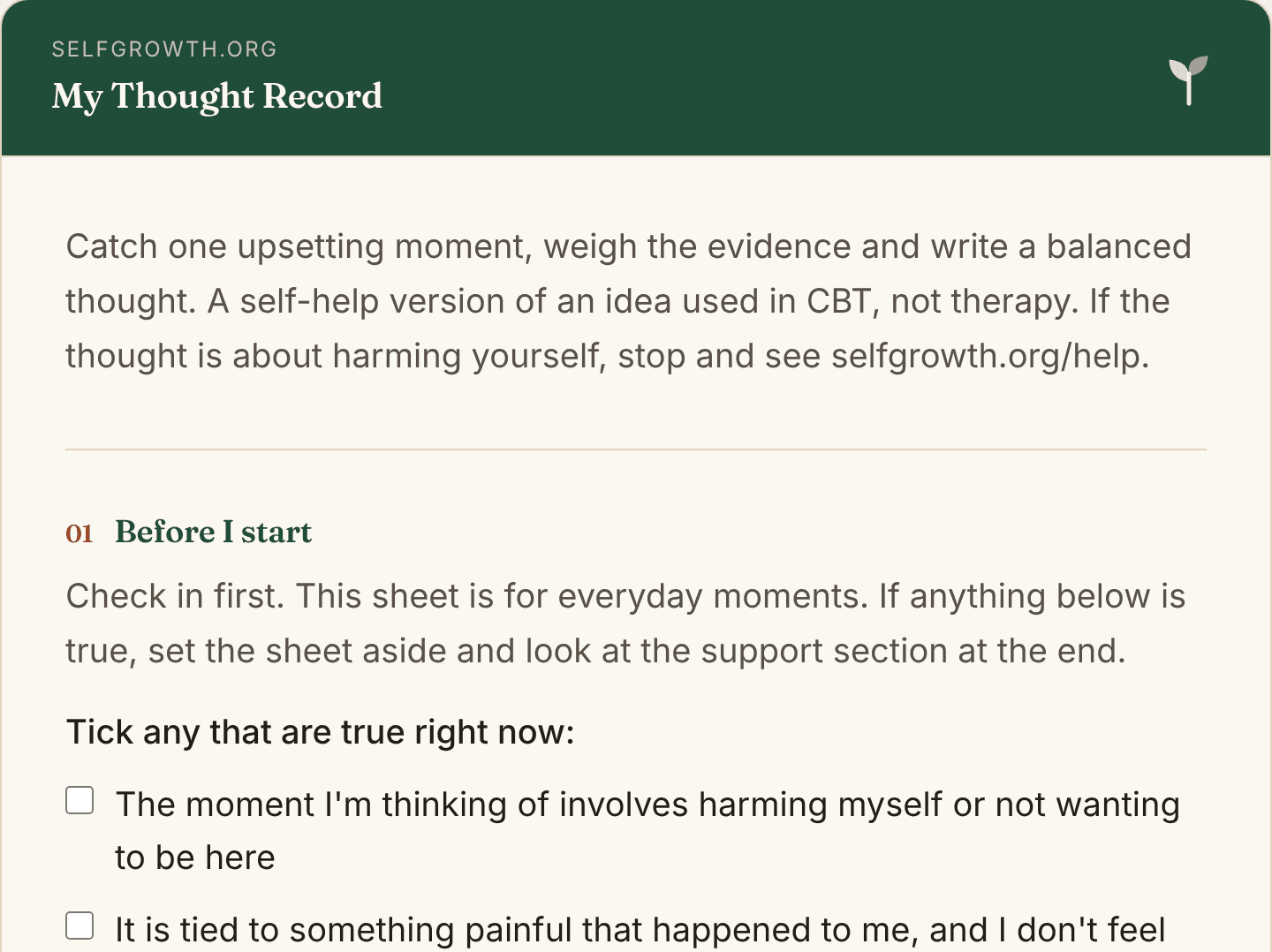
Thought Record Worksheet
Free thought record worksheet: note the situation, feeling and thought, weigh the evidence and write a balanced thought. Self-help, not therapy. Free PDF.
Open worksheet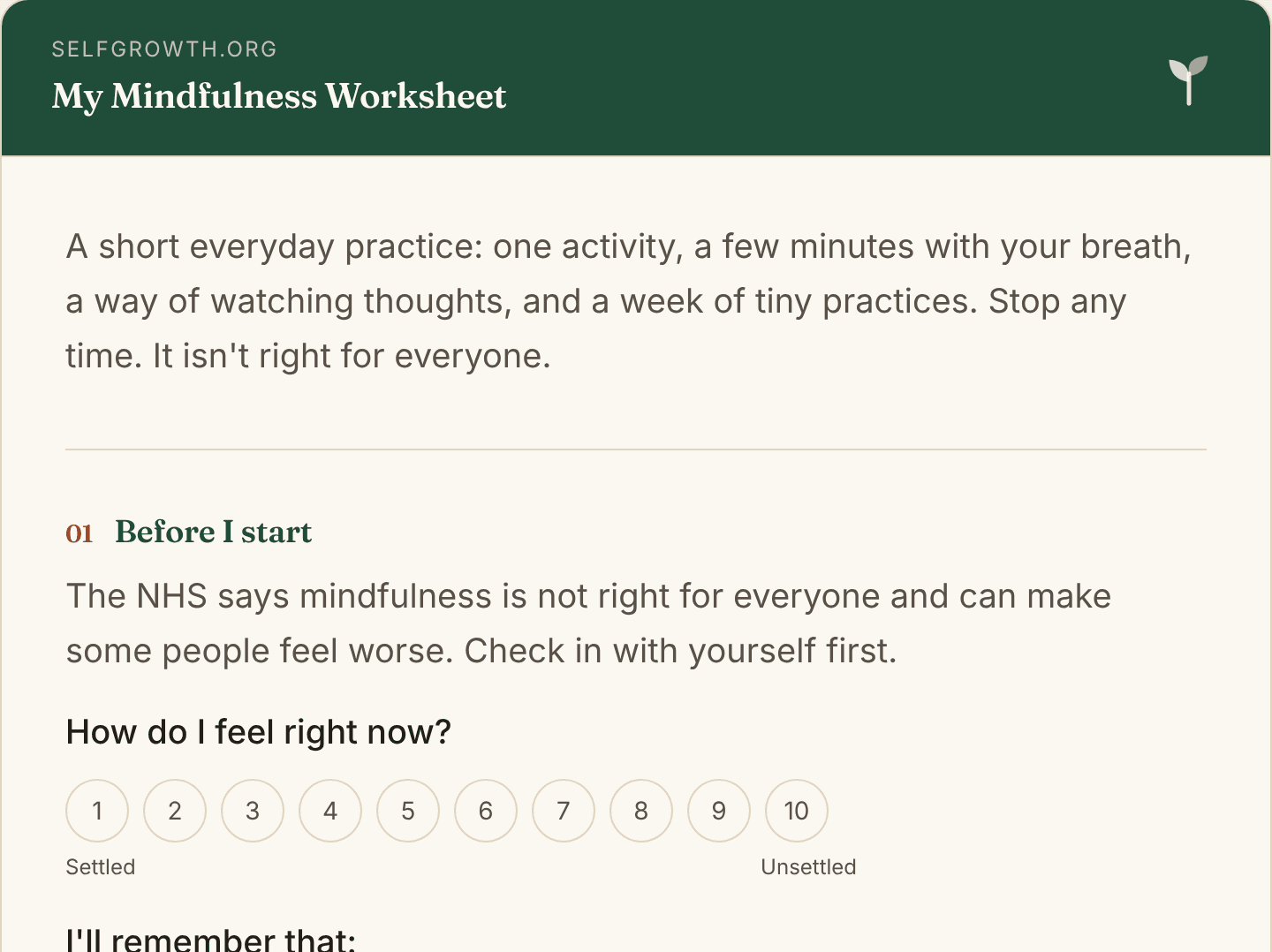
Mindfulness Worksheet
A free mindfulness worksheet: one everyday activity, a few minutes with your breath, a way to watch thoughts and a week of tiny practices. Not for everyone.
Open worksheetNew worksheets, straight to your inbox
An occasional new worksheet or tool, sent only when there's something genuinely worth your time. No spam, no pressure, unsubscribe any time.