
Anxious moments
Anxiety cycle worksheet: a free printable to map one anxious loop
Updated 23 October 2026 · 7 min read · Free to print
The anxiety cycle is a loop: a trigger sets off an anxious thought and a body reaction, you do something to feel safe, you get short-term relief, and the worry returns. This free printable worksheet helps you map one loop, spot avoidance or reassurance-seeking, and choose one small change to try.
Drawn from NHS anxiety self-help advice and research on safety behaviours · Part of feelings and calm
Fill it in here (it saves in this browser, but not in a private window), print it, or download the PDF. Free, no sign-up.
Picture a text you have not answered, or a message from work. A thought lands: 'I have upset them.' Your stomach tightens. So you check the message again, or ask a friend if it sounds okay, or leave it for later. For a moment you feel better. Then the worry comes back, and the next trigger starts the loop again.
That loop is what this worksheet maps. You pick one anxious moment and write down the trigger, the thought, how your body felt, what you did, the relief that followed, and what the whole thing taught you. Laid out on paper, the pattern can be easier to see than it is inside your head.
Two of the things we do to feel safe are worth looking at closely. Avoidance means staying away from the thing that worries you. Reassurance-seeking means asking, checking or looking things up to be told it is fine. Both bring relief quickly. The trouble is that the relief is short-lived and the urge tends to return. NHS advice says avoiding situations or relying on habits we think will keep us safe might actually make anxiety worse.
This is a self-help sheet for an everyday moment. It is not therapy and it does not tell you whether you have an anxiety problem. Please read this first. See a GP if your anxiety is constant, stops you doing things you need to do, or comes as panic attacks. If you have chest pain or trouble breathing, get urgent medical care: call 999 (UK) or 911 (US); use NHS 111 if you are unsure. Thoughts like these are serious, so if you have thoughts of harming yourself, call Samaritans on 116 123 (UK and Ireland), call or text 988 (US), or find a line at findahelpline.com. More support is listed at selfgrowth.org/help.
How to use this worksheet
- 1Choose one recent, ordinary anxious moment. Not the worst one you can remember.
- 2Fill in the loop in order. Short answers are fine, and you can leave a box blank.
- 3Then look at what you did and the relief it gave, and decide whether you would like to try one small change.
- 4Choosing no change is allowed. Mapping the loop is already useful.
- 5Common avoidance and reassurance behaviours include checking messages, asking if it is fine, googling symptoms and cancelling plans.
The worksheet
selfgrowth.org
My anxiety cycle
Map one anxious loop, notice avoidance or reassurance-seeking, and choose one small thing to try. For everyday worry, not a diagnosis. If anxiety is constant, stops you doing things you need to do, or comes as panic attacks, see a GP. A new or changing physical symptom is worth checking with a doctor.
01Before I start
Pick a moment you can look at calmly. If any of these is true, set the sheet aside and get help first.
Get help first if:
The person or line I will turn to first if I need to:
02The moment I am mapping
Choose one situation and describe it in a sentence or two.
What happened, where and when?
How anxious did I feel at the peak?
03Map the loop
Go in order. The loop starts with a trigger and, if nothing changes, comes round to the next one.
Trigger: what set it off?
A message, a place, a date in the diary, a memory, a sound. Sometimes you will not know, and that is fine.
Thought: what went through my mind?
Write it as it came, for example 'I have upset them' or 'I will not cope'.
Body: what did I feel?
For example a tight chest, a knot in the stomach, a racing heart, shaky hands, restlessness.
What I did: what did I do, or avoid doing?
Left, cancelled, put it off, checked, asked, looked it up, kept busy, had a drink.
Short-term relief: how did I feel straight afterwards?
What it taught me: what did my mind take from it?
For example 'I only got through it because I left' or 'I needed them to say it was fine'.
04Avoidance and reassurance
Avoidance and reassurance-seeking are two kinds of safety behaviour: things you do to feel safe. Tick any that were part of this loop.
In this loop I:
What did the relief cost me (time, plans, energy, a relationship)?
Did the worry come back, and how soon?
05Where I could try one small change
You do not have to break the whole loop. Pick one place in it and try one small thing. Small and doable beats big and dropped.
Places in the loop I could try something different:
My one small change (kept small and safe):
For example 'wait a few minutes before asking for reassurance' or 'stay in the shop a little longer'.
Who or what could help me do it:
06After I tried it
Come back to this part afterwards. 'It was hard and I did it' counts, and so does 'I could not do it yet'.
What did I do, and what happened?
How anxious did I feel at the peak this time?
What did the anxiety do over time, and what did I learn?
When you're done, a moment to reflect
- Which part of the loop did you find hardest to see: the trigger, the thought, the body feeling or what you did?
- What does the relief give you now, and what does it take away later?
- Is there something you have been avoiding that you would like to get back to?
- Who could you ask for company, rather than reassurance, while you try something small?
- If this loop keeps coming round and costs you a lot, who could you talk to about it?
Done for now?
Save today's answers as a dated entry. You can come back, fill it in again and compare the two side by side.
Does avoiding things keep anxiety going?
The idea that avoidance keeps anxiety going appears in NHS advice. The NHS Every Mind Matters pages say that avoiding situations or relying on habits we think will keep us safe might actually make anxiety worse, and that slowly facing up to a situation might help. The NHS page on panic disorder describes people avoiding places because they fear another attack, and living in fear of fear.
Researchers call these behaviours safety behaviours: actions to prevent, escape or reduce a feared outcome. A 2016 review found safety behaviours are linked to anxiety lasting. It was less clear how they affect treatment. That review is about clinical anxiety and its treatment, not everyday worry. A short 2013 article by David Osborne and Christopher Williams in Advances in Psychiatric Treatment describes reassurance-seeking as bringing immediate relief that does not last.
The sheet is a way to look at your own pattern, and no study tests this worksheet. Your own notes show whether a small change helps.
These are educational self-reflection tools, not therapy.
If you want to go deeper
- NHS Every Mind Matters. Anxiety: tips on managing anxiety. nhs.uk/every-mind-matters/mental-health-issues/anxiety/
- NHS. Generalised anxiety disorder in adults: self-help. nhs.uk/mental-health/conditions/generalised-anxiety-disorder/self-help/
- NHS. Panic disorder. nhs.uk/mental-health/conditions/panic-disorder/
- Blakey, S. M. & Abramowitz, J. S. (2016). The effects of safety behaviors during exposure therapy for anxiety: Critical analysis from an inhibitory learning perspective. Clinical Psychology Review, 49, 1-15.
- Osborne, D. W. S. & Williams, C. J. (2013). Excessive reassurance-seeking. Advances in Psychiatric Treatment, 19(6), 420-421.
Your questions, answered
- What is the anxiety cycle?
- It is a picture of how anxiety can feed itself: a trigger brings an anxious thought and a body reaction, you do something to feel safe, you feel relief for a short while, and the worry returns. This worksheet helps you map one loop from your own life.
- How does avoidance keep anxiety going?
- Avoiding what worries you brings quick relief, but it stops you finding out what would have happened. NHS advice says avoiding situations or relying on habits we think will keep us safe might actually make anxiety worse, and suggests slowly facing situations instead. A 2016 review found safety behaviours are linked to anxiety lasting. It was less clear how they affect treatment.
- Why does asking for reassurance make anxiety worse?
- A short 2013 article by Osborne and Williams describes reassurance-seeking as bringing immediate relief that does not last, with the urge returning. In other words, the relief is short-lived and the urge tends to return. Asking a friend for support is fine. It is the repeated asking, checking and looking things up for certainty that can become part of the loop.
- How do I break the anxiety cycle?
- Pick one place in the loop and try one small change: notice a trigger sooner, write a thought down, slow your breathing, or wait a few minutes before you avoid or check. NHS advice for anxiety includes slowly building up time in situations that worry you. If it feels like too much alone, a GP can point you to talking therapies, and in England you can refer yourself to NHS talking therapies.
- Is the anxiety cycle the same as a panic attack?
- Not exactly. The cycle describes a pattern that can build up around any anxious moment. Panic attacks are sudden and intense. If you have panic attacks, or you start avoiding places because you fear another one, see a GP. A new or changing physical symptom is worth checking with a doctor. For chest pain or trouble breathing, get urgent medical care: call 999 (UK) or 911 (US); use NHS 111 if you are unsure.
- Is there an anxiety cycle worksheet PDF?
- Yes. Use the Download PDF button for a clean, print-ready copy, or Print to print straight from the page. It is free, with no payment and no email needed. You can also fill it in on screen, and your answers save in your browser.
- Is this worksheet a substitute for therapy?
- No. It is a self-help tool for mapping an everyday moment, not therapy or medical advice, and it cannot tell you whether you have an anxiety problem. If anxiety is part of daily life, see a GP. If you have thoughts of harming yourself, thoughts like these are serious: call Samaritans on 116 123 (UK and Ireland), 988 (US), or find a line at findahelpline.com.
Keep going, related worksheets
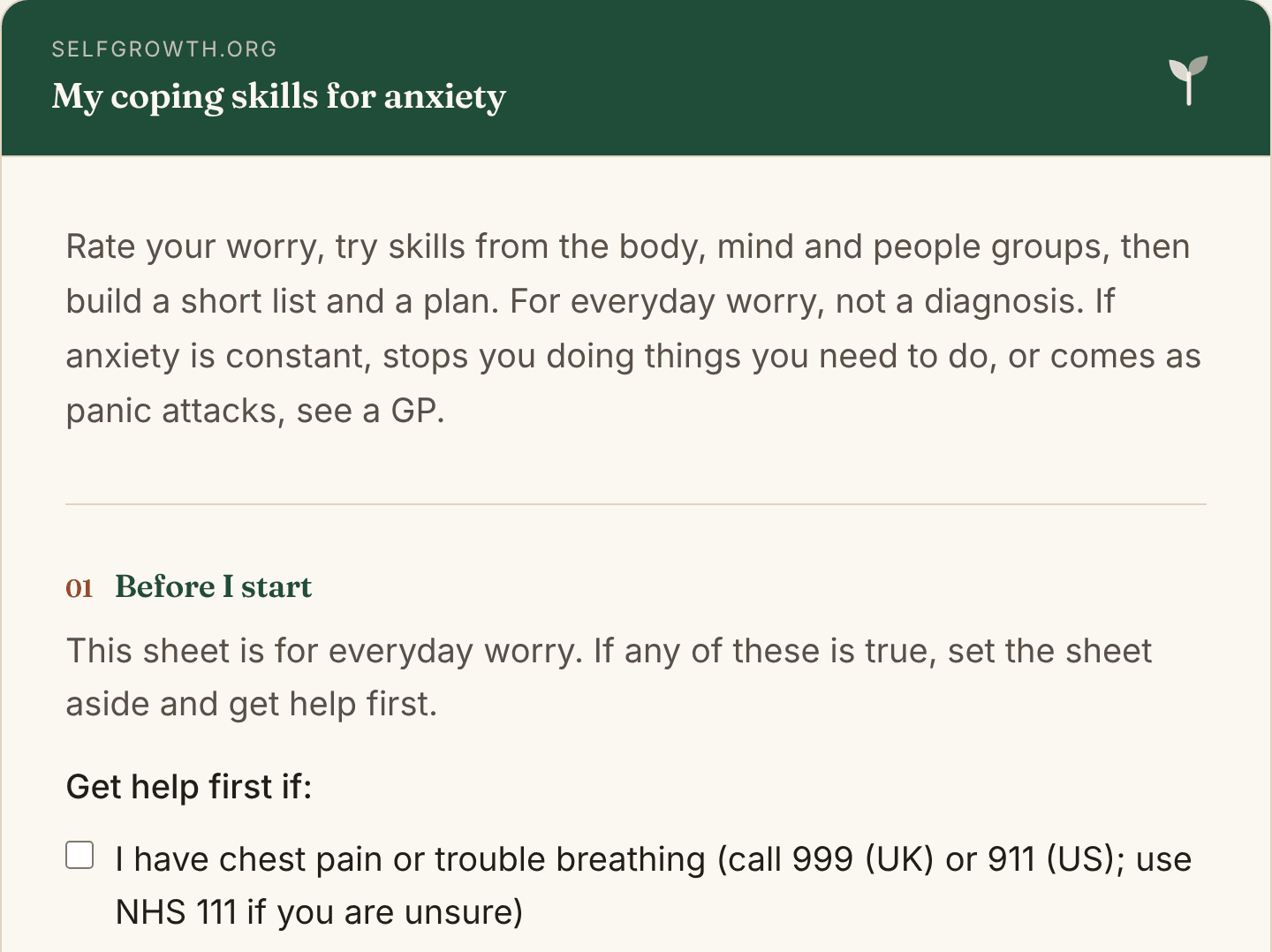
Coping Skills for Anxiety Worksheet
Free printable coping skills for anxiety worksheet: rate your worry, try body, mind and people skills, then build a short list and an if-then plan.
Open worksheet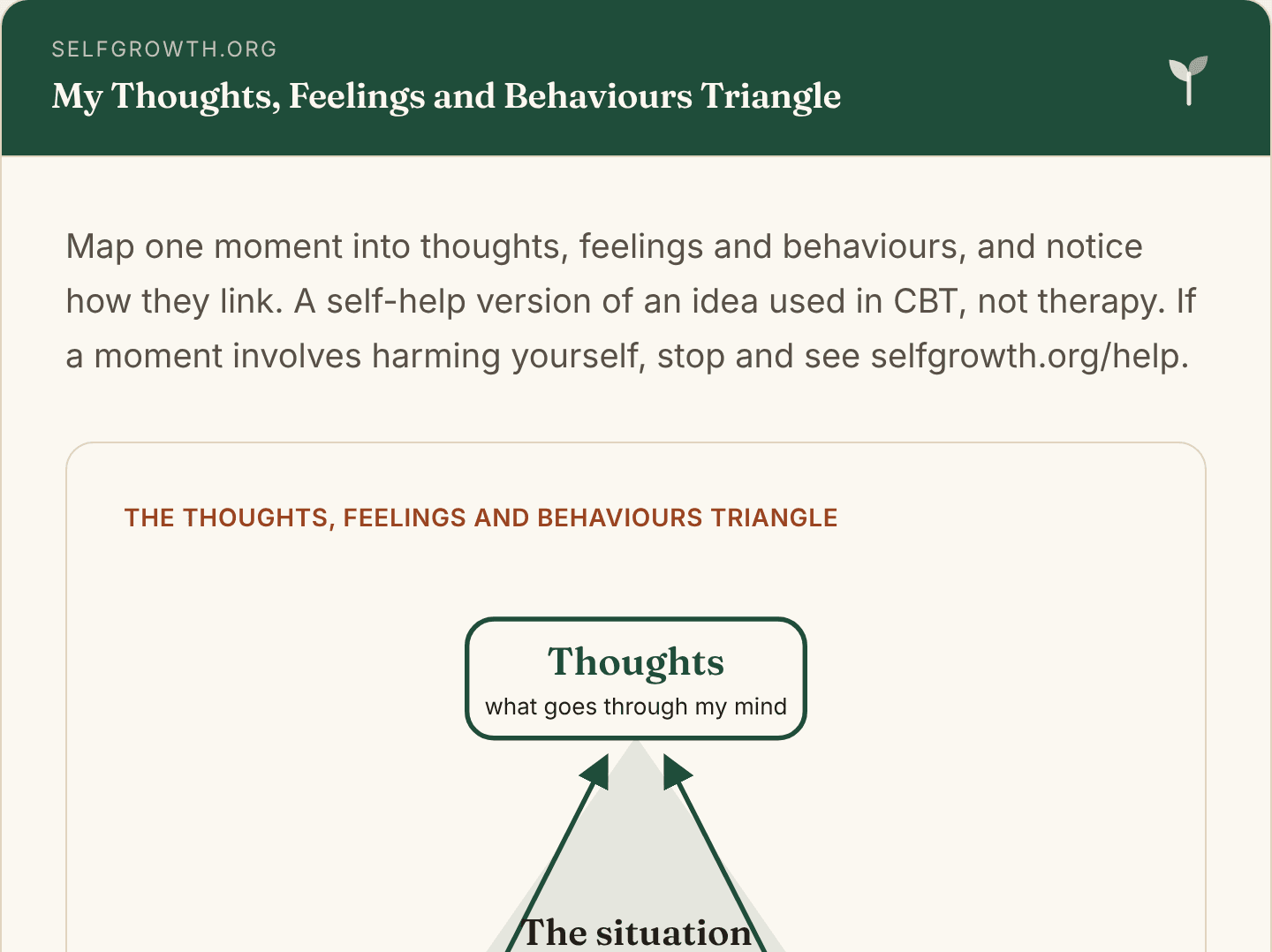
CBT Triangle Worksheet
Free CBT triangle worksheet: map one moment into thoughts, feelings and behaviours and see how they link. Self-help, not therapy. Free printable PDF.
Open worksheet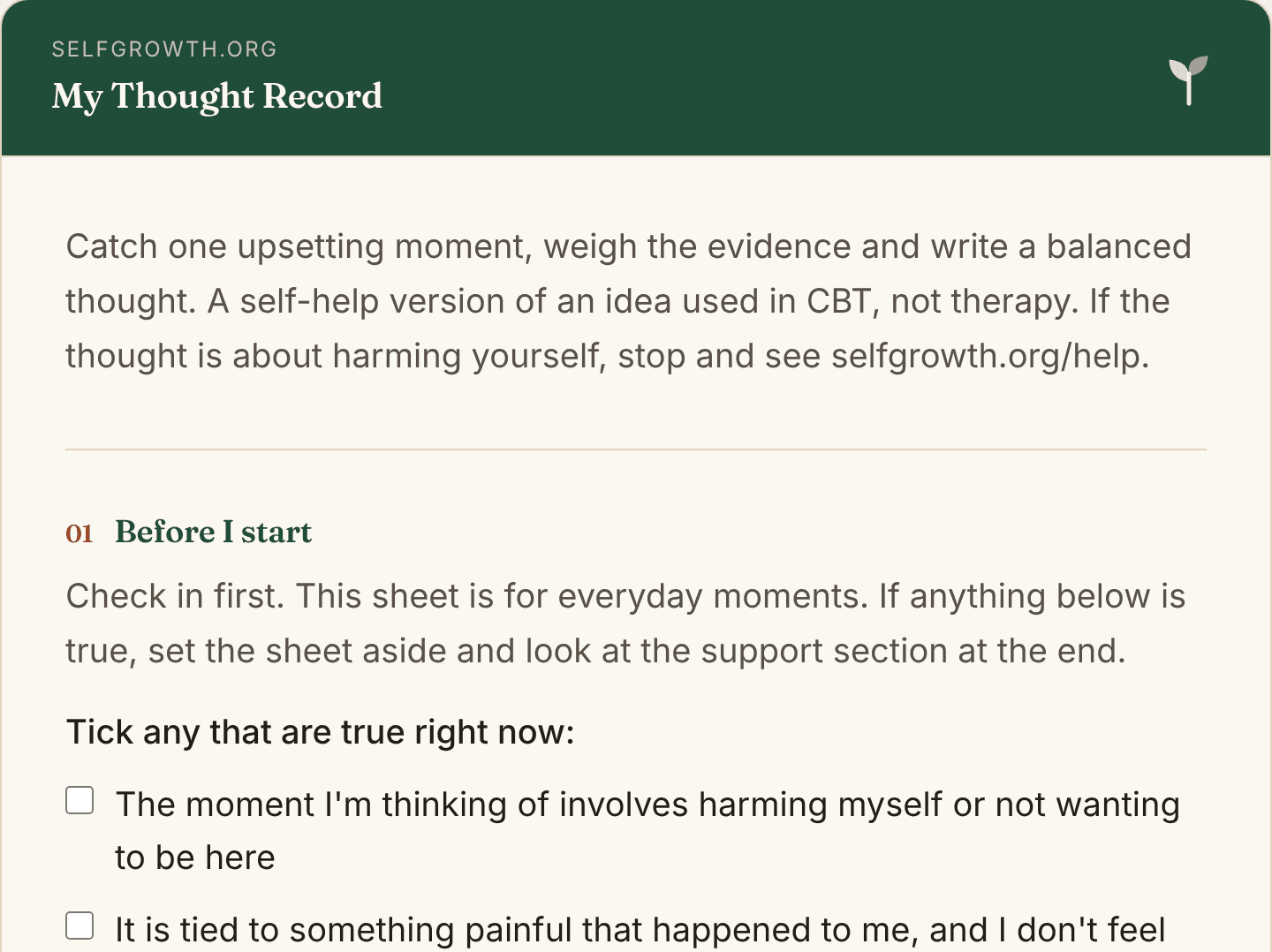
Thought Record Worksheet
Free thought record worksheet: note the situation, feeling and thought, weigh the evidence and write a balanced thought. Self-help, not therapy. Free PDF.
Open worksheetNew worksheets, straight to your inbox
An occasional new worksheet or tool, sent only when there's something genuinely worth your time. No spam, no pressure, unsubscribe any time.