
Relationships
Friendship worksheet: a free way to look at the friendships you have and want
Updated 25 October 2026 · 10 min read · Free to print
A friendship worksheet helps you look at the friendships in your life as they are now. You map who you see and how you feel afterwards, note what you value in a friend, pick one friendship to grow with a small step, and decide what to do about one that drains you.
A self-reflection format, with a little research on how friendships form · Part of relationships and communication
Fill it in here (it saves in this browser, but not in a private window), print it, or download the PDF. Free, no sign-up.
Friendships can drift without anyone deciding it. A new job, a move, a baby or a busy year, and the people you meant to call become the people you never got round to calling. This sheet gives you an hour to look at them on purpose: who is in your life, how you feel after seeing them, and where one small step would help.
It is about your own feelings, not scores for other people. If you want to meet new people, start with the guide to making friends as an adult. To be a better listener once you are together, try the active listening worksheet.
This is a self-help tool, not therapy. It is for ordinary ups and downs in friendships. If you feel lonely a lot of the time, or low in a way that will not lift, a GP can help.
How to use this worksheet
- 1Start with the map in section 1. Use first names or initials if you plan to print it and leave it out.
- 2Write how you feel, not what a friend 'should' be. There are no right answers.
- 3Pick just one friendship to grow and one small step. A small step is easier to do.
- 4Come back to the monthly look-back at the end, in a month's time.
The worksheet
selfgrowth.org
My Friendships
Map your friendships, name what you value, pick one to grow and one to ease, plan a reach-out. If you feel afraid of or controlled by someone close to you: England 0808 2000 247, Scotland 0800 027 1234, Wales 0808 80 10 800, Northern Ireland 0808 802 1414, US 1-800-799-7233.
01My friendships now
List the people who matter to you, from close friends to ones you would like to be closer to. Write about your own experience only. This is not a ranking of anyone.
Entry 1
Entry 2
Entry 3
Entry 4
Entry 5
Entry 6
Looking at the list, what do I notice?
How do I feel about my friendships overall, right now?
02What I value in a friend
Tick what matters to you. These are your own preferences. None is more correct than another.
Three things I value most in a friend, in my own words:
03What kind of friend I am
Think about how you show up for people. Give yourself the same fairness you would give a friend.
Two things I do well as a friend:
One thing I would like to work on, and why:
A time I felt I was a good friend to someone:
04A friendship I would like to grow
Friendship needs time together. In one 2019 paper by J. A. Hall, two studies found that more hours spent together went with closer friendship. In the first, time doing leisure activities together also predicted closeness. They show links, not proof of cause. A small, shared thing is a good place to start.
The friendship I would like to grow (name or initials):
Why it matters to me:
My one small step, and when I will do it:
05A friendship that drains me
Sometimes you leave a friend feeling flat, worried or small. That is worth noticing, gently. It does not mean they are a bad person or that the friendship has to end. This section is for friendships where you can speak up safely. If you feel afraid of someone close to you, or they control, threaten or hurt you, do not try to talk it through alone. In England, the National Domestic Abuse Helpline is free and open 24 hours on 0808 2000 247. In Scotland, call 0800 027 1234; in Wales, 0808 80 10 800; in Northern Ireland, 0808 802 1414. US: National Domestic Violence Hotline 1-800-799-7233. In immediate danger, call 999 (UK) or 911 (US).
The friendship (name or initials) and what I notice after seeing them:
What happens that leaves me feeling this way:
What I would like to change, and one small first step:
06Reaching out
A short, warm message is enough. You do not need to explain a long gap. Change the words until they sound like you.
My own message to someone I want to reach out to:
When I will send it:
07Monthly look back
Once a month, take ten minutes with this section. Write the date yourself. It is for you, not a score.
Date:
A friendship moment this month that I am glad of:
Who I reached out to, and how it went:
How supported do I feel by my friendships this month?
One small step for next month:
When you're done, a moment to reflect
- Who do you feel most like yourself with, and what do they do that helps?
- Is there someone you keep meaning to contact? What is stopping you?
- What do you give to your friends that you would like to receive too?
- Which friendships fit the person you are now, and which fitted an earlier you?
- What is one small thing you could do this week to be a friend, or to let one in?
Done for now?
Save today's answers as a dated entry. You can come back, fill it in again and compare the two side by side.
What the research says about friendship
The layout is a common self-reflection format: look at what you have, name what you value, pick one small step, and look back. No study has tested it, and it does not measure how good your friendships are. It is a way to think, not a score.
One 2019 paper looked at how friendships form. It is by J. A. Hall and called 'How many hours does it take to make a friend?'. In the first study, adults who had recently moved estimated their time with a new acquaintance. In the second, first-year students reported their hours with two new acquaintances over nine weeks. In both, more hours together went with closer friendship. In the first, time in leisure activities also predicted closeness. These are links, not proof of cause, and they are about new friendships. The guide to making friends as an adult covers this in more detail.
Friendships are not a project to optimise. Some fade, and that can be fine. If a friendship feels unsafe, the right step is support, not a talk. If loneliness or low mood is the real block, see your GP.
These are educational self-reflection tools, not therapy.
If you want to go deeper
- Hall, J. A. (2019). How many hours does it take to make a friend? Journal of Social and Personal Relationships, 36(4), 1278-1296.
- National Domestic Abuse Helpline (nationaldahelpline.org.uk); National Domestic Violence Hotline (thehotline.org).
Your questions, answered
- How do I know if a friendship is healthy?
- There is no official test. A useful sign is how you feel with the person and after seeing them: can you be yourself, do you feel listened to, and can you say no or disagree without a fight? Section 1 helps you notice this. If you feel afraid of someone, get support from a helpline.
- What makes a good friend?
- It depends on you. You might value listening, honesty, kindness, humour or keeping in touch. The checklist in section 2 lets you tick what matters to you, so you know what you are looking for, and what you offer.
- How do I make a friendship closer?
- Spend time together doing something you both enjoy, and make a small plan with a named day. In one 2019 paper, more hours spent together went with closer friendship, though that shows a link, not proof of cause. Keep in touch between meetings, too.
- What if a friend drains me?
- Notice what happens and when. You can say how it affects you, ask for one change, see them less often or in a group, or let the friendship fade. Section 5 lays these out. If you feel afraid of them, do not confront them alone. Call a helpline (England 0808 2000 247, Scotland 0800 027 1234, Wales 0808 80 10 800, Northern Ireland 0808 802 1414, US 1-800-799-7233).
- How do I reach out to a friend I have lost touch with?
- Keep it short and warm. 'I was thinking of you. How are you?' is enough, and you do not need to explain the gap. Suggest one easy plan with a named day. Section 6 has message starters you can change.
- Is there a friendship worksheet PDF?
- Yes. Use the Download PDF button for a clean, print-ready copy, or Print to print straight from the page. It is completely free, with no payment and no email needed. You can also fill it in on screen, and your answers save in your browser.
- Is this a substitute for therapy?
- No. It is a self-help tool, not therapy. If loneliness or low mood is getting in the way of daily life, talk to your GP. If someone close to you frightens or controls you, call a domestic abuse helpline (England 0808 2000 247, Scotland 0800 027 1234, Wales 0808 80 10 800, Northern Ireland 0808 802 1414, US 1-800-799-7233). If you ever feel unsafe or have thoughts of harming yourself, call Samaritans on 116 123 (UK and Ireland), 988 (US), or find a line at findahelpline.com.
Keep going, related worksheets
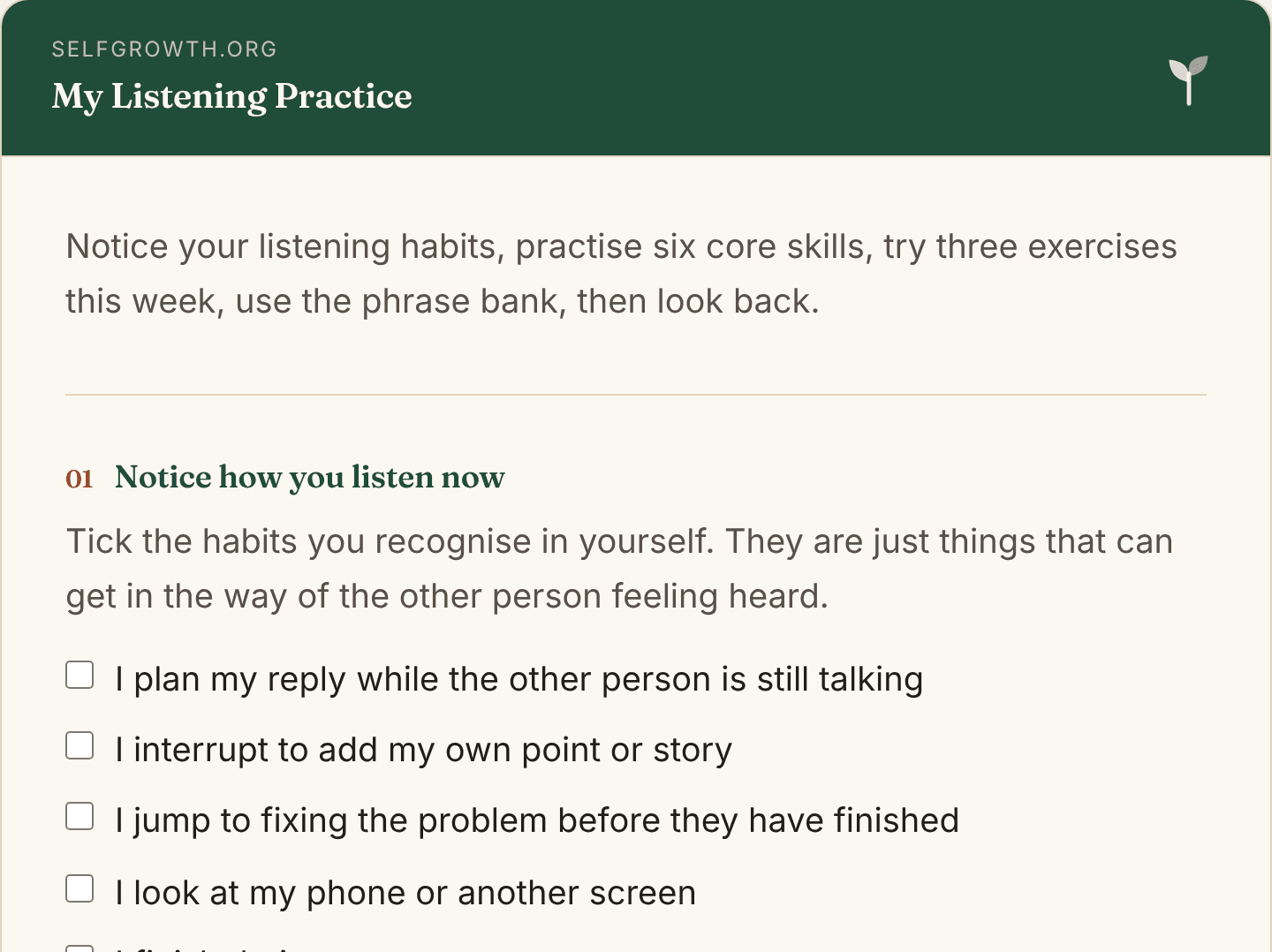
Active Listening Worksheet
A free active listening worksheet with exercises: spot your listening habits, practise six core skills, try three conversations this week and look back at what you noticed.
Open worksheet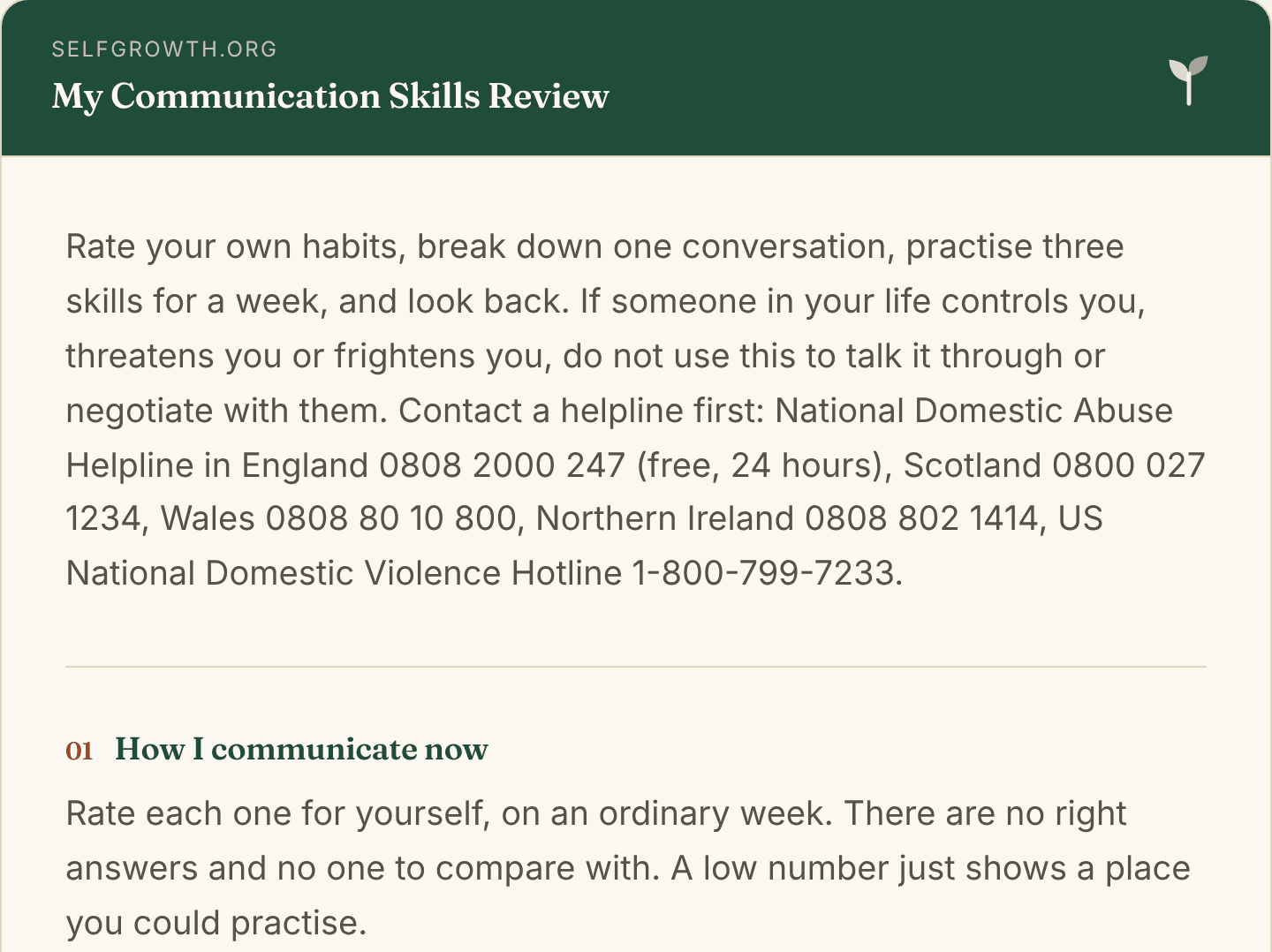
Communication Skills Worksheet
A free communication skills worksheet: rate your own habits, break down one hard conversation, practise three skills for a week, and use a phrase bank.
Open worksheet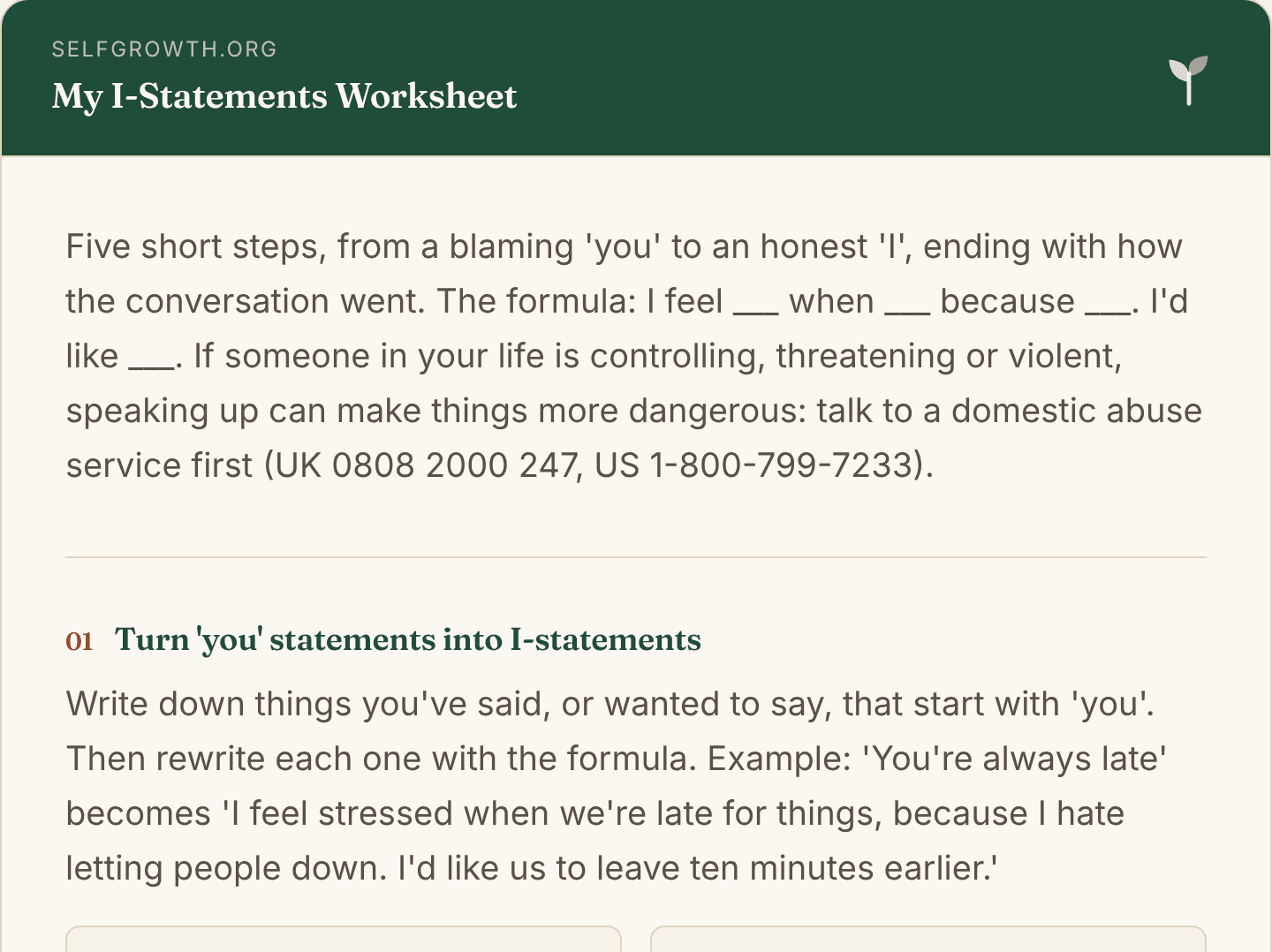
I-Statements Worksheet
A free, printable I-statements worksheet with I statement examples, the 'I feel... when... because...' formula, and space to plan one real conversation.
Open worksheetNew worksheets, straight to your inbox
An occasional new worksheet or tool, sent only when there's something genuinely worth your time. No spam, no pressure, unsubscribe any time.