
Anxious moments
Coping skills worksheet: a free printable to build your own plan for a hard day
Updated 23 October 2026 · 7 min read · Free to print
Coping skills are the things you do to get through a hard day: calming your body, taking your mind off it, reaching out, moving, looking after the basics, or working on the problem. This free printable worksheet helps you sort skills into those groups, pick a few, and write an if-then plan.
Drawn from everyday self-help and research on how people cope · Part of feelings and calm
Fill it in here (it saves in this browser, but not in a private window), print it, or download the PDF. Free, no sign-up.
A hard day is easier when you already know what you might reach for. Some days you need to calm down. Some days you need a break from the thing. Some days the best move is to sort out the problem itself. One skill rarely fits all of them, so this worksheet gives you a menu.
You rate how you feel, tick skills across six groups, then choose a top few and write an if-then plan for the next hard day. A short log lets you rate before and after, so your own results tell you what belongs on the list.
This is a self-help sheet. It is not therapy, and it cannot tell you what is behind how you feel. If you want skills aimed at worry in particular, the coping skills for anxiety worksheet is a companion to this one.
Please read this first. If you are struggling most days, or a low mood or worry is not lifting, talk to a GP. If you have chest pain, trouble breathing or fainting, get urgent medical care: call 999 (UK) or 911 (US); use NHS 111 if you are unsure. Thoughts like these are serious, so if you have thoughts of harming yourself or ending your life, call Samaritans on 116 123 (UK and Ireland), call or text 988 (US), or find a line at findahelpline.com. More support is at selfgrowth.org/help.
How to use this worksheet
- 1Fill in the first rating on a hard day, or think back to a recent one. Then tick skills you have used or want to try.
- 2Be honest. A skill that did nothing is useful to know about, so write it down.
- 3Choose a few for your top list. A short list you will use beats a long one you will not.
- 4Write the if-then plan on a calmer day, and keep the sheet where you will see it.
The worksheet
selfgrowth.org
My coping skills plan
Rate how you feel, tick skills from six groups, choose a top few and write an if-then plan. For hard days, not a diagnosis. If you are struggling most days, see a GP.
01Before I start
This sheet is for hard days. If any of these is true, set the sheet aside and get help first.
Get help first if:
The person or line I will turn to first if I need to:
02How am I doing right now?
A quick, honest check. There is no right number.
How hard does this feel right now?
What is making today hard, in a few words?
Keep it to yourself and your own situation. Leave out other people's names and details.
What do I feel in my body, and what do I feel like doing?
03Calm down, distract and connect
Three groups for when you need relief now. Calm skills settle your body. Distraction gives your mind a break. Connection puts someone alongside you.
Calm down. Tick the ones I have used or want to try:
Distract. Tick the ones I have used or want to try:
Connect. Tick the ones I have used or want to try:
Skill from these groups I tried, and what happened:
04Move and look after the basics
Two groups that make the next hour or two easier. Pick movement that suits your body today, and skip anything your doctor has told you to avoid.
Move. Tick the ones I have used or want to try:
Look after the basics. Tick the ones I have used or want to try:
Skill from these groups I tried, and what happened:
05Make it better
Some hard days come with a problem you can do something about. This group is for working on the problem, not only getting through it.
Is there part of this I can act on? What is it?
Tick the ones I could try:
My next step, and when I will do it:
A thought that feels heavy, or a fear that keeps coming back:
If it is about harming yourself or ending your life, thoughts like these are serious: call Samaritans on 116 123 (UK and Ireland), 988 (US), or find a line at findahelpline.com.
06How do I feel now?
Re-rate. It does not need to reach the bottom. Lower is a real result, and so is no change: it tells you that skill is not for you today.
How hard does this feel now?
What helped most, and what did nothing?
07My top skills and my plan
Pick the skills that helped most, ideally from more than one group, then decide now what you will do next time.
My top coping skills
A few is plenty. Try to include one for calming down and one for making things better.
- 1.
- 2.
- 3.
- 4.
If-then plan
Entry 1
Entry 2
Entry 3
08When I used a skill
A short log shows you what works for you. Rate before and after, 1 to 10.
Entry 1
Entry 2
Entry 3
Entry 4
Entry 5
When you're done, a moment to reflect
- Which group of skills helped you most today: calm down, distract, connect, move, basics or make it better?
- Do you tend to reach for the same skill every time? Which group could you add?
- Is there a problem under today that you could act on, even in a small way?
- Who could you tell about a hard day, and what would you want from them?
- If hard days are coming thick and fast, who could you talk to about it?
Done for now?
Save today's answers as a dated entry. You can come back, fill it in again and compare the two side by side.
Where do these coping skills come from?
The six groups are everyday ideas, not a named therapy. Calming your body, taking a break, reaching out, moving, eating and sleeping, and working on the problem are all things you already do. The worksheet puts them in one place so you can choose on purpose.
A common split in coping research is problem-focused versus emotion-focused. In 1989 researchers published a questionnaire about how people cope. It separates dealing with the problem from dealing with the feeling. That paper measured coping. It did not test which skills work best, so the ratings and the log are how you judge which skills belong on your top list.
This is a reflection exercise, so use your own notes as the test.
These are educational self-reflection tools, not therapy.
If you want to go deeper
- Carver, C. S., Scheier, M. F. & Weintraub, J. K. (1989). Assessing coping strategies: A theoretically based approach. Journal of Personality and Social Psychology, 56(2), 267-283.
Your questions, answered
- What are coping skills?
- Coping skills are the things you do to get through stress or a hard feeling. Some calm your body, some give your mind a break, some bring in other people, and some tackle the problem itself. The ones that help are worth keeping. They are not a cure, and they are not a replacement for support.
- What are some examples of coping skills?
- Slow breathing, a warm shower, a favourite show, a puzzle, texting a friend, a short walk, a meal, an early night, and writing down one small next step. This worksheet sorts examples like these into six groups: calm down, distract, connect, move, look after the basics, and make it better.
- What is the difference between calming down and solving the problem?
- Calming down helps you get through the moment. Problem-solving changes the situation behind it. Researchers often separate problem-focused coping from emotion-focused coping, which is the same split. This worksheet includes both, so you are not stuck with only one kind.
- Does one type of coping work best?
- Different skills may suit different moments. Rating before and after is how you find out what works for you.
- How do I choose which coping skills to use?
- Test them. Rate how hard the day feels, try a skill for a few minutes, then rate again. Over a few hard days the log shows which skills help and which do nothing. Aim for a top list that covers more than one group, so you have a choice.
- Is there a coping skills worksheet PDF?
- Yes. Use the Download PDF button for a clean, print-ready copy, or Print to print straight from the page. It is free, with no payment and no email needed. You can also fill it in on screen. Typed answers save in your browser and, if you are signed in, also to your account.
- Is this worksheet a substitute for therapy?
- No. It is a self-help tool for hard days, not therapy or medical advice, and it cannot tell you what is behind how you feel. If you are struggling most days, see a GP. For chest pain, trouble breathing or fainting, call 999 (UK) or 911 (US); use NHS 111 if you are unsure. If you think about harming yourself or ending your life, thoughts like these are serious: call Samaritans on 116 123 (UK and Ireland), 988 (US), or find a line at findahelpline.com.
Keep going, related worksheets
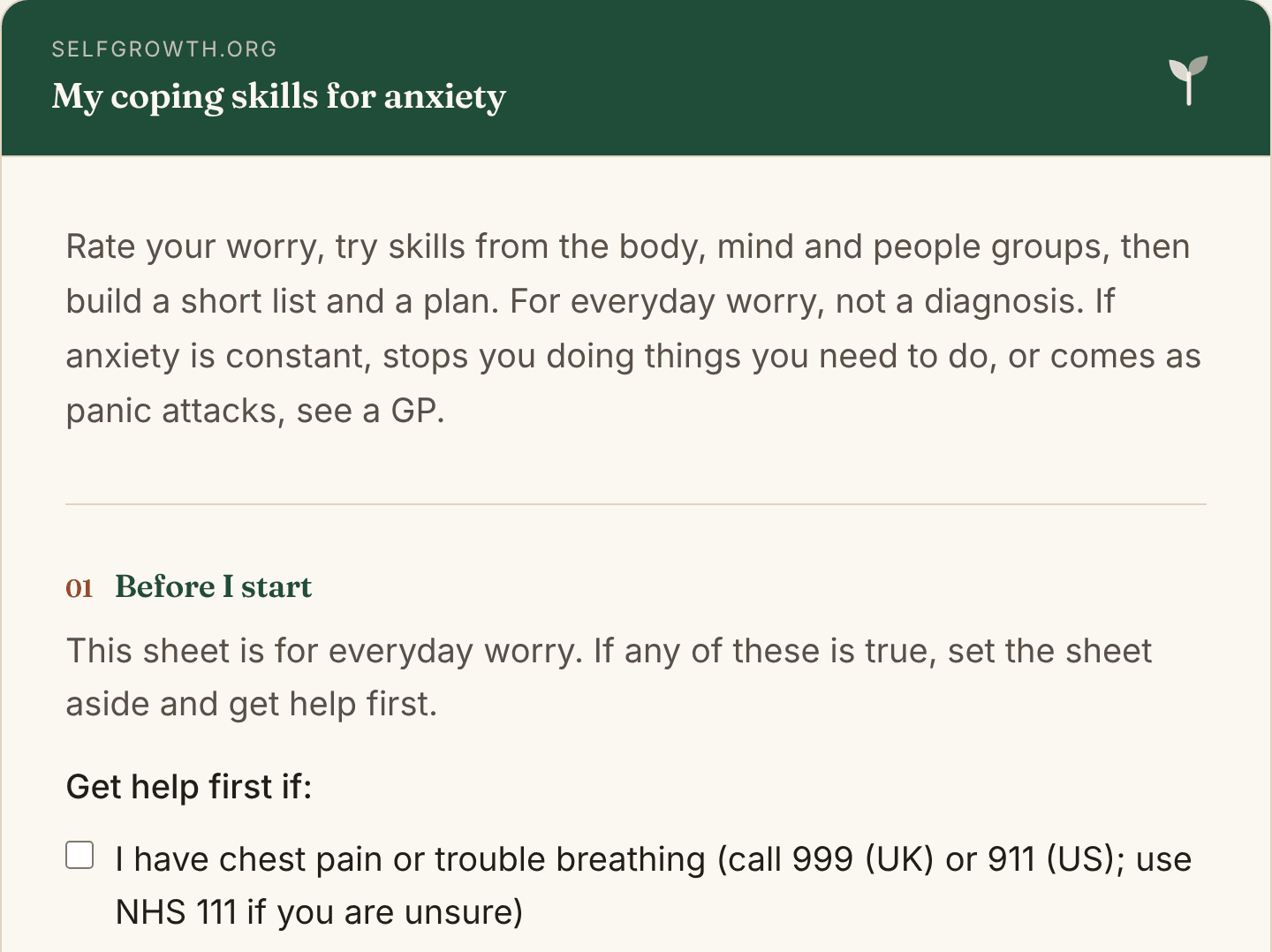
Coping Skills for Anxiety Worksheet
Free printable coping skills for anxiety worksheet: rate your worry, try body, mind and people skills, then build a short list and an if-then plan.
Open worksheet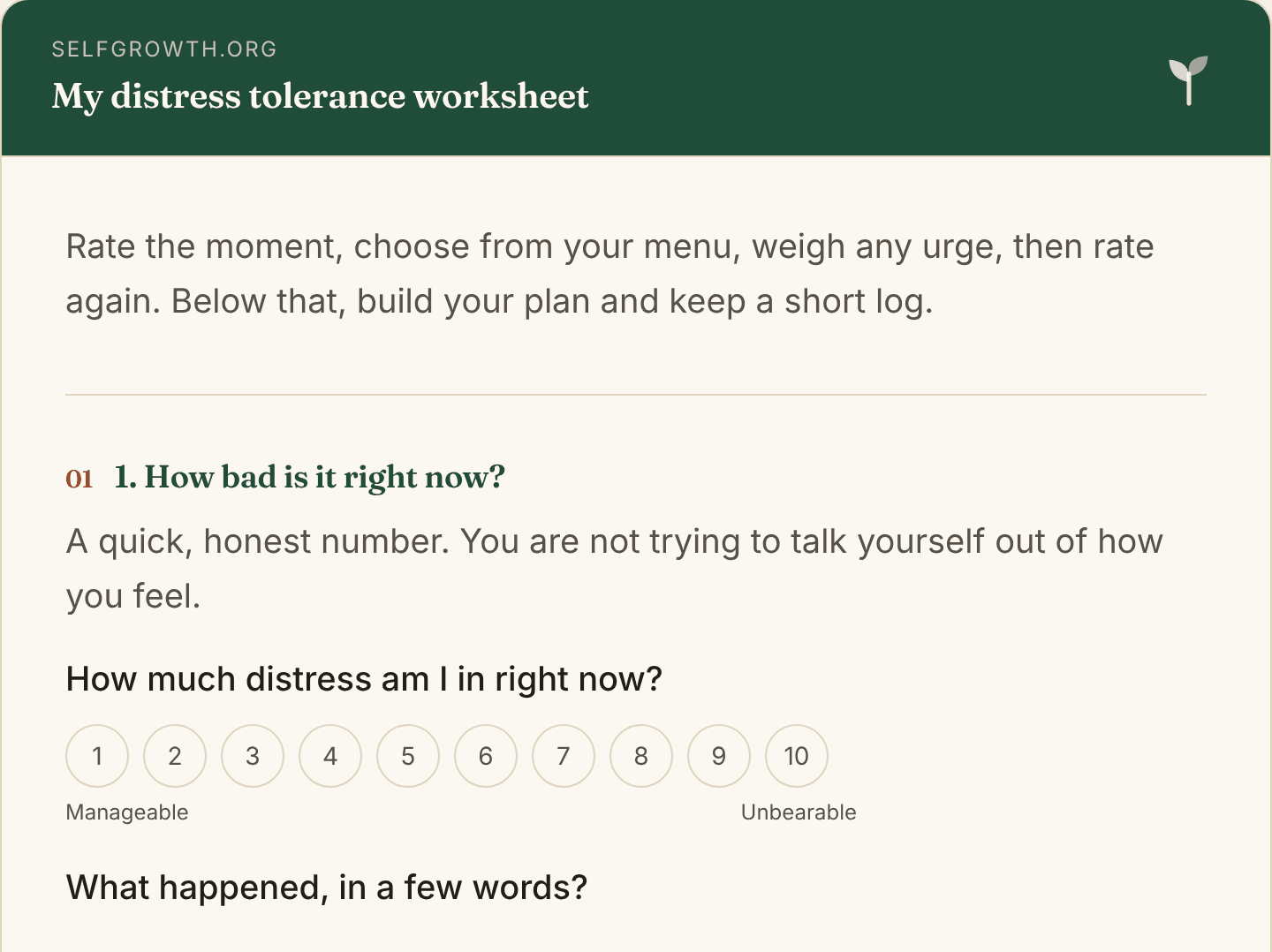
Distress Tolerance Worksheet
A free, printable distress tolerance worksheet: rate the moment, choose from your own skills menu, weigh the urge, and plan ahead. Self-help, not therapy.
Open worksheet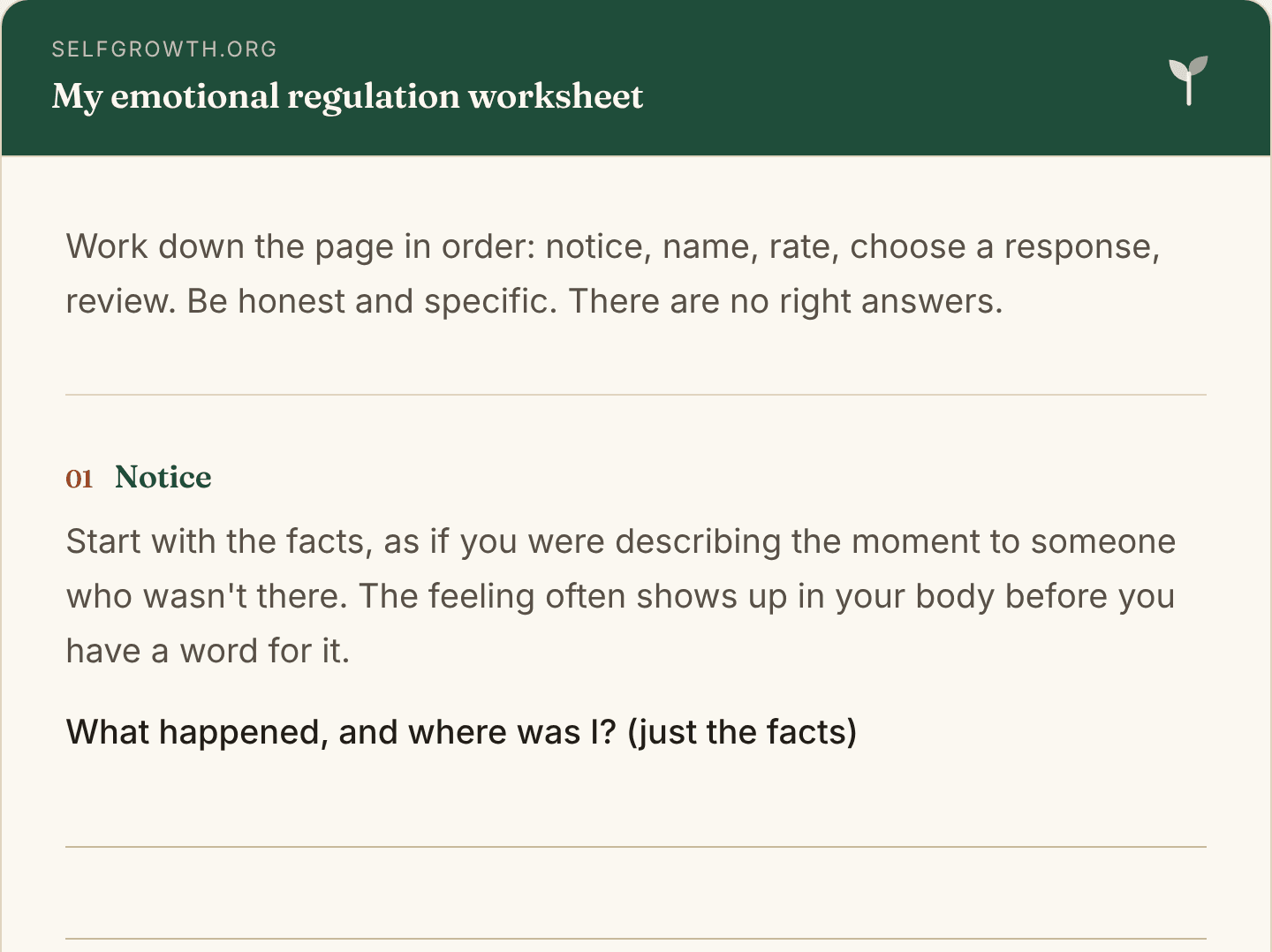
Emotional Regulation Worksheet
A free emotional regulation worksheet: notice a strong feeling, name and rate it, choose how to respond, then review what helped. Printable PDF, no email.
Open worksheetNew worksheets, straight to your inbox
An occasional new worksheet or tool, sent only when there's something genuinely worth your time. No spam, no pressure, unsubscribe any time.